Candidates in the June 3 local elections hold average assets of 900 million won; one in 10 has not completed military service
- Input
- 2026-05-16 09:00:24
- Updated
- 2026-05-16 09:00:24
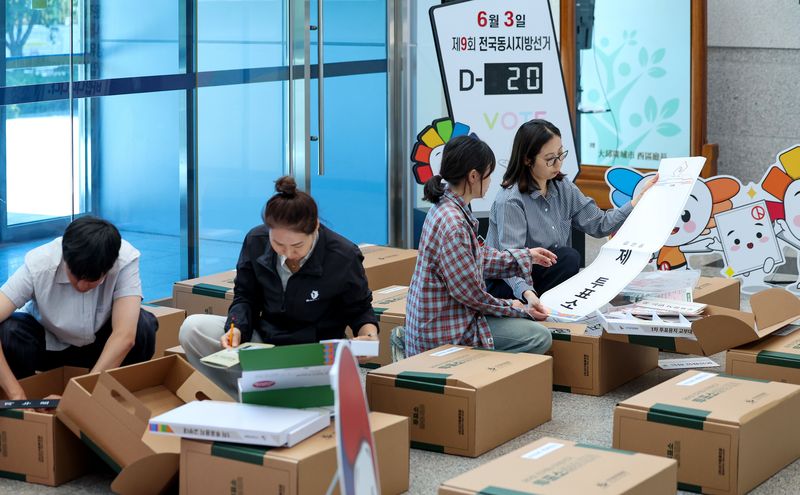
According to the National Election Commission (NEC) on the 16th, the average assets per candidate stood at 895.14 million won as of 9 p.m. the previous day.
The candidate who reported the most assets was Park Geun-ryang, a People Power Party (PPP) candidate for Tongyeong City Council, who declared 104.9 billion won. Among candidates for metropolitan and provincial governors, Oh Se-hoon, the PPP candidate for Seoul Metropolitan City Mayor, ranked first with assets in the 7 billion won range.
Other candidates who ranked near the top in assets included Kim Jae-seon, an independent candidate for Mayor of Jeonju in North Jeolla Province, who reported 50.01953 billion won; Kim Hwe-su, an independent candidate for Hwasun County Mayor in South Jeolla Province, who reported 26.11523 billion won; and Park Young-seo, a PPP candidate for Mungyeong City Council, who reported 24.39474 billion won.
The 579 candidates for city and county mayor posts had average assets of 1.58825 billion won each, while their average tax payment came to 51.73 million won.
A total of 1,031 candidates, including five metropolitan and provincial governor candidates, 65 city and county mayor candidates, and 961 metropolitan and provincial as well as city and county council candidates, had records of tax delinquency. That means 13.6 percent of all candidates had past arrears.
Of the 7,569 candidates overall, 5,202 were men, or 68.7 percent, and 2,367 were women, or 31.3 percent. This is the first time in the history of local elections that the share of female candidates has exceeded 30 percent.
Among male candidates, 589, or 11.3 percent, had not completed military service due to illness, imprisonment, or other reasons. By party, 244 Democratic Party of Korea candidates and 193 PPP candidates had not fulfilled their military duty.
Among metropolitan and provincial governor candidates, 12 of the 44 male candidates had not completed military service. By party, the Democratic Party of Korea had the largest share with six, followed by the PPP with four, and the Justice Party and the Progressive Party with one each.
A total of 2,554 candidates, or 33.7 percent, were found to have criminal records.
Kim Byeong-yeon, an independent candidate for Ganghwa County Council member, Incheon, had the most with 15 convictions. Kang Hae-bok, an independent candidate for Busan City Councilor, and Byun Young-hyun, an independent candidate for Ongjin County Council member, Incheon, tied for second with 14 each.
Among candidates for metropolitan and provincial governors, 20 had criminal records. Kim Hyun-wook, a candidate from People's Solidarity for Governor of Gyeonggi Province, and Yang Jeong-mu, a PPP candidate for Governor of North Jeolla Province, reported the most with nine each.
The 47 candidates for National Assembly members elected in by-elections had average assets of 2.08296 billion won each. By party, Kim Yong-nam, a Democratic Party of Korea candidate, ranked first with 12.77049 billion won. Kim Young-bin, another Democratic Party of Korea candidate running in the Gongju-Buyeo-Cheongyang constituency in South Chungcheong Province, came in second with 10.45816 billion won, and Lee Jin-sook, a PPP candidate in Dalseong, Daegu, ranked third with 8.21539 billion won.
Cho Kuk, a candidate from the Rebuilding Korea Party (RKP), reported 5.66767 billion won, while Hwang Kyo-ahn, a candidate from Freedom & Innovation, reported 5.03777 billion won, placing fourth and fifth, respectively.
The average tax payment of the 47 candidates was 280.86 million won.
Fourteen National Assembly candidates, or 29.8 percent, had criminal records. Jeon Ju-yeon, a Progressive Party candidate in Gwangju Gwangsan-eul, reported the most with five. Lee Kwang-jae, a Democratic Party of Korea candidate in Hanam-gap, Gyeonggi Province, and Kim Seok-hoon, a PPP candidate in Ansan-gap constituency, followed with four each.
Among the National Assembly candidates, 39 were men, and eight of them had not completed military service.
[email protected] Bae Han-geul Reporter