"I Am a Woman Who Survived by Luck" ... 10 Years After the Gangnam Station Murder, a High School Girl Falls in Gwangju [Recorder of the Low Places]
- Input
- 2026-05-17 06:00:00
- Updated
- 2026-05-17 06:00:00
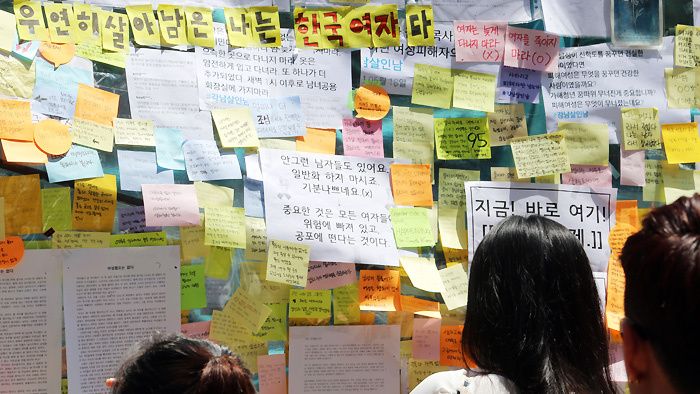
/Yonhap News Agency In May 2016, after a murder case, Post-it notes were placed at Gangnam Station Exit 10 in Seoul to mourn the victim. Ten years later, those messages are still brought up whenever debates over women’s safety and crime resurface.
Marking the 10th anniversary of the 2016 Seocho-dong public-toilet murder case, we looked at why the questions raised at the time keep coming back. [Financial News] "She died because she was a woman.
/Yonhap News Agency In May 2016, after a murder case, Post-it notes were placed at Gangnam Station Exit 10 in Seoul to mourn the victim. Ten years later, those messages are still brought up whenever debates over women’s safety and crime resurface." "I survived by luck. " The Post-it messages once left at Gangnam Station Exit 10 in Seoul are being recalled again, even 10 years later.At the time, investigators classified the 2016 Seocho-dong public-toilet murder case as a random crime linked to mental illness. But women asked, "Why was the victim a woman?" After a recent case in Gwangju Metropolitan City in which a high school girl was stabbed to death by a stranger while returning home, online users again asked whether the case should also be seen as a matter of women’s safety.On the 10th anniversary of the 2016 Seocho-dong public-toilet murder case on the 17th, the debate over 'random crimes' and 'misogynistic crimes' has flared up again. Some argue that a case whose motive has not been clearly established should not be reduced to a gender issue.
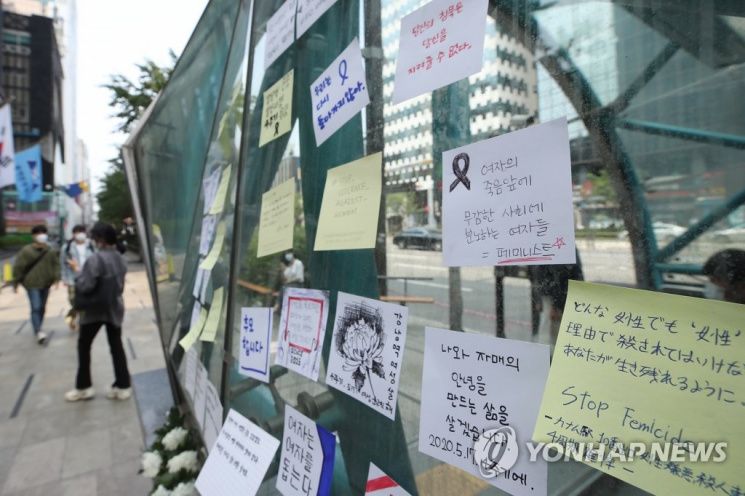
Still, the anxiety women feel in everyday life is repeatedly reflected in related statistics and in remarks made at memorial sites. "Why do women always have to be careful?" .the words left at Exit 10 The 2016 Seocho-dong public-toilet murder case refers to the killing of a woman in her 20s by a stranger in a public restroom inside a building near Gangnam Station in Seoul in the early hours of May 17, 2016. Investigators later found that the suspect did not attack men who entered the restroom, but assaulted the woman when she came in.Soon after the incident, memorial Post-it notes appeared at Gangnam Station Exit 10. They included messages such as, "The reason I, a woman in South Korea, survived was luck," and "I don't just want to survive; I want to live well." Another note read, "This was not a murder for no reason. She was killed because she was a woman." The phrase "Please save women" became a symbol of the memorial space at the time. A female office worker in her 30s, identified as A, said, "When I saw those Post-it notes back then, I realized for the first time that my anxiety was not just a matter of being personally careful." She added, "People often told us to be careful on the way home at night or in restrooms, but there was no answer to why women always had to be the ones being careful. " Conflicts repeated after the Gangnam Station case At the time, police did not classify the case as a misogynistic crime.Their position was that the suspect’s mental illness and delusions influenced the attack. Women’s groups and some citizens, however, argued that the victim’s gender could not be separated from the context of the case.
/Yonhap News Agency In May 2016, after a murder case, Post-it notes were placed at Gangnam Station Exit 10 in Seoul to mourn the victim. Ten years later, those messages are still brought up whenever debates over women’s safety and crime resurface.
That debate continues today. The term 'random crime' is used for cases in which the motive is unknown or difficult to identify.
/Yonhap News Agency In May 2016, after a murder case, Post-it notes were placed at Gangnam Station Exit 10 in Seoul to mourn the victim. Ten years later, those messages are still brought up whenever debates over women’s safety and crime resurface.But critics say it fails to fully explain the victim’s gender and the broader social context. On the other hand, some say it is premature to label a case as misogynistic when the motive has not yet been confirmed.
A male office worker in his 30s, identified as B, said, "I understand why women feel anxious, but I think we need to be careful about immediately seeing every case as misogyny. " He added, "In the Gwangju case, a male student who tried to help the victim was also seriously injured, so shouldn't we look at that part too?" said.
Memorial messages are posted in front of Gangnam Station Exit 10 in Seoul on the afternoon of May 17, 2020, marking the fourth anniversary of the Gangnam Station women’s murder case. [Image source: Yonhap News Agency] Questions raised again after the Gwangju high school girl case The same debate resurfaced in the recent Gwangju case.
/Yonhap News Agency In May 2016, after a murder case, Post-it notes were placed at Gangnam Station Exit 10 in Seoul to mourn the victim. Ten years later, those messages are still brought up whenever debates over women’s safety and crime resurface.
At around 12:10 a. m.
/Yonhap News Agency In May 2016, after a murder case, Post-it notes were placed at Gangnam Station Exit 10 in Seoul to mourn the victim. Ten years later, those messages are still brought up whenever debates over women’s safety and crime resurface.on the 5th, a 17-year-old high school girl returning home was stabbed to death by a man in his 20s on a road in Gwangsan-gu, Gwangju. Another male student who approached after hearing her screams was also seriously injured.
Police arrested the suspect on charges of murder and attempted murder, and disclosed his identity on the 14th. Online reactions included comments such as, "Another woman was killed on her way home at night," and "Shouldn't the Gwangju high school girl case also be seen as a misogynistic crime?" As the timing overlapped with the 10th anniversary of the Gangnam Station case, posts linking the two incidents also continued to appear in memorial spaces and women’s online communities.
Still some say it is too early to conclude that this case was a misogynistic crime. Some citizens argue, "The attacker chose a target that appeared vulnerable, and we need to look at the fact that the target was a woman." Women's anxiety remains 10 years later On the afternoon of the 11th, 129 co-organizers of the 'Gangnam Station Women’s Murder 10th Anniversary Memorial Action,' including the Seoul Women's Association, held a press conference in front of Gangnam Station Exit 10 on Seoul Subway Line 2 to declare a memorial week. The photo shows participants carrying out a 'die-in performance.11. /Photo=Newsis Meanwhile, the Gangnam Station 10th anniversary memorial action declared a memorial week in front of Gangnam Station Exit 10 on the 11th.A total of 129 groups, including the Seoul Women's Association, took part, and they said the memorial activities would continue until the 17th. At the memorial site, the Post-it messages from 10 years ago were mentioned again.
/Yonhap News Agency In May 2016, after a murder case, Post-it notes were placed at Gangnam Station Exit 10 in Seoul to mourn the victim. Ten years later, those messages are still brought up whenever debates over women’s safety and crime resurface.
From the Sindang Station stalking murder case and intimate partner homicide to illegal filming, deepfake sexual crimes, and the Gwangju high school girl murder case, each incident has its own nature and circumstances. Yet every time such a case occurs, people again express fear about women’s safety.
/Yonhap News Agency In May 2016, after a murder case, Post-it notes were placed at Gangnam Station Exit 10 in Seoul to mourn the victim. Ten years later, those messages are still brought up whenever debates over women’s safety and crime resurface.Women’s anxiety also appears in surveys on nighttime walking.
5% of people aged 13 and older said they felt anxious when walking alone at night.
8% for men.9%.That is the backdrop for why the phrase "I survived by luck," left on the Post-it notes after the Gangnam Station case, is still being read again 10 years later.
/Yonhap News Agency In May 2016, after a murder case, Post-it notes were placed at Gangnam Station Exit 10 in Seoul to mourn the victim. Ten years later, those messages are still brought up whenever debates over women’s safety and crime resurface.
The Post-it notes at Gangnam Station Exit 10 were removed long ago, but those messages are brought back every time a similar case occurs.
/Yonhap News Agency In May 2016, after a murder case, Post-it notes were placed at Gangnam Station Exit 10 in Seoul to mourn the victim. Ten years later, those messages are still brought up whenever debates over women’s safety and crime resurface.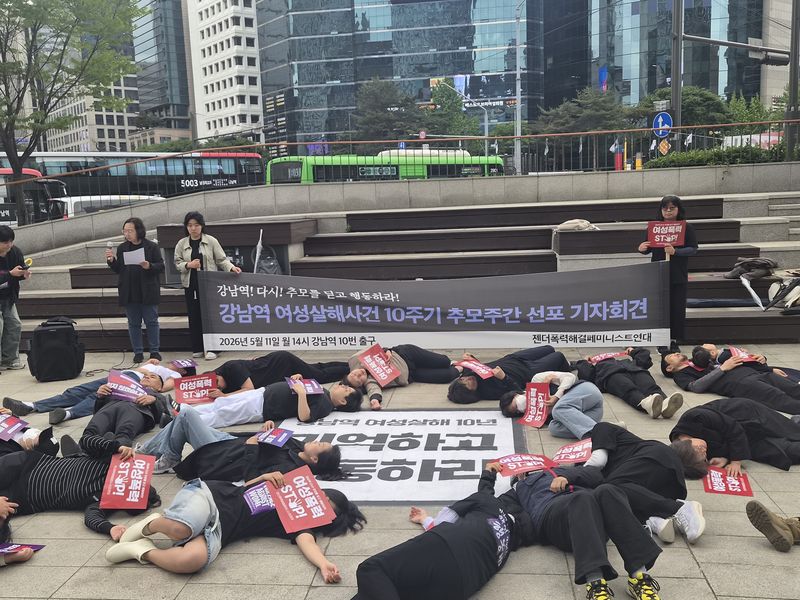
A female office worker in her late 30s, identified as C, said, "At the time of the Gangnam Station case, I was in my 20s.
Now I am old enough to be raising a daughter." She added, "It feels bitter to see the Post-it notes from back then still appearing in articles." "Even while people argue over whether it is misogyny or not, women’s anxiety remains the same," she said.
Experts say that whether a case can be regarded as a misogynistic crime should be judged by examining both the motive and how the target was chosen.
Oh Yoon-sung, a professor in the Department of Police Administration, Soonchunhyang University, said, "The label of a misogynistic crime can involve subjective interpretation.
" He stressed, "The key issue should be whether the offender chose someone he believed to be weaker than himself, and what the actual motive for the crime was." We record the stories of real lives in writing.Even if the language is rough, we preserve the words gathered on the scene as they are.
From alleyways and markets to someone’s workplace, the record of an ordinary day that we have passed by comes to meet our readers.
/Yonhap News Agency In May 2016, after a murder case, Post-it notes were placed at Gangnam Station Exit 10 in Seoul to mourn the victim. Ten years later, those messages are still brought up whenever debates over women’s safety and crime resurface.
If you would like to follow [Recorder of the Low Places] easily, please subscribe to the reporter profile page.
/Yonhap News Agency In May 2016, after a murder case, Post-it notes were placed at Gangnam Station Exit 10 in Seoul to mourn the victim. Ten years later, those messages are still brought up whenever debates over women’s safety and crime resurface.[email protected] Han Seung-gon Reporter