Ruling Party Promotes Southeast Regional Investment Corporation as PK Support Gap Narrows
- Input
- 2026-05-15 16:00:55
- Updated
- 2026-05-15 16:00:55
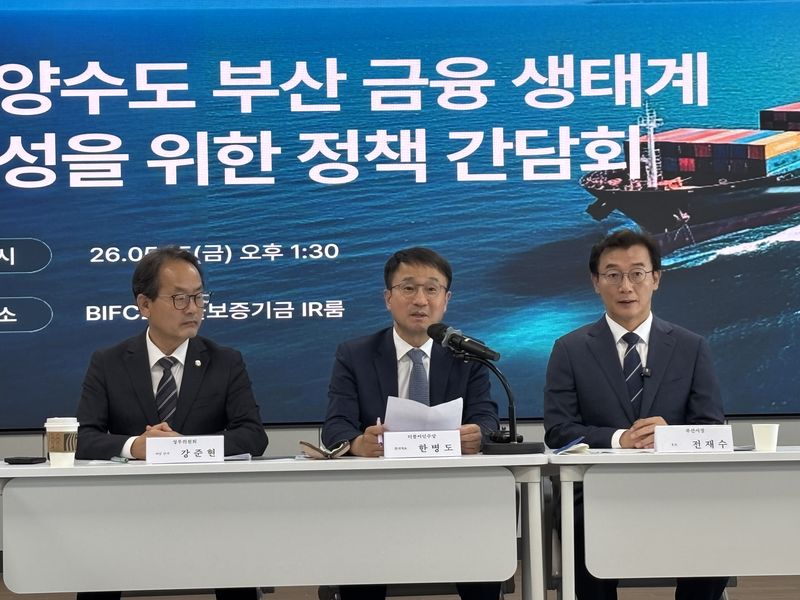
Han Byung-do visited Busan that day and held a policy meeting titled "Policy Meeting for Completing Busan's Financial Ecosystem," stressing that the party would push ahead with the bill to establish the Southeast Regional Investment Corporation. Kang Jun-hyun, the Democratic Party's chief spokesperson and floor secretary on the National Policy Committee, also attended to bolster the appeal.
The Southeast Regional Investment Corporation is one of the key pledges of Democratic Party Busan mayoral candidate Chun Jae-soo. The plan is to create a 50 trillion won corporation that would build a financial infrastructure to invest in industries across PK.
At the meeting, Chun said, "Finance is ultimately what grows industries, and investment is ultimately what grows companies." He added, "A financial platform for regional growth is essential to provide long-term, stable funding for Busan and PK's future industries, including maritime logistics, smart ports, shipbuilding, shipping and energy."
Two bills to establish the Southeast Regional Investment Corporation have currently been submitted to the National Assembly.
One of them is the "Act on the Establishment and Operation of the Southeast Regional Investment Corporation," introduced in December last year by Democratic Party lawmaker Kim Jung-ho, who represents the Gimhae Eul constituency in South Gyeongsang Province. The bill calls for the corporation to be set up in Busan and specifies a capital contribution of 300 billion won. The contributors would include the central government, local governments in PK, Korea Development Bank (KDB), Industrial Bank of Korea (IBK), The Export-Import Bank of Korea (KEXIM), and regional banks based in PK.
Notably, the bill was drafted after prior consultations with the government. Another bill introduced by Democratic Party lawmaker Min Byung-deok, who serves on the National Policy Committee, is largely similar in content. After the meeting, Chief spokesperson Kang said, "This is a bill that has been pursued for a long time, and it has already been introduced quite some time ago." He added, "Following the principle of first in, first out, we will complete the June reorganization of the National Assembly and move ahead as quickly as possible."
Meanwhile, some analysts say Han, who leads legislation in the National Assembly, personally visiting Busan to promote the corporation is an effort to win over local voters as the support gap between the ruling and opposition candidates in PK has recently narrowed. In other words, the party is actively appealing to local sentiment by making use of its status as the governing party and the largest force in parliament.
Competition between the ruling and opposition parties over the PK region is expected to intensify further.
In a Busan mayoral preference poll released that day by polling firm Fair Poll and commissioned by Penn & Mike, Chun received 45.6 percent support, while People Power Party (PPP) candidate Park Hyung-joon received 41.3 percent among 803 men and women aged 18 or older living in Busan, surveyed over two days from the 13th to the 14th. The gap between the two candidates narrowed to 4.3 percentage points, within the margin of error. Reform Party candidate Jeong I-han was at 3.2 percent.
The poll was conducted by wireless RDD phone survey using a structured questionnaire. The margin of error is plus or minus 3.5 percentage points at the 95 percent confidence level, and the overall response rate was 6.7 percent. For more details, see the website of the Central Election Poll Deliberation Commission.
[email protected] Kim Hyung-gu Reporter