ROK-U.S. Alliance Accelerates Common Drone Standards, Evolving into a 'Drone Alliance'?
- Input
- 2026-05-15 17:49:10
- Updated
- 2026-05-15 17:49:10
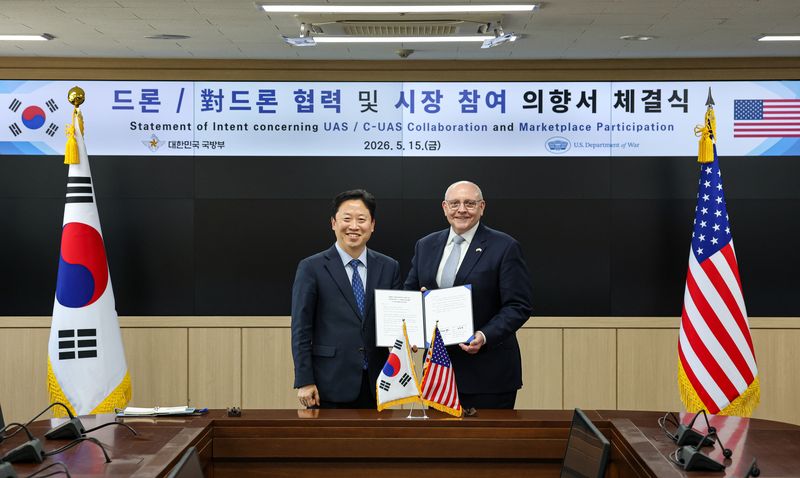
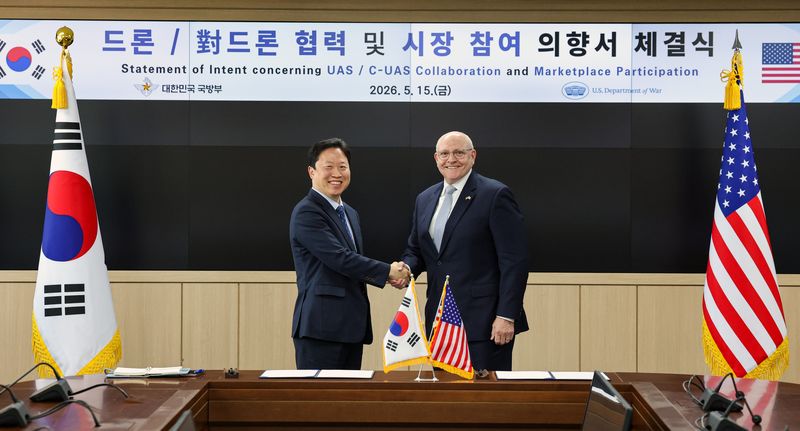
The Ministry of National Defense announced on the 15th that it had signed a Letter of Intent (LOI) with the United States Department of Defense for cooperation in drone and counter-drone collaboration and market participation. The signing was carried out by Jun-beom Jeon, director-general of the Defense Artificial Intelligence Planning Bureau, and Patrick Mason, Deputy Assistant Secretary of the Army for Defense Exports and Cooperation, as representatives of the two sides.■ A foothold for entering procurement markets after talks with the U.S. Army secretaryDuring a meeting at the Ministry of National Defense Building in Yongsan on October 2 last year, U.S. Department of the Army Secretary Daniel Driscoll met with Minister of National Defense Ahn Gyu-back and agreed that "the importance of drones in modern warfare is increasing." The two sides also decided to expand cooperation in joint research, production, and operations involving drones.
At the time, Driscoll also exchanged views with Kim Kyu-ha, Chief of Staff of the Republic of Korea Army, and the two sides agreed to work closely together to share military innovation and pursue joint development in areas requiring sustained support.
The LOI signed this time focuses on concrete cooperation to improve the efficiency and interoperability of drone and counter-drone systems, including joint supply chain development and system standardization. To build a joint supply chain, the two sides will prioritize registering South Korean products on the "Drone and Counter-Drone Online Marketplace" that the U.S. Department of Defense aims to establish within the year. This is expected to allow both countries to purchase and operate South Korean products, improving interoperability while reducing logistics costs.
The two countries also agreed to continue exchanging information and conducting joint research to quickly establish a "common standard system" for items such as batteries and communication modules for small military drones in the short term, while also promoting the creation of a "common certification system" that can be applied to both countries' weapons systems.■ Responding to Indo-Pacific threats and deploying next-generation IFPC to USFKEarlier, during his visit to Korea, Secretary Driscoll said in an interview at Camp Humphreys in Pyeongtaek, Gyeonggi Province, that "the primary mission of USFK is to address the basic threats posed by both China and North Korea." William Taylor, then acting commander of the Eighth United States Army, also stressed that "the alliance's mission is to maintain strong and modernized forces under the Mutual Defense Treaty so that it can respond to any threat in the Indo-Pacific."
In particular, Driscoll identified drones as the biggest security threat on the Korean Peninsula and said that additional advanced weapons systems would be deployed there in the future. As part of that security posture, the United States has recently reportedly deployed the next-generation Indirect Fire Protection Capability (IFPC) air and missile defense system, which can intercept cruise missiles and drones, to the 35th Air Defense Artillery Brigade of USFK at Osan Air Base in Gyeonggi Province.
When asked about the possibility of defense cooperation with South Korea, he added, "To respond effectively to drone threats, close cooperation is essential not only with the South Korean military but also with South Korean manufacturers and technology companies," and "we urgently need solutions that enable real-time information sharing and joint responses with them." The signing of this LOI is seen as the result of combining the U.S. strategic demand with the technological capabilities of South Korea's defense industry.■ Launching a government-wide joint supply chain and working-level consultative bodyThe agreement is expected to go beyond technical cooperation between the South Korean and U.S. defense authorities and lead to the creation of a stable, government-wide defense supply chain.
Won Jong-dae, assistant minister at the Ministry of National Defense, who met with U.S. officials, said, "The signing of this memorandum of intent marks the starting point of the evolution of the ROK-U.S. alliance in the drone sector," adding, "We will work with relevant ministries, including the Ministry of Trade, Industry and Energy and the Ministry of Land, Infrastructure and Transport, to help build a stable joint supply chain for both countries." Jang Ji-hyung, head of the Technology Research Division at DTaQ, who attended the meeting, also said he would play a central role in quality certification.
South Korean and U.S. defense authorities are expected to immediately form a Working-level Consultative Body after the signing of the memorandum of intent and closely cooperate on specific implementation measures.
[email protected] Lee Jong-yoon Reporter