Fear of the way home grows after high school girl is killed... police to step up special patrols in cram school districts
- Input
- 2026-05-15 15:41:10
- Updated
- 2026-05-15 15:41:10
[Financial News] "When it gets past 10 p.m. after cram school, I find myself looking out the window for no reason."Lee, 48, who is raising a middle school daughter in Gwangjin-gu, Seoul, said she has recently been turning down the TV volume and waiting until her child gets home more often. "In the past, I would only tell her not to stay out late, but after the Gwangju case, I keep urging her to come straight home when cram school ends," she said. "Just seeing police cars more often makes parents feel much more at ease."
Park, 52, who has a high school son, also sighed and said, "On nights when he gets home late, I end up calling more often than before." He added, "I hope patrols are strengthened on a permanent basis, at least in cram school districts where students gather." Parents say it is not unusual to see students traveling in groups or taking brighter main roads on purpose around cram school areas.
Public anxiety over students' safety on the way home has spread nationwide after a high school girl in downtown Gwangju was killed by a knife attack carried out by a man she had never met. As parents continue to say they are "afraid to send children to school or cram school alone," police are stepping up special security operations centered on cram school districts and school routes. Experts say this should go beyond simply increasing patrols and should be accompanied by more active police stop-and-question checks and a national system for analyzing and responding to the root causes of crime.
According to police on the 15th, special security operations centered on students' daily living areas are being carried out on a large scale nationwide following the killing of the high school girl in Gwangju. The previous day, Gwangju Gwangsan Police Station sent Jang Yoon-gi, 23, who was arrested on suspicion of murdering a high school girl he had never met at 12:11 a.m. on the 5th on a sparsely populated pedestrian path in Wolgye-dong, Gwangsan-gu, Gwangju, to prosecutors in custody on murder charges and pledged to prepare measures to prevent a recurrence.
Gwangju Police are currently carrying out special security operations centered on crime-prone areas and densely populated locations in Gwangsan-gu, while expanding patrols around cram school districts and school routes. They are also strengthening management of high-risk groups in relationship-based crimes such as stalking, as well as response systems for knife-related and violent crimes.
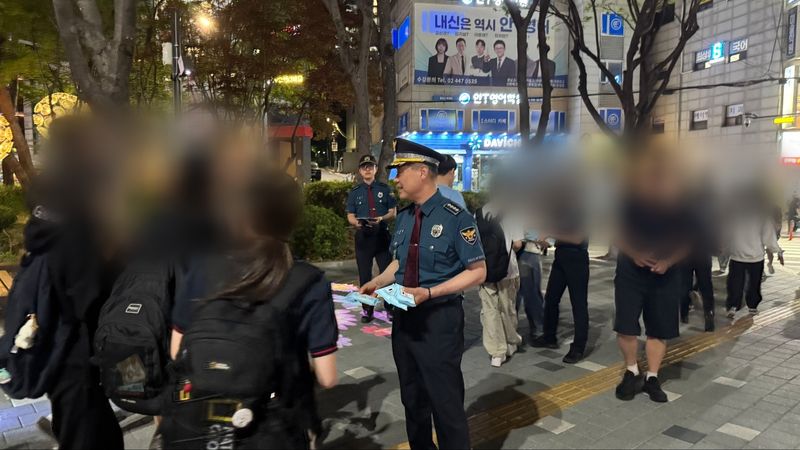
Patrols centered on students' daily living areas are also continuing in Seoul. On the afternoon of the 14th, Gwangjin Police Station carried out a campaign and a crime-prevention inspection of vulnerable areas in the cram school district of Gwangjang-dong, Gwangjin-gu, Seoul, to ensure students' safety on the way home.
The activity, led by the chief of Gwangjin Police Station and carried out in cooperation with all units of the station, including the Crime Prevention and Response Division, the Women and Juveniles Division, the Criminal Investigation Division, the Traffic Division, and the Gwangnaru Police Box, is part of the Seoul Metropolitan Police Agency's "student-tailored special security activities." Gwangjin Police Station chief Oh Seong-hoon said, "We will build a dense safety net not only during arrival and dismissal hours, but also for students who study at cram schools late into the night and head home afterward, in order to ease parents' anxiety."
Analysts say this trend is closely linked to growing public anxiety about crime across society. According to the 2024 social survey by the Korean Statistical Information Service (KOSIS), "crime" accounted for the largest share, at 17.9%, among the social factors that people feel make society unsafe. The share of respondents who said society as a whole feels safe fell by 4.4 percentage points from the previous survey, while expectations that it will become safer in the future also declined.
Experts advise that one-off patrols are not enough and that more active use of state power, along with a national-level analysis of the causes of crime, must proceed in parallel. Lee Woong-hyuk, a professor in the Department of Police Science at Konkuk University, said, "If there are warning signs such as carrying a weapon, active use of police authority, including stop-and-question checks, is necessary." He added, "This should not be seen as a restriction on freedom, but as a regular preventive activity for public safety." He went on to say, "Such incidents should not simply be dismissed as 'crimes with unusual motives.' The government must analyze the underlying causes, such as social isolation, breakdowns in relationships, and accumulated anger, and establish a cross-ministerial response system."
[email protected] Kim Ye-ji Reporter