"Samsung union demands may clash with shareholder rights"...Experts say "institutional reforms are needed"
- Input
- 2026-05-15 14:28:36
- Updated
- 2026-05-15 14:28:36
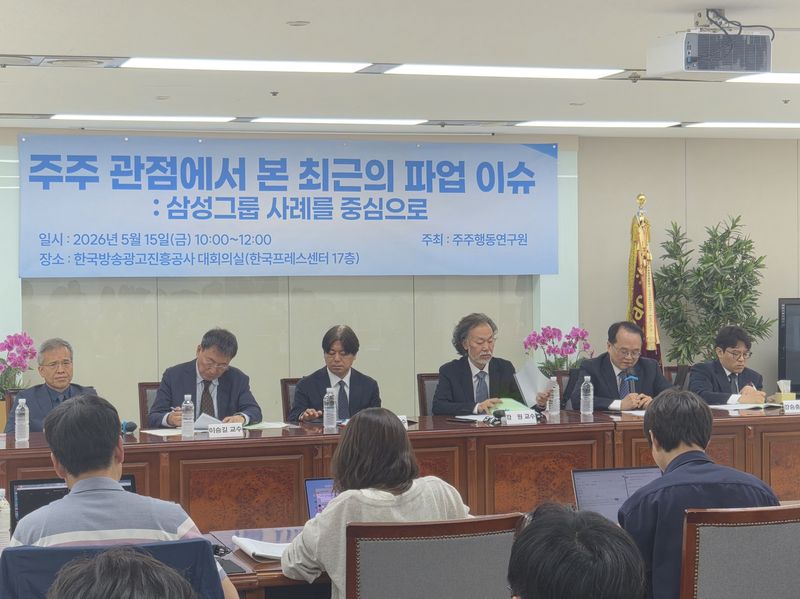
[Financial News] Experts said the labor dispute at major Samsung affiliates, including Samsung Electronics and Samsung Biologics, could spread beyond wages and bonuses to shareholder value and management risk. They added that institutional reforms are needed, as disputes over profit distribution and demands for management involvement may conflict with shareholder rights and the current corporate law framework.
At the roundtable held on the 15th at the Korea Press Center in Jung District, Seoul, Professor Jeong Mu-gwon of Kookmin University's College of Business Administration said, "Operating profit is the core foundation of shareholder value creation." He added, "If a large share of profits is transferred to workers, investment funds shrink and the room for shareholder returns, such as dividends and share buybacks, may also decrease."
He continued, "Performance-based compensation should be designed around profit growth or free cash flow, rather than a fixed percentage of operating profit." He explained, "In a structure where workers do not bear the same downside risk, demands for a fixed percentage may not align with the principle of risk and reward."
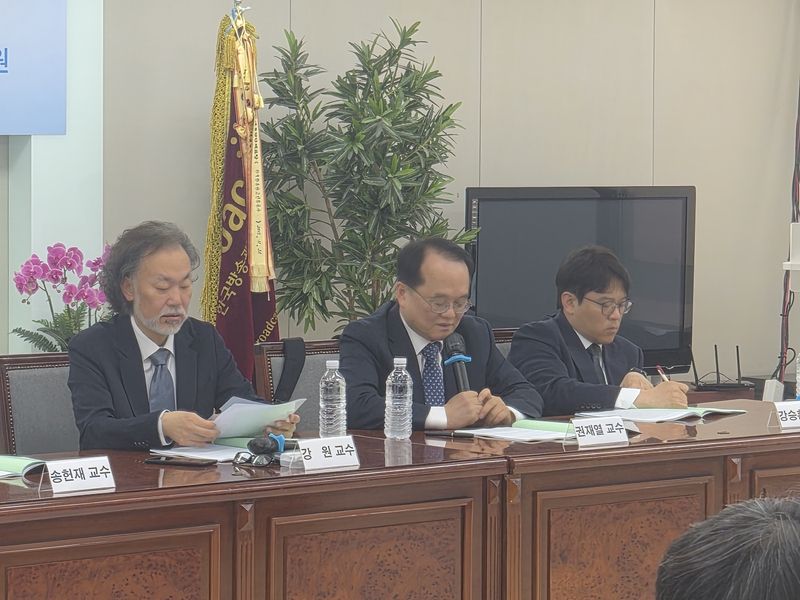
The possibility of conflict with the corporate law system also emerged as a major issue at the event. Professor Kwon Jae-yeol said, "Demanding a certain percentage at the operating profit stage can be interpreted as a structure that secures profits ahead of shareholder rights." He noted, "Maintaining the status of a fixed-income beneficiary while demanding rights similar to those of shareholders is inconsistent with the current corporate law framework."
Concerns were also raised over union demands to intervene in management decisions. Professor Kwon said, "Mergers, spin-offs, and transfers are matters that must go through board and shareholder meeting resolutions." He added, "If union consent is additionally required through a collective agreement, it could alter the decision-making structure under the Commercial Act."
He also said demands for treasury stock distribution face major practical limits. "Treasury stock can only be acquired within the scope of distributable profits, and under recent revisions to the Commercial Act, treasury shares are, in principle, canceled," he explained. "It is not easy under the current system to make treasury stock allocation to workers mandatory."
There were also concerns that labor disputes could weaken industrial competitiveness. Because supply disruptions in the semiconductor industry can affect long-term business relationships, strike risks may spread across a company's overall competitiveness. Lee Seung-gil, president of the Korean ILO Association, said, "Samsung Electronics is such a symbolic company that it is often called a national company." He stressed, "Labor-management agreements need to be reached in a way that can win public support."

Experts agreed that companies need to share their performance with employees, but said it is urgent to establish a compensation system that reflects rising corporate value.
Professor Song Heon-jae of the Department of Economics at UOS said, "Performance bonuses are a system that reflects future uncertainty." He added, "Rather than a simple percentage-based payout, a more flexible structure is needed to reflect a variety of business conditions." Professor Jeong also said, "Compensation methods such as restricted stock can be an alternative that aligns the interests of shareholders and workers." He added, "It would be desirable to share the gains from rising corporate value together."
Industry observers also said that as the importance of the social component of Environmental, Social, and Governance (ESG) grows, labor disputes could be directly reflected in corporate value assessments. They warned that if strikes lead to production disruptions, reduced investment, and lower supply chain trust, concerns over damage to shareholder value could intensify.
Meanwhile, Samsung Electronics and its labor union held post-mediation meetings from the 11th to the 12th under the arbitration of the National Labor Relations Commission, but negotiations collapsed early on the 13th when the union left the bargaining table. As the Samsung union signaled it would push ahead with a strike, Samsung Electronics executives again urged the union to resume talks and proposed unconditional dialogue.
[email protected] Lee Dong-hyuk Reporter