Operating Profit as the Union's Exclusive Domain? "Excessive Compensation Demands Will Ultimately Destroy Companies"
- Input
- 2026-05-15 12:59:40
- Updated
- 2026-05-15 12:59:40
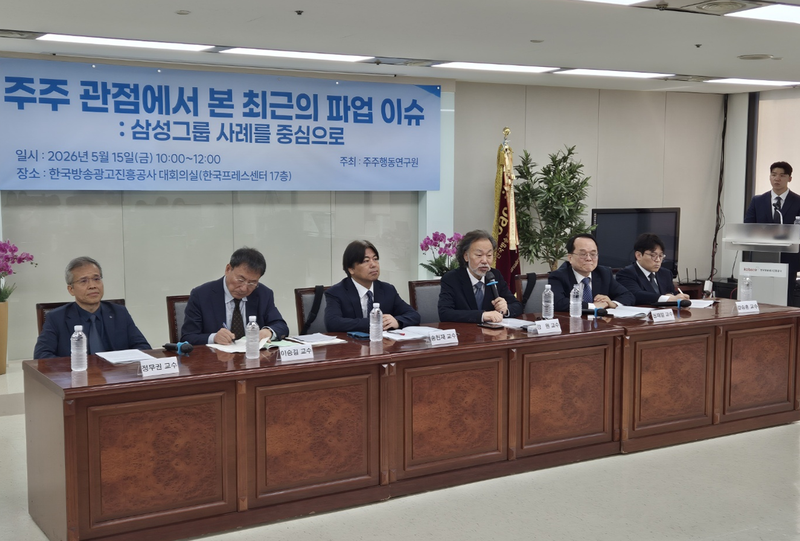
[Financial News] Labor unions at companies including Samsung Electronics and Samsung Biologics have recently demanded that a fixed share of operating profit be written into performance bonuses and have called for broader involvement in management decisions, intensifying legal and industrial disputes over the issue. Experts warned that such demands could violate shareholder rights under commercial law and undermine the global competitiveness of South Korea's strategic semiconductor and bioindustry sectors.
At the expert roundtable held by the Shareholder Action Institute at the Korea Press Center on the 15th, participants agreed that the unions' current demands had gone beyond "mutual growth" and were turning into a "self-serving grab for gains."
"Is operating profit the shareholders' share? It shakes the foundation of commercial law"
Professor Kwon Jae-yeol of Kyung Hee University School of Law said the unions' demand for performance bonuses tied to operating profit runs counter to the basic principles of corporate law. He explained that operating profit is the remaining income after labor costs and selling, general and administrative expenses are deducted, and that it belongs to shareholders as the source of corporate tax payments and dividends. "Employees are guaranteed income even when a company posts a loss, but they are now trying to claim the shareholder's right to profit distribution at the same time," he said, adding that this does not fit the structure of a joint-stock company.In particular, Kwon criticized Samsung Biologics labor union's demands for a prior agreement right over personnel policies and union consent on management matters such as mergers and spin-offs. He called them "an act that distorts the board of directors' and shareholders' meeting's exclusive authority under commercial law." He added that demands for stock compensation are also unlikely to be feasible under current law, since they require annual approval from the General Meeting of Shareholders, and that they directly conflict with the interests of ordinary shareholders seeking to raise share value through treasury stock cancellations.
Using Biopharmaceutical Production as Leverage.. "A Strike Is a Gamble With Patients' Lives"
There was also growing concern that the strikes recently advocated by these unions would have devastating industrial consequences. Kang Seung-hoon, a professor in the Department of Bioengineering and Pharmaceutical Engineering at Inha University, warned of the risks of a strike at Samsung Biologics, citing the unique nature of biopharmaceutical production.He explained, "Biopharmaceuticals are produced by cultivating living cells, so 24-hour real-time monitoring and continuous purification are essential." He added, "If a union halts the process through a strike, it would not just cause production disruptions. It could be treated as an unauthorized suspension of the process by regulators, forcing the company to discard all products currently in production."
He continued, "Samsung Biologics is a Contract Development and Manufacturing Organization (CDMO) that produces products on behalf of global pharmaceutical companies without having its own branded items." He emphasized that on-time delivery and quality are the core of trust. "If supply is interrupted by labor disputes, global clients will immediately look for alternative suppliers, and that will quickly become an existential crisis for the company," he said.
Labor Relations Have Become a 'Chicken Game' — "If I Can't Have It, Neither Can You"
Professor Kang Won of the Sejong University College of Business Administration said the unions' recent demands have moved away from the traditional logic of compensation for productivity gains and are instead fixated on the unusual claim that workers should receive what shareholders would otherwise take. "The Samsung Electronics labor union's warning that a strike could cause 30 trillion won in losses is not a negotiation for mutual growth. It is an approach that says, 'If I can't have it, no one else can either,'" he said. "The 11 trillion won in dividends going to about 4.2 million shareholders is far removed from coexistence when 120,000 employees are demanding up to 45 trillion won in performance bonuses."Experts at the roundtable said labor disputes have now expanded beyond a conflict between unions and major shareholders to a confrontation involving minority shareholder groups, National Pension Service (NPS) subscribers, suppliers, and other stakeholders. They said courts and the government must recognize this shift, as minority shareholder groups are considering joint damage claims against the unions and the broader paradigm of labor-management disputes is changing.
[email protected] Kang Jung-mo Reporter