Binance Says Crypto Institutionalization Has Entered the Stage of "Financial Infrastructure Efficiency" [Crypto Briefing]
- Input
- 2026-05-14 15:38:34
- Updated
- 2026-05-14 15:38:34

[Financial News] Binance, the world's largest cryptocurrency exchange, said the institutionalization of the cryptocurrency market has moved beyond simple asset allocation and entered a stage of practical integration with traditional financial infrastructure. The company said that after the U.S. Securities and Exchange Commission (SEC) approved spot Bitcoin exchange-traded funds (ETFs), the legitimacy of the asset was established, and institutional interest is now shifting toward improving operational efficiency through real-world asset tokenization (RWA) and stablecoins.
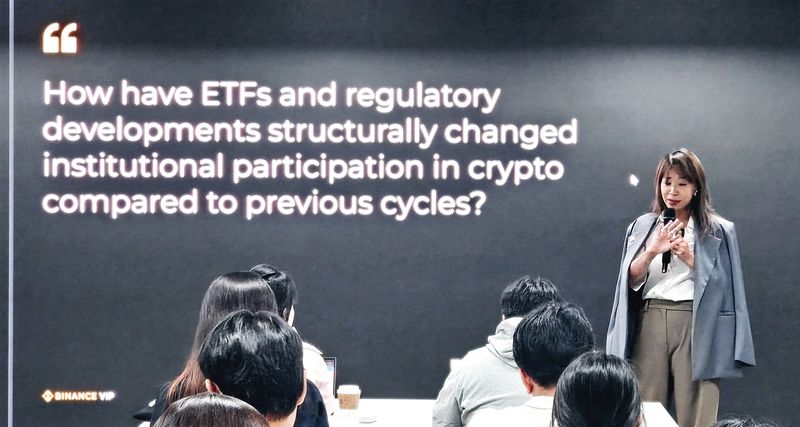
Catherine Chen, head of Binance's institutional division, said at a media event for the Binance Blockchain Study (BBS) held on the 14th at Episode Gangnam 262 in Seocho District, Seoul, that "the entry of institutions, which began in 2021, has entered a completely new phase with the launch of Bitcoin ETFs" and that "institutions are moving beyond asking 'why should we invest?' and are now thinking about 'how can we integrate this infrastructure into our existing business?'"
Chen pointed to spot Bitcoin ETFs launched by global asset managers such as BlackRock as the decisive turning point in crypto institutionalization. She explained that "Bitcoin ETFs surpassed $60 billion in assets under management (AUM) in about two years after launch," adding that this was far faster than the time it took gold ETFs to reach the same scale and marked the fastest growth in history.
She especially emphasized that the arrival of a familiar financial product such as an ETF removed psychological and regulatory barriers for institutions. Insurance companies and pension funds that previously could not buy cryptocurrencies directly can now allocate capital to Bitcoin within an established regulatory framework, she noted.
Chen also highlighted the qualitative growth of real-world asset tokenization (RWA) and stablecoins. Unlike earlier attempts to tokenize illiquid assets such as real estate and agricultural products, which struggled due to a lack of liquidity, she said the market is now being led by tokenization of traditional financial products such as money market funds (MMFs), bonds and stocks.
Tokenized MMFs launched by BlackRock and Franklin Templeton Investments initially had around $200 million in AUM, but have recently surpassed $2 billion, showing rapid growth. Chen said stablecoins have also seen circulation increase tenfold over the past five years, proving their superior efficiency in payments and remittances. She added that with regulatory clarity from the GENIUS Act in the United States and MiCA in Europe, major financial platforms such as Visa and Mastercard are also incorporating stablecoins as a core part of next-generation payment networks.
Binance also shared its response measures for institutional investors. One representative solution is the Three-Party Collateral Agreement, designed to address the risks institutions worry about when depositing directly with an exchange. The structure allows institutions to keep funds with a trusted third-party custodian bank while using Binance liquidity to trade.
Chen said, "The cryptocurrency industry has moved beyond its early stage and is now at a phase where it adapts to and upgrades mature financial infrastructure." She added, "Backed by abundant liquidity, competitive pricing and a secure infrastructure, Binance will continue building a comprehensive ecosystem that meets the diverse needs of institutional investors."
[email protected] Kim Mi-hee Reporter