Trump Calls for a “Open China,” Xi Pushes for a “U.S.-China Relationship of Equals” in G2 Clash of Visions [U.S.-China Summit]
- Input
- 2026-05-14 15:37:29
- Updated
- 2026-05-14 15:37:29
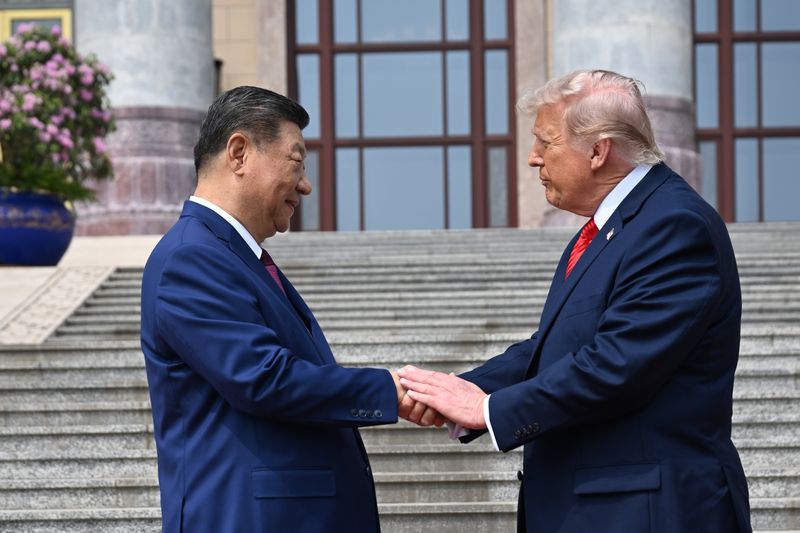
[Financial News] The summit between U.S. President Donald Trump and Xi Jinping, President of China, which could shape the future of the global economic and security order, was held on the 14th local time at the Great Hall of the People in Beijing. Meeting again in Beijing for the first time in nine years, the two leaders projected a warm atmosphere by speaking of a “great leader” and a “partner.” Behind the scenes, however, they engaged in a tense contest of wills, each advancing a different formula for reciprocity and equal coexistence.
The two leaders began the official welcome ceremony around 10 a.m. and held a 135-minute summit. Their face-to-face meeting came seven months after last October’s APEC summit in Busan. Trump’s visit to Beijing was his first in about nine years, since 2017.
On the red carpet leading to the meeting room, Trump appeared friendly, spreading his arms wide, explaining something to Xi, and lightly patting him on the back. But once negotiations began, key issues such as tariffs, semiconductors, Iran and Taiwan were sharply at odds.
In his opening remarks, Xi directly invoked the international relations concept known as the “Thucydides Trap,” underscoring a new paradigm for U.S.-China ties. “Whether the two countries can open a model for a new type of major-country relationship is a question posed by history and the world,” Xi said. “We should become partners, not rivals, and achieve shared prosperity.”
This was widely interpreted as a move to counter U.S. pressure on China while also demanding that China be recognized as an equal superpower helping lead the world order alongside the United States. Xi also showed a refined diplomatic touch by offering congratulatory remarks on the United States’ upcoming 250th anniversary, a cause Trump has been emphasizing. On Taiwan, he warned that “if handled wrongly, the United States and China could collide.”
Trump repeatedly praised Xi as a great leader, highlighting their personal rapport. But on economic issues, he put reciprocity front and center. He specifically noted that major U.S. corporate leaders, including Elon Musk of Tesla, Tim Cook of Apple and Jensen Huang of NVIDIA, were part of the delegation, saying, “They are looking forward to doing business with China, and it will be entirely reciprocal.” The remark was interpreted as a demand for a major “gift” ahead of the November midterm elections, in the form of large-scale Chinese purchases of U.S. goods such as soybeans, beef and Boeing aircraft.
The summit was also reported to have covered the Iran war, which has dragged on for more than two months, and the global energy crisis triggered by the blockade of the Strait of Hormuz. The United States is seeking to use China’s Iran influence to pressure Tehran into reopening the strait, while China is said to be pushing back by demanding tariff relief and the lifting of export controls on advanced technologies.
The two sides are still coordinating the details of any agreement after the closed-door talks. As of Thursday afternoon, they had not issued a joint statement or held a press conference on the outcome.
[email protected] Kim Kyung-min Reporter