"Musk Got Off Before the Cabinet"... What the First Scene of Trump's China Visit Revealed [U.S.-China Summit]
- Input
- 2026-05-14 11:54:24
- Updated
- 2026-05-14 11:54:24
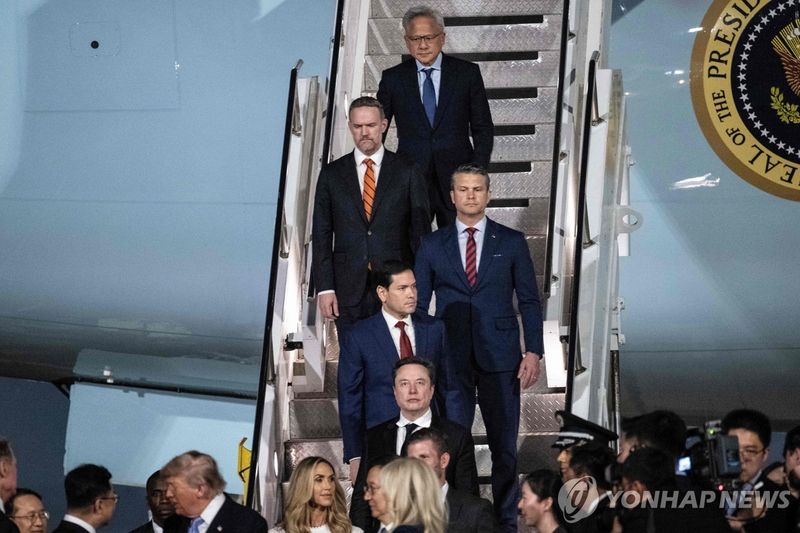
[Financial News] As Donald Trump's China visit began on the 14th, a symbolic scene from the U.S.-China technology rivalry unfolded. Tesla CEO Elon Musk and NVIDIA CEO Jensen Huang made their presence felt from positions ahead of key members of the U.S. government. The summit is being seen as expanding beyond trade to include artificial intelligence, semiconductors, and supply chains.
The most eye-catching moment right after Air Force One landed in Beijing was Musk. He stepped off the plane before major cabinet members, including Defense Secretary Pete Hegseth, Secretary of State Marco Rubio, and U.S. Trade Representative Jamieson Greer, and appeared at the Chinese welcome ceremony.
In particular, Musk and Huang stayed close to Trump throughout the reception. Their presence stood out more than that of the U.S. government delegation.
The two men symbolize the most sensitive points in the current U.S.-China economic conflict. Musk is at the center of the electric vehicle and battery supply chains, while Huang stands at the heart of AI semiconductors and export controls on advanced chips.
Tesla uses its Shanghai Gigafactory as a key production base and remains heavily dependent on the Chinese consumer market. NVIDIA is also a core supplier of chips for the AI race, making it one of the companies most directly affected by Washington's tightening restrictions on semiconductor exports to China.
Huang's participation, in particular, has sparked various interpretations in and around Washington, D.C. He was not originally on the official delegation list. But his inclusion at the last minute has raised the possibility that access to AI technology and semiconductor supply chains will be discussed far more prominently than expected at this summit.
The Trump administration is continuing to pressure China on trade, but at the same time, U.S. big tech companies cannot easily give up the Chinese market and supply chains. As AI, semiconductors, and the electric vehicle industry become linked to national security and industrial strategy, business leaders are increasingly taking center stage in diplomacy.
Although the two countries face complex issues such as tariffs, trade imbalances, and supply chain restructuring, observers say technological dominance is likely to emerge as the biggest issue during this China visit.
[email protected] Kim Kyung-min Reporter