Ruling Party Says, "It Makes No Sense That Semiconductor Dividends Would Send KOSPI Tumbling"
- Input
- 2026-05-14 10:55:16
- Updated
- 2026-05-14 10:55:16
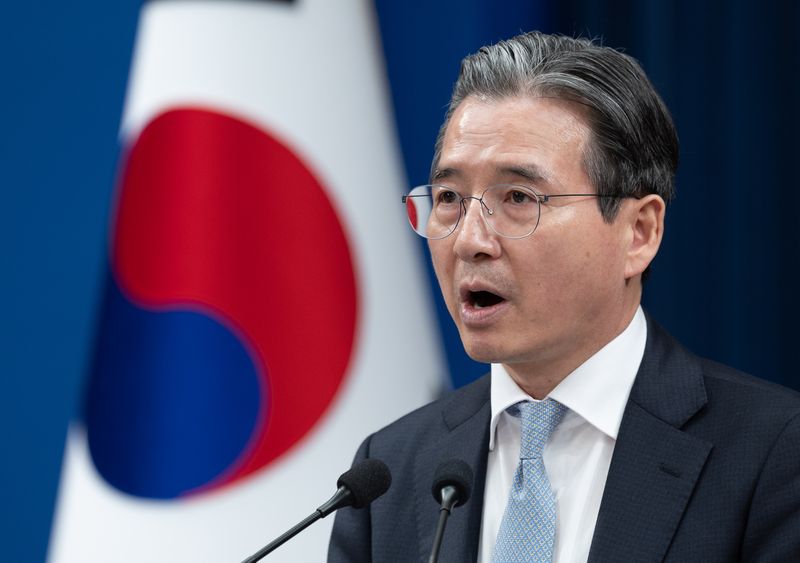
[Financial News] The ruling Democratic Party of Korea on the 14th rejected claims that stock prices plunged because of remarks by Kim Yong-beom, senior presidential secretary for policy at the Blue House, who suggested distributing national dividends from the semiconductor boom.
Kang Jun-hyun, the party's chief spokesperson, told reporters at the National Assembly of the Republic of Korea that Kim was simply sharing a personal view in anticipation of a major shift in the era of Artificial Intelligence (AI). He said the proposal was not about distributing private profits, but about reallocating excess tax revenue generated from windfall gains. "Claims that this caused the KOSPI Composite Index to plunge or that it is socialism are utterly absurd," he said.
On the 11th, Kim argued on social networking service (SNS) that the semiconductor boom had entered a "technology monopoly economy" in which excess profits could continue over the medium to long term. He said, "Using part of the excess profits to support social stability for the current generation and ease transition costs is not simply redistribution, but part of the cost of maintaining the system." He added, "How should this be institutionalized socially? I would like to tentatively call that principle a National Dividend."
The People Power Party (PPP) criticized the remarks on the 11th, saying they were the reason for the KOSPI Composite Index's sharp decline. On the 12th, floor leader Song Eon-seok said, "The market reacted immediately to the shocking anti-market view that sees corporate excess profits as something to be socially recovered, and investors were deeply shaken." Park Su-young, the PPP's secretary for the Finance, Economy and Planning Committee, described it as a "socialist rationing system" and warned that South Korea could follow Venezuela's path to becoming one of the world's poorest countries after hyperinflation.
Still, the Democratic Party of Korea left the door open, saying the National Dividend idea could be considered in the long term. Kang said, "This is something we can discuss sufficiently going forward." He added, "Given the enormous changes brought by advanced industries such as AI and autonomous vehicles, it is necessary for academia to hold enough discussion and for us to carefully consider the direction we should take."
Jung Cheong-rae, the party leader, also said the previous day that there had been no discussion with the Lee Jae Myung administration. He added, "This is a matter for academics to study first, for scholarly review to come before anything else, and for us to gather those findings and build public consensus through policy and law before putting them into practice."
Han Jeoung-ae, chairperson of the Policy Committee, noted that the United States is discussing universal basic income, a concept similar to the National Dividend. "With AI being introduced, jobs are shrinking and productivity is rising so much that manufactured goods are flooding the market, so there must be a way to ensure someone will buy them," she explained. "In South Korea as well, it is time for scholars to take the lead and begin thinking about this."
[email protected] Kim Yun-ho Kim Hyeong-gu Reporter