Economic chiefs say Samsung strike would pose significant risks to growth, exports and finance
- Input
- 2026-05-14 10:21:33
- Updated
- 2026-05-14 10:21:33
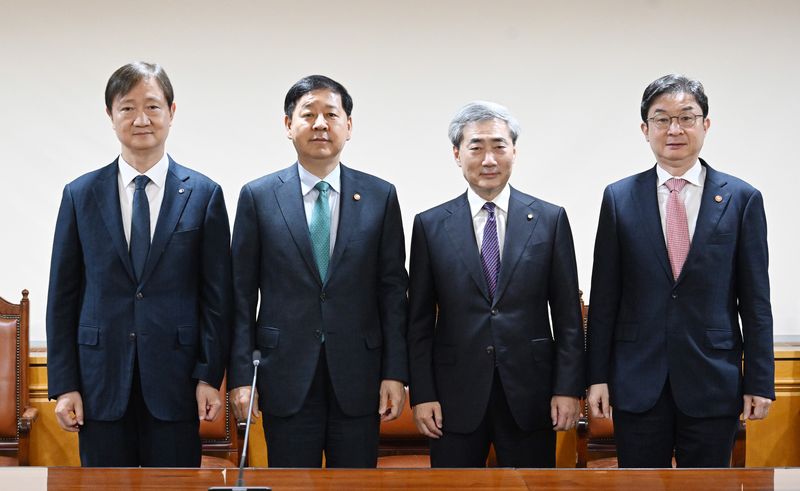
[Financial News] Koo Yun-cheol, Deputy Prime Minister and Minister of Economy and Finance, and Hyun-Song Shin, Governor of the Bank of Korea, said on the 14th that if a Samsung Electronics strike becomes a reality, it could pose significant risks across the board, including growth, exports and financial markets. They added that the issue needs to be resolved quickly through principled negotiations between labor and management.
That day, Koo held a joint market situation review meeting with Shin, Lee Eok-won, Chairperson of the Financial Services Commission, and Lee Chan-jin, Governor of the Financial Supervisory Service, at the Korea Federation of Banks Building. They reviewed recent trends and risk factors in the financial and foreign exchange markets and discussed response measures.
The participants assessed that the Korean economy is expanding faster than initially expected, helped by the strong semiconductor sector, and that the fundamentals of the macroeconomy and the financial and foreign exchange markets remain solid. However, they said volatility in the financial and foreign exchange markets continues, with government bond yields and the won's exchange rate recently rising amid uncertainty stemming from the Arab-Israeli conflict and other factors.
On the stock market, which is nearing the 8,000-point mark, the participants agreed that it has grown into one of the world's top markets by market capitalization. They also said structural improvements in the capital market must continue steadily for it to establish itself as a truly world-class market.
Regarding the foreign exchange market, they agreed that volatility has recently widened excessively relative to the economy's fundamentals, driven by foreign investors' stock sales and increased offshore speculative trading.
They also noted that foreign currency liquidity remains favorable, and that institutional improvements such as recent inclusion in the WGBI, the National Pension Service's New Framework and the Domestic Market Return Account are helping stabilize supply and demand. They added that conditions are becoming more favorable for market stability, including a record-high current account surplus, and predicted that the foreign exchange market will stabilize quickly.
In the bond market, they decided to manage the government bond market stably based on current favorable conditions. Recent rises in Korean Treasury Bond yields have mainly reflected shifting expectations for monetary policy in major economies amid global inflation concerns, as well as improved expectations for the domestic economy following strong first-quarter GDP growth.
The participants said the structural demand base for Korean government bonds is improving, with foreign capital flowing in following the WGBI inclusion and supported by sound fiscal health.
[email protected] Jung Sang-gyun Reporter