Food Prices Remain Unstable... Tariff Quotas to Be Applied to Imported Chicken and Pork
- Input
- 2026-05-14 10:00:00
- Updated
- 2026-05-14 10:00:00
[Financial News] The government has decided to apply quota tariffs to imported chicken and pork in an effort to stabilize food prices amid the Middle East conflict. It will also provide discount support worth 22 billion won for agricultural, livestock and fisheries products in May and June. In addition, it is considering importing more fresh shell eggs from the United States and Thailand. The government also plans to push for revisions to the Price Stabilization Act to strengthen penalties for hoarding and cornering of goods.
Lee Hyoung-il, first vice minister of the Ministry of Economy and Finance, chaired a meeting of the Middle East conflict price response team and the vice ministers' meeting on price issues at 10 a.m. on the 14th at Government Complex Seoul. The meeting discussed measures to monitor price trends for key items closely tied to livelihoods and to respond, as well as ways to strengthen economic sanctions under the Price Stabilization Act. Officials from the Ministry of Justice, MAFRA, MOTIE, MOF, KFTC, MFDS, the Ministry of Data and Statistics, KCS and the Korean National Police Agency attended. According to the April Consumer Price Trends report, the Consumer Price Index rose 2.6% from a year earlier last month. That marks the sharpest increase in one year and nine months, since July 2024, when it also rose 2.6%.
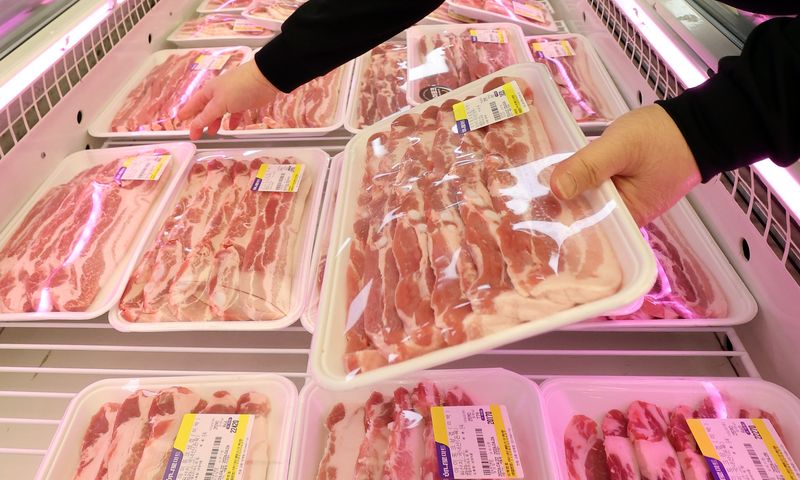
To prepare for the summer season, when meat consumption tends to rise, the government plans to push for emergency quota tariffs on 30,000 tons of imported chicken through the end of July and on 12,000 tons of pork through the end of the year. The move is part of a preemptive policy response as food prices have become more unstable due to the Middle East conflict. A quota tariff is a flexible tariff system that temporarily applies a rate lower or higher than the basic tariff rate for a set period and volume of specific imports.
The government will also roll out broad discount support totaling 22 billion won between May and June for items directly linked to everyday living, including agricultural, livestock and fisheries products. For four popular fish species — mackerel, squid, cutlassfish and pollock — it plans to release 8,000 tons from state reserves in May. It also plans to expand pork supplies in wholesale markets starting in May. Beyond the existing fresh egg imports from Thailand and the United States, 2.24 million eggs from each country, it is also reviewing additional imports from either country.
It will also revise guidelines to raise the upper limit for diesel fuel price-linked subsidies, which help ease the burden on bus and freight transport operators, from 1,961 won per liter to 2,100 won per liter. Under the subsidy program, when diesel prices exceed 1,700 won per liter, the government covers 70% of the amount above that threshold. Previously, however, the payment cap was set at 183 won per liter, making it difficult to provide additional support once fuel prices rose above 1,961 won. The change will raise the ceiling for fuel prices eligible for subsidies.
The government is also moving to amend the Price Stabilization Act to strengthen penalties for hoarding and cornering of goods. Under the current law, such acts can be punished by up to three years in prison or a fine of up to 100 million won. Related goods may also be confiscated, or if confiscation is not possible, the value may be collected. Lee said, "Through discussions with relevant ministries, we will thoroughly review the current system and swiftly push for revisions to the Price Stabilization Act, including measures to ensure the effectiveness of the forfeiture system, the introduction of a reward for reporting violations, and an unjust enrichment penalty."
[email protected] Choi Yong-joon Reporter