Why Was Han Zheng There to Greet Trump? The Hidden Message in China's Protocol
- Input
- 2026-05-14 02:31:40
- Updated
- 2026-05-14 02:31:40
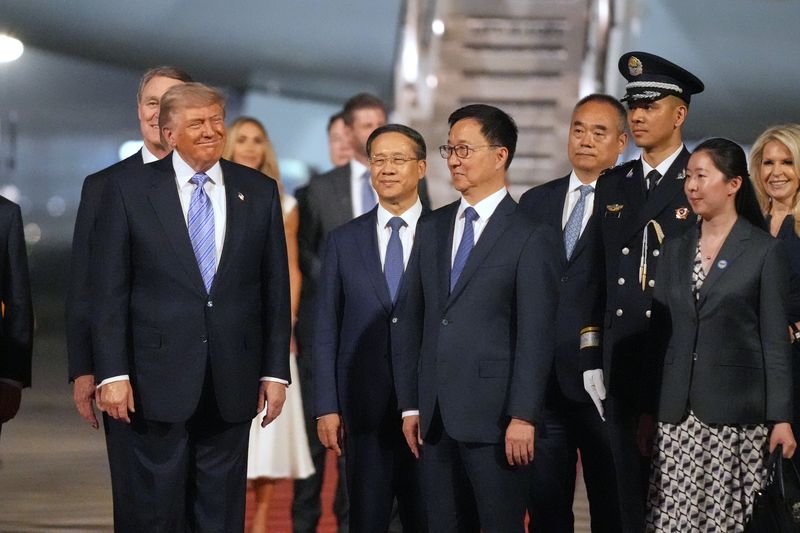
Trump arrived in Beijing on the night of the 13th local time. China staged a large-scale welcome ceremony, deploying a military band, an honor guard and hundreds of young people waving national flags. Han Zheng, Vice President of the People's Republic of China, personally came to the airport.
On the surface, it was a top-level welcome. But diplomatic experts focused on who did the greeting.
Julian Gewirtz, a Columbia University professor who served as a senior China official on the White House National Security Council (NSC) during the Biden administration, told The New York Times (NYT), "China knows very well that President Trump values formality and status," adding, "It appears to have judged that the title of vice president alone could carry symbolic weight."
Han is no longer a member of the Standing Committee of the Political Bureau of the Communist Party of China Central Committee, the core of China's current power structure. Although his formal rank is high, many say his actual policy influence is limited.
Experts said China is dealing with the United States by "raising the protocol level while withholding any real special treatment."
Evan Medeiros, a Georgetown University professor who served as a White House aide for Asia during the Barack Obama administration, explained, "In Chinese diplomacy, protocol is substance," and added, "The airport greeting is China's first political message to the other side."
Some also say this reception was somewhat lower than the treatment Trump received during his first term in 2017. At that time, Yang Jiechi, China's top diplomatic official and a Politburo member, personally went to the airport. Xinhua News Agency later described it as reflecting China's "high importance attached to the summit between the two leaders."
This time, by contrast, Han Zheng, a figure with strong symbolic weight, appeared instead. Wei-Feng Tzeng, a researcher at National Chengchi University and an expert on Chinese diplomatic protocol, said, "If a Politburo member had greeted him in person, it would have meant, 'You are our most important guest.'"
In diplomatic circles, the move is being read as evidence of China's much greater confidence and changed standing compared with the past. Trump may still be the leader of the world's most powerful country, but China was also signaling through protocol that it is no longer overawed by the United States.
China has often used protocol to send political messages. When Obama visited China in 2014, Wang Yi, then the foreign minister, greeted him. By contrast, when Obama visited China in 2009, in the first year of his presidency, Xi Jinping, then vice president and widely seen as the next top leader, personally went to the airport.
[email protected] Reporter Lee Byung-chul Reporter