Samsung Electronics Faces Strike Crisis... Will an Emergency Arbitration Order Be Issued for the First Time in 21 Years? [Samsung Electronics Strike Countdown]
- Input
- 2026-05-13 18:29:37
- Updated
- 2026-05-13 18:29:37
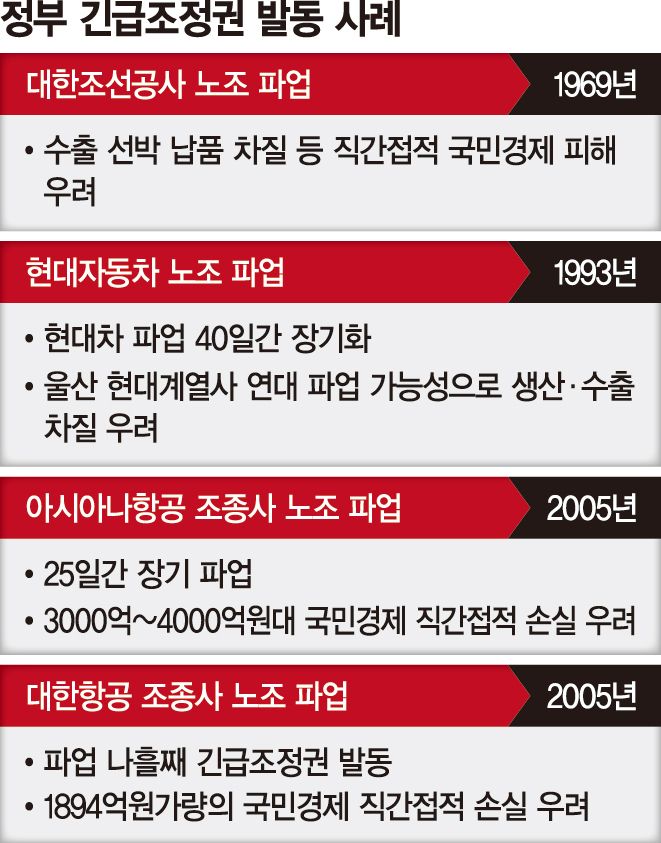
According to business and labor circles on the 13th, the Emergency arbitration order has been issued only four times since the system was introduced in 1963, underscoring how strict the requirements are. The most recent case was the Korean Air pilots' union strike in 2005. The labor minister can issue the order after hearing the opinion of the chairman of the National Labor Relations Commission, and it applies only when there is an imminent risk of endangering the national economy or public life. It is a policy tool under the labor law that can be used in public-interest businesses, large-scale operations, or situations where such risks are present.
Professor Kim Kwang-hyun of the Department of Business Administration at Korea University (KU) told this paper in a phone interview, "If this is not just a problem for a specific company but an issue with broad social impact and major ripple effects, I think it is a situation where issuing an Emergency arbitration order could be considered."
He added, "The desirable outcome is for labor and management to resolve this on their own, but the current situation requires government mediation." He continued, "Taking that into account, issuing an Emergency arbitration order could be considered."
If an Emergency arbitration order is issued, strikes and other labor disputes will be banned for 30 days. It is seen as necessary because it can prevent economic and social losses from a large-scale strike, but it also draws criticism for restricting the union's right to collective action and dispute activity.
Another feature is that it effectively compels an agreement between labor and management. Once the order is issued, the two sides enter mediation. If mediation fails, the case moves to arbitration based on the National Labor Relations Commission's decision. In the arbitration stage, both sides must accept the arbitration proposal presented by the commission.
The reason an Emergency arbitration order is being discussed is the economic ripple effect of Samsung Electronics and the semiconductor industry. If the union carries out a general strike for 18 days as announced, losses inside and outside Samsung Electronics are estimated at between 18 trillion won and as much as 40 trillion won. There are also concerns that exports, the stock market, and the country's overall competitiveness, all of which are tied to the semiconductor boom, would inevitably suffer a chain reaction. That is why the government is closely watching the negotiations between Samsung Electronics and the union.
For now, the government plans to encourage a voluntary agreement between labor and management as much as possible.
At a briefing at Chunchugwan, the press briefing room at Cheong Wa Dae, Kang Yoo-jung, senior presidential spokesperson, was asked about the government's position after the collapse of Samsung Electronics' labor-management talks. She said, "There is still time before the strike date. The government will actively support labor and management so they can resolve this through dialogue."
Asked about the possibility of blocking the strike through an Emergency arbitration order, she said, "There is still time, so we will support labor and management in resolving the issue through dialogue, and that can be considered afterward." She added, "It should be understood that there is still time for labor and management to talk."
Labor Minister Kim Young-hoon, who has the authority to issue an Emergency arbitration order, said on the YouTube program "Jang Yoo-seon's News Convenience Store" that the issue should be resolved through dialogue when asked whether the government was considering the measure. This is being interpreted as meaning that, at this stage, the ministry is placing more weight on a resolution through talks between labor and management than on an Emergency arbitration order. Another burden is that such an order could clash with the Lee Jae-myung administration's emphasis on "respect for labor" and "labor-management autonomy."
[email protected] Kim Jun-hyuk, Cho Eun-hyo, Seong Seok-woo Reporter