Even when family members take wages as fake employees, it is only uncovered during post-audit checks [Vanished Young Entrepreneurs (Part 2)]
- Input
- 2026-05-13 18:26:27
- Updated
- 2026-05-13 18:26:27
#2. D received 500 million won in government funding over two years, saying he would develop technology to read building blocks toy products. However, a post-project review concluded that "the development output cannot even be verified, and commercialization cannot even begin." In January, the court ruled that the recovery of the subsidy and the ban on participation in state projects were lawful.
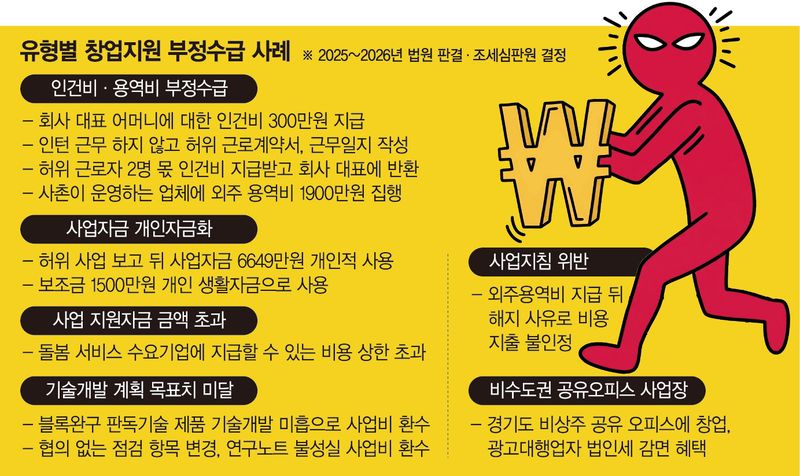
Cases are piling up in which recipients of youth startup support funds from the government later had to return the money after falsely claiming it as family labor costs or using it for other purposes. There are also cases in which companies received technology development grants but remained stuck at an early stage or failed to build a commercialization model. Tax benefits obtained through so-called 'phantom shared offices' are also still being abused. Experts say such fraudulent claims can only be detected after the fact.
A review by this paper of 10 civil, criminal, and administrative rulings related to youth startup support, handed down by courts nationwide from last year through April this year, found four cases of fraudulent wage claims, two cases of personal misuse of business funds, one case of violation of program guidelines, one case of spending beyond the subsidy limit, and two cases of failure to meet technology development targets. Most of the cases involved recipients who had already been ordered to return the funds and then sought to overturn the decision by suing the Ministry of SMEs and Startups or the support agency.
At present, youth startup support programs are operated by the Ministry of SMEs and Startups and other agencies through dedicated institutions such as KISED, which provide project expenses, R&D funds, and labor costs. After a project ends, performance evaluations and spending audits are conducted. If improper use is found, the recipient faces recovery of the funds and restrictions on participation in state projects.
The most common form of fraud was registering family members or relatives as fake employees to receive labor costs or business funds. In repeated cases, family members who did not actually work were listed as interns, fake attendance logs were prepared, and wages were collected. In other cases, subcontractors handling prototype production were selected under relatives' names, allowing project funds to be paid indirectly.
In recent technology development programs, attempts to evade post-project verification have also been identified. E, who received 150 million won in Ministry of SMEs and Startups funding for a spacecraft auxiliary device manufacturing project, was found to have arbitrarily changed the evaluation indicators in the business plan during the review process after the support period ended. The project review committee ordered the funds to be recovered, saying the research log was poorly maintained and the explanation materials were insufficient. Those who were ordered to repay the money asked the courts to cancel the decisions, but none of the rulings reviewed accepted their claims.
There are also cases of abusing tax breaks through shared offices. F, who ran an advertising agency, registered a business site in a shared office in Gyeonggi Province and received corporate tax reductions under the Special Tax Exemption for Start-up SMEs provided by the Restriction of Special Taxation Act. But a tax authority investigation found that the actual business was conducted in Seoul. The shared office was found to have 313 corporations registered there, including F's company. The tax authority traced site visit records and the sources of sales and recovered the tax amount. The decision was upheld even after the appeal process.
Experts say there are structural blind spots in the current startup support system. Park Jung-hwan, a tax accountant at Yulje Tax & Accounting Firm, said, "If someone is determined to deceive others, it is essentially difficult to screen out in advance." Park Hoon, a professor in the Department of Taxation at the University of Seoul, noted, "In many cases, problems surface only later because companies fail to distinguish between corporate money and personal money," adding that "preliminary checks and management are needed from the startup support stage."
[email protected] Choi Eun-sol Kim Ye-ji Reporter