Samsung Electronics at a Crossroads: Backroom Talks, Injunction, or Emergency Mediation? [Samsung Electronics Strike Countdown]
- Input
- 2026-05-13 18:26:10
- Updated
- 2026-05-13 18:26:10

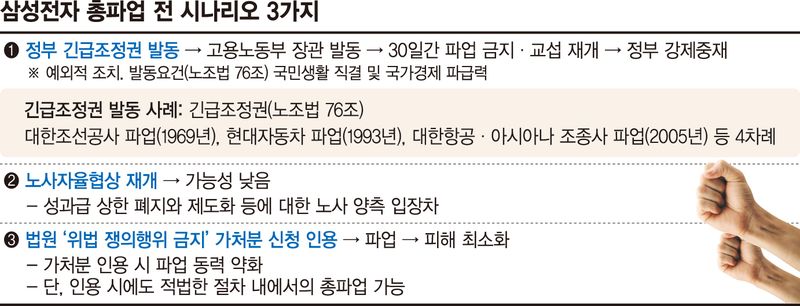
On the 13th, Samsung Electronics and its labor union again failed to find common ground in the second round of post-mediation talks, which lasted about 17 hours at the National Labor Relations Commission starting the previous day. According to the union, management proposed keeping the existing EVA-based OPI system and maintaining the bonus cap at 50% of annual salary. In return, it suggested paying an additional special reward equal to 12% of operating profit on any OPI excess if the Device Solutions Division achieves industry-leading performance this year. The union, however, is demanding that a fixed share of operating profit be set aside each year as a formal bonus pool, making it difficult to narrow the gap with management, which has offered conditional, one-time compensation while preserving the current system. Three main scenarios now remain.
First, the two sides could resume voluntary negotiations and reach a dramatic last-minute deal. But after the collapse of post-mediation talks and given the wide differences between them, that outcome appears unlikely. Choi Seung-ho, the union leader representing Samsung Electronics workers, already said on the day that he was not considering any further talks with management, reaffirming his intention to push ahead with the strike.
■ "Conditions for emergency mediation have been met"
The most realistic option is for the government to invoke emergency mediation powers. If that happens, strikes and other labor actions would be banned for 30 days, while mediation and arbitration procedures would proceed through the National Labor Relations Commission. If no agreement is reached after that, the government would impose compulsory arbitration. Because this could undermine the constitutional right to labor and the principle of autonomous labor-management bargaining, it has been used only in exceptional cases where the impact on the national economy and the public interest is severe. There have been only four cases of emergency mediation: the 1969 strike at Korea Shipbuilding Corporation, the 1993 strike at Hyundai Motor Company, and the July and December 2005 pilot strikes at Asiana Airlines and Korean Air.
In effect, the decision now rests with the government. Given the special status of semiconductors as a core national industry, some argue that the conditions for emergency mediation may be met.
Kim Yang-paeng, a senior researcher at KIET, also said, "Because a significant impact on the national economy is unavoidable, this situation may meet the conditions for invoking emergency mediation."
■ "It will be difficult to completely block the general strike"
If the strike cannot ultimately be stopped, the court’s ruling on the injunction becomes a second line of defense that could help minimize damage. On the 13th, Suwon District Court held the second hearing on the company’s request for an injunction to ban illegal labor disputes. Management argues that even during a strike, essential workers must remain in place at semiconductor critical processes and safety facilities that store chemicals and other materials. Legal experts say that, given the urgency of the case with the strike set to begin on the 21st, a decision could come as early as this week.
Park Ji-soon, a professor at Korea University School of Law, said, "Even if the injunction is granted, it is likely to be limited to safety facilities and some essential processes." He added, "Only about 20% of the processes could be maintained, so that alone would be far from enough to prevent the damage caused by a general strike."
[email protected] Im Su-bin, Jeong Won-il, Lee Dong-hyeok Reporter