"AI-Driven Drug Development Is a New Paradigm... It Is a Golden Opportunity for Us" [News Analysis from the Editorial Desk]
- Input
- 2026-05-13 18:22:48
- Updated
- 2026-05-13 18:22:48
During the Japanese colonial period, pharmaceutical companies laid the foundation for a national drug industry by producing household medicines such as Antiphlamine.
After liberation, pharmaceutical self-reliance became a rallying cry: "Let's make our own medicine with our own hands." For a long time, the domestic market and generic drugs formed the backbone of Korea's pharmaceutical industry.
It was not until the 2000s that the industry opened the door to the global market. Technology exports and global clinical trials began in earnest. Korean companies also posted record results in the biosimilar and Contract Development and Manufacturing Organization (CDMO) markets, which produce copies of biopharmaceuticals.
Investment in research and development also began to accelerate. Last year's first-ever $10 billion in pharmaceutical exports was the result of that long journey. The remaining hurdle is blockbuster new drugs.
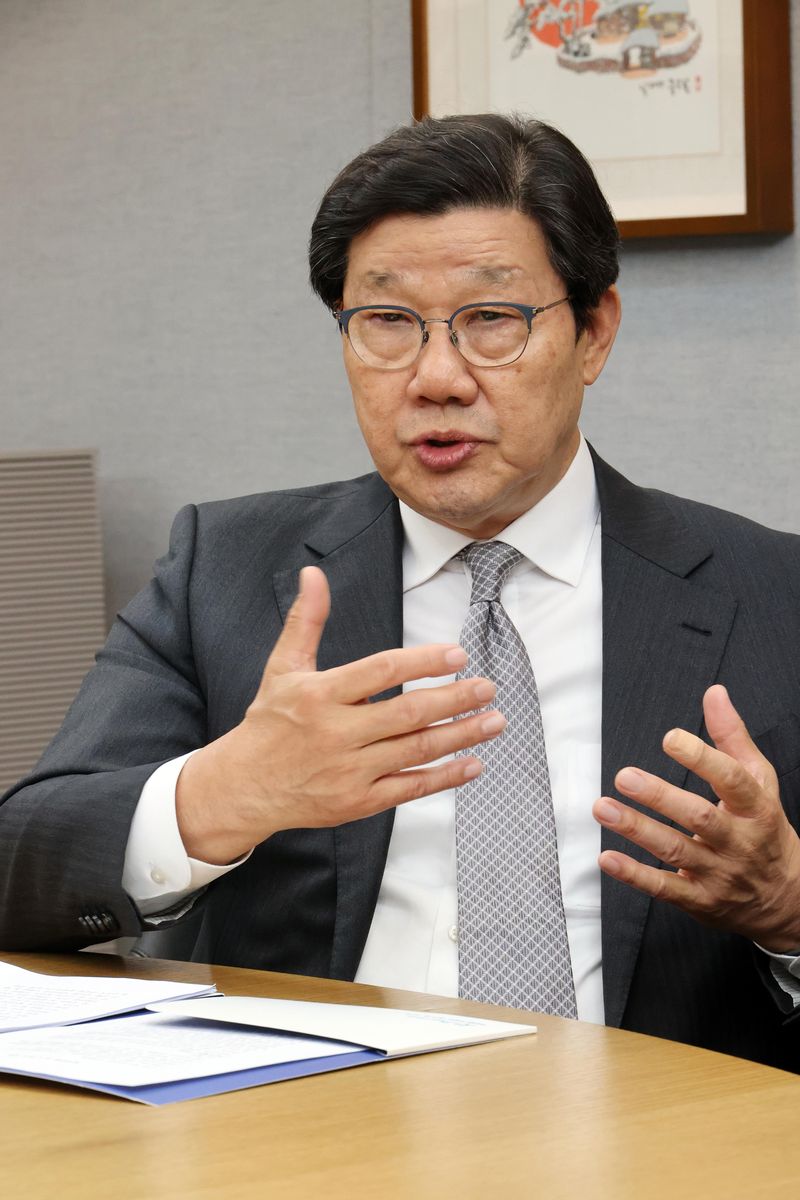
The government has signaled its commitment to supporting new drug development under its "Top 5 Global Biopharmaceutical Powerhouse" campaign. Many believe the pharmaceutical and bio sector could become Korea's next growth engine, following semiconductors. We spoke with Noh Yeon-hong about the prospects for Korean new drugs and the path to becoming a bio powerhouse.
—What is the current state of Korea's pharmaceutical and bio industry?
▲In terms of global market size, Korea ranks 13th. If you look at indicators that comprehensively assess technology and talent, the country is also viewed as being in the top 10. Last year, the pharmaceutical industry was worth about 34 trillion won. Among major players, Samsung Biologics and Celltrion each posted sales in the 4 trillion won range, Yuhan Corporation around 2.6 trillion won, and GC Biopharma about 1.9 trillion won. Korea can be seen as a strong challenger with the potential to become a global bio leader. Overseas, blockbuster drugs with sales of more than $1 billion have come from big pharma companies worth over 5 trillion won. This could be a major turning point for us.
—Is the foundation for new drug development sufficient?
▲One indicator of future growth potential is the new drug pipeline. It refers to the process of developing candidate compounds for new drugs. By pipeline size, Korea ranks third in the world. The United States has about 10,000, and China about 7,000, ranking first and second. Korea has secured more than 3,200, following those countries. The trend shows that the number of pipelines has risen rapidly over the past few years. Our technological capabilities have reached a considerable level. More companies have also secured platform technologies. Technology exports alone exceeded 20 trillion won last year. The challenge now is to successfully complete the final commercialization stage. Progress had been slow, but I cautiously believe we are now at the stage just before explosive growth.
—Why has the number of new drug candidates increased so sharply recently?
▲I think a unique ecosystem has played a role. The strength of pharmaceutical and bio ventures has exceeded expectations. The atmosphere is not especially academic compared with the United States or Japan, and the scale is not very large either. Still, young talent is stepping up, joining ventures, and creating markets. There are a great many local bio ventures. There are at least more than 3,000 of them. Over the past several years, many talented people have entered the field to work on new drug development. Another important task now is how to nurture and sustain these bio ventures.
—Many say bio could become Korea's second semiconductor industry.
▲The overall pharmaceutical and bio market is already much larger than semiconductors. As of 2024, global semiconductor sales were about $620 billion. The top 10 pharmaceutical markets alone reached $1.3 trillion. According to overseas institutions, global pharmaceutical spending is expected to reach $2.3 trillion by 2028. If you include medical devices, diagnostics, and healthcare services, the market is enormous. As societies age faster and incomes rise, demand in the bio market expands. The pharmaceutical and bio industry has received less attention than its potential warrants. Now is the last chance. Korea's next core industry group, after semiconductors, shipbuilding, and automobiles, could be pharmaceuticals and bio.
—What drove last year's $10 billion in exports?
▲As patents for original biopharmaceuticals expired, overseas expansion of Korean biosimilars increased sharply. As the biosimilar market grew, Korean companies with strong capabilities seized the opportunity. The Trump administration's policy of lowering drug prices also creates opportunities in the biosimilar market. Continued recognition of Korea's technology seems to have given companies confidence. After technology exports, we now need to move quickly to producing the final output.
—What is the main reason that producing the final output is so difficult?
▲A major reason is a lack of experience. Research capabilities have accumulated, but there are still shortcomings in price negotiations, insurance, and post-launch promotion in the global market. Making a good drug and creating a commercially successful global blockbuster are different challenges.
—What is Korea's edge in bio technology?
▲At this point, it is still difficult to say that we are fully leading in any specific field. That is why it is cautious to talk about a technological edge, but within areas outside new drug development, we can find world-class capabilities. It is unfortunate that these are not new biopharmaceuticals, but Korea's biosimilar and CDMO sectors are globally dominant. Celltrion and Samsung Biologics are companies worthy of that recognition. I believe we can further solidify that edge in the future.
—What are Korea's strengths in new drug development?
▲There are not many countries in the world that can develop new drugs. You could count them on one hand, roughly 10 countries. Korea has now produced 43 domestically developed new drugs. The fact that we can make new drugs is itself a source of hope. What is even more encouraging is artificial intelligence (AI). AI is affecting every industry, but the pharmaceutical and bio sector is one area where it can create explosive synergy. Clinical trials in pharmaceuticals and bio rely on countless rounds of trial and error before reaching conclusions. AI is a new tool that can dramatically reduce that trial-and-error time. Korea is a latecomer in bio, but that is why I believe it can catch up quickly. I am confident that AI will help Korea rapidly narrow the technological gap with advanced bio countries.
—How can AI technology be applied to pharmaceuticals and bio?
▲If the two fields are combined, the impact will be enormous. But the reality is that there are still no experts or institutions that can fully cover both areas. So AI experts, pharmaceutical and bio specialists, and data experts will ultimately have to work together in consortium form. It is difficult for pharmaceutical and bio experts to use AI directly, and the reverse is also true. We need to build a new model from now on.
—What is needed to secure a firm competitive edge in AI-based drug development?
▲The power of AI lies in data. Korea's healthcare data is overwhelming in both quantity and quality. Real-world clinical data from HIRA and NHIS is a valuable asset. It is not yet being used effectively because of various regulations, but that will change in the future.
—Blockbuster new drugs appear to require full-scale government support.
▲Clinical trial regulations need to be improved, and approval and licensing processes must become faster. These are key factors in global competitiveness. Regulators must strike a balance between safety and speed, and a predictable regulatory environment is important. Of course, standards must be made clear so companies can set development strategies. There must also be sufficient communication during the review process. Review staff have recently been expanded, but more are needed. Only by improving both expertise and efficiency in the review process can the pace of new drug development also accelerate.
—Drug development can take 15 years and cost trillions of won, can't it?
▲Drug development is a high-risk, high-cost business. Without profits secured through technology exports, sustained innovation may be difficult. We need to create an environment in which researchers can focus on the same topic for a long period of time. Financial support through the government's National Growth Fund would help. Cooperation with global pharmaceutical companies can be advantageous in clinical strategy, financing, and market entry. We need to explore a wide range of ways to ensure companies do not rely only on technology exports and can also challenge themselves to commercialize their products.
—What are the key tasks for becoming a Top 5 Global Biopharmaceutical Powerhouse?
▲The government has set goals of doubling pharmaceutical exports by 2030, creating three blockbuster drugs, and ranking third in global clinical trials as part of its push to become a Top 5 Global Biopharmaceutical Powerhouse. I believe the key is building a full-cycle innovation ecosystem that spans research and development, clinical trials, approval, and global commercialization. We need a long-term roadmap and a strong control tower to consistently promote the pharmaceutical and bio industry as a national strategic sector. Laws and systems that allow the industry to move actively, including those related to clinical trials, approvals, data use, and tax support, are urgently needed. A bold and sustained investment ecosystem, policy finance, and tax incentives must be systematized. If policy execution is strengthened in this way, the goal of becoming a top-five powerhouse is entirely achievable.
■ Profile of Noh Yeon-hong, chairman of the Korea Pharmaceutical and Bio-Pharma Manufacturers Association: Hankuk University of Foreign Studies; completed doctoral coursework at York University; doctorate from CHA University; Senior Secretary for Health and Welfare at the Office of the President of the Republic of Korea; Commissioner of the Korea Food & Drug Administration; Senior Secretary for Employment and Welfare at the Office of the President of the Republic of Korea; chairman of the Special Committee on Medical Reform; chairman of the Global Training Hub for Biomanufacturing Support Foundation (current); member of the National Bioinnovation Committee (current)
[email protected] Reporter