Integrated Korean Air to Take Off on Dec. 17, Aiming for Mega Synergies and Higher Profitability
- Input
- 2026-05-13 18:10:42
- Updated
- 2026-05-13 18:10:42
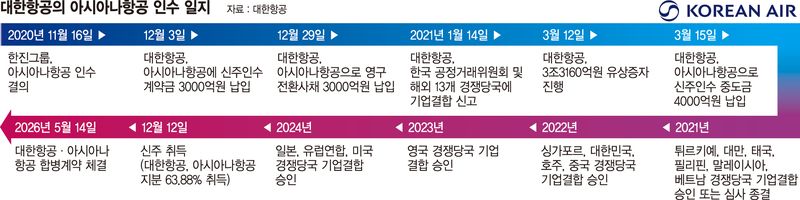
Based on simple combined passenger traffic, Korean Air will become a top-10 global airline. After the merger, it will enter direct competition with leading carriers such as Qatar Airways, Singapore Airlines and Emirates.
■ Merger of the two airlines approved by their boards
According to the Financial Supervisory Service's electronic disclosure system on the 13th, Korean Air and Asiana Airlines each held regular board meetings that day and approved the merger agreement. The two companies are expected to sign the final merger contract on the 14th and officially announce the launch schedule for the integrated airline.
In the global aviation industry, mergers are already seen as a proven way to strengthen competitiveness. Lufthansa, the world's fourth-largest airline, became one of Europe's biggest carriers after acquiring SWISS International Air Lines in 2005. The merger ratio was calculated at 1 to 0.2736432 for Korean Air and Asiana Airlines, respectively, based on the market prices prescribed under the Financial Investment Services and Capital Markets Act. As a result, Korean Air's capital is expected to increase by about 101.7 billion won.
Immediately after signing the merger contract, Korean Air will begin follow-up procedures, including approval for changes to its operational specifications, or OpSpecs, to ensure the stable integration of its aviation safety system. On the 14th, it plans to apply to the Ministry of Land, Infrastructure and Transport for merger approval, and in June it will also seek approval for changes to its operational specifications, which include compliance conditions and restrictions related to aviation safety. Asiana Airlines plans to hold an extraordinary shareholders' meeting in August to approve the merger agenda. Korean Air meets the requirements for a small-scale merger, so it will replace a shareholders' meeting with a board resolution on the same day.
■ Securing economies of scale to boost profitability
The biggest strength of Integrated Korean Air is the realization of economies of scale. By combining the aircraft, routes and workforce of both companies, the carrier has built a foundation to compete more evenly with major global airlines. Reassigning overlapping routes and expanding new ones will also broaden customer choice. By efficiently reorganizing the routes previously operated separately by Korean Air and Asiana Airlines, the company expects to improve profitability while also opening the door to new routes.
Ahead of the merger, Korean Air has also expanded investment to strengthen flight safety and customer service. It is expanding or building large-scale aircraft maintenance facilities, including an engine test cell, a new engine maintenance plant and a maintenance hangar near Incheon International Airport. On the customer service side, it has worked to improve perceived quality through airport lounge renovations, in-flight meal overhauls and terminal relocations. The plan to integrate the two airlines' mileage programs is currently under discussion with the Fair Trade Commission and other relevant authorities, and customers will be informed separately once it is finalized.
Throughout the acquisition and merger process, Korean Air has continuously supported Asiana Airlines in improving its financial structure and restoring management stability. In particular, it is also being credited with successfully completing the restructuring of South Korea's aviation industry by fully repaying the 3.6 trillion won in public funds provided by the government and creditors during the COVID-19 pandemic.
A Korean Air official said, "With the launch of the integrated airline, we will be able to generate synergies such as preserving the competitiveness of the national aviation industry, strengthening Incheon International Airport's hub function and expanding the global aviation network, while taking South Korea's aviation industry to the next level."
ggg@fnnews.com Kang Gu-gwi Reporter