[Editorial] Samsung Electronics bonus dispute meets the requirements for an emergency arbitration order
- Input
- 2026-05-13 18:10:30
- Updated
- 2026-05-13 18:10:30
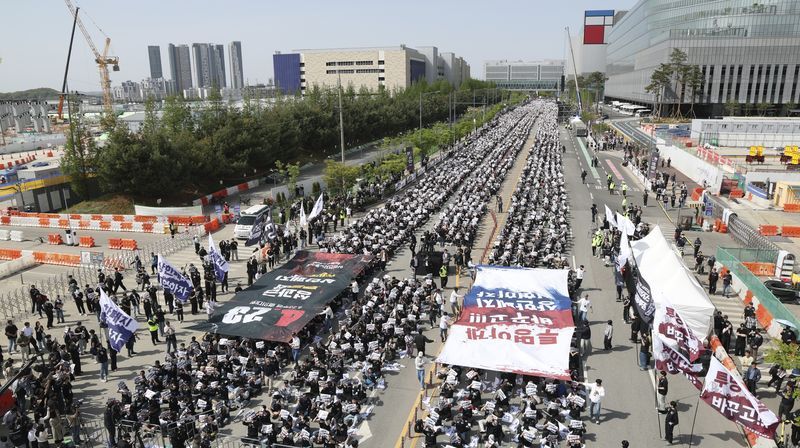
An emergency arbitration order is a system based on Article 76 of the Trade Union and Labor Relations Adjustment Act. It is an exceptional mediation procedure that the Minister of Employment and Labor can invoke when industrial action threatens the public's daily life or is likely to significantly harm the national economy. Once such an order is issued, all industrial action must stop immediately, and it cannot resume for 30 days. In the past, it has been invoked only four times, including during the 2005 strikes by Korean Air and Asiana Airlines pilots.
Although the conditions are strictly limited, they must be weighed against the current situation. The union is openly threatening that a strike would cause more than 30 trillion won in damage. That appears to meet the condition of a situation likely to significantly harm the national economy. The amount is enormous, and the impact could extend not only to suppliers but to the economy as a whole.
A strike at Samsung Electronics would not only undermine trust in its business partners and weaken its market position, but could also inflict even greater damage by dragging down the country's creditworthiness. The impact on the national economy and the public interest could hardly be greater. The estimated 30 trillion won in damage is more than 100 times the 206.3 billion won in losses caused by Korean Air's strike in 2005.
Of course, the government has no choice but to proceed cautiously. It is only natural to make every effort to keep talking until the very end. But if there is still no sign of a breakthrough as the strike date approaches, the government should use an emergency arbitration order as a last resort. Samsung Electronics workers' labor rights should, of course, be protected just as those of other unions are. Even so, the government is surely aware of how serious this issue is.
Against that backdrop, the remarks made by Kim Yong-beom, Chief Presidential Secretary for Policy, were highly inappropriate. In a Facebook post, he argued that "the gains of the AI infrastructure era are not the result of any single company alone. Some of those gains must be structurally returned to the entire public." He then proposed a 'National Dividend' that would return excess tax revenue generated by the AI boom to the public.
The point of his post is not entirely wrong: Samsung Electronics' astronomical profits were not created solely by its own employees. There are also suppliers, and more broadly, the state has contributed by supporting the semiconductor industry through national policy. That contribution is ultimately based on resources formed through taxes paid by the public. But that does not mean the entire population should be treated as dividend recipients.
When companies make profits, they already fulfill their basic responsibilities to the state by paying corporate tax. Even so, the idea that unexpected profits should be distributed so that everyone benefits is extremely socialist in nature. Corporate profits should instead be used more for investment in growth and innovation.
In that sense, it is fair to criticize the government for jumping in when employees are demanding excessive bonuses, as this amounts to a kind of populism that ignores market principles. The Blue House drew a line by saying the remarks were Kim's personal opinion, but such absurd personal views should not be casually voiced again.