Semiconductor Strength Overpowers Middle East War, Setting a Record $240 Billion Current Account Surplus This Year
- Input
- 2026-05-13 12:01:02
- Updated
- 2026-05-13 12:01:02
[Financial News] The semiconductor industry is lifting the Korean economy so strongly that it is offsetting even the effects of the Middle East war. Growth this year is now expected to jump into the mid-2% range. In particular, the current account surplus is projected to reach an unprecedented level in the $200 billion range for two straight years, this year and next. The semiconductor supercycle, driven by expanded chip production capacity and other factors, is expected to continue at least through the first half of next year. As the economy enters a full-fledged expansion phase, inflation is likely to rise into the high 2% range because of higher oil prices from the Middle East war and the government's expansionary fiscal stance. The chance of an interest rate hike within the year has also increased.
On the 13th, the state-run Korea Development Institute (KDI) forecast that South Korea's economy will grow 2.5% this year, 0.6 percentage point higher than its previous February estimate of 1.9%, despite the fallout from the Middle East war. It put next year's growth at 1.7%.
According to KDI's outlook, the Korean economy has entered an expansion phase, driven by a record boom in semiconductor exports.
Above all, semiconductors are expected to remain in an exceptional boom this year, more than offsetting the downside risks to growth from the Middle East war.
Senior Research Fellow Kyucheol Jung of KDI said, "The semiconductor industry will contribute more than half of this year's growth forecast of 2.5%," adding, "Demand next year is somewhat uncertain, but strong demand will continue at least through this year." He viewed the Middle East war as a downside factor that would cut growth by 0.5 percentage point, meaning the Korean economy could have grown in the 3% range this year if the war had not occurred.
The most notable indicator is the current account surplus. KDI projected a surplus of $239 billion this year and $213.7 billion next year, more than double last year's level. It would be a record high never seen before. Jung said, "As semiconductor prices rise and export earnings surge, the current account surplus will reach an unusually high level," adding, "We have never seen figures like this before."
A record current account surplus in the $200 billion range for a full year means higher national income and greater fiscal room for future investment in the economy. However, the deepening concentration on semiconductors in Korea's industrial structure is also widening gaps in income, industry and employment.
Exports are expected to rise 4.6% this year and 2.2% next year, thanks to the semiconductor boom. Facility investment is also projected to grow strongly, by 3.3% this year and 2.4% next year, led by semiconductors.
Private consumption is forecast to increase 2.2% this year and 1.5% next year, supported by improved incomes and government policies to boost spending. Senior Research Fellow Jung said, "Expansionary fiscal policy aimed at stimulating the economy is not necessary, given the semiconductor boom and the expansion of domestic demand."
As the economy expands, prices are expected to rise further on income gains and government spending to spur consumption. High international oil prices, forecast to remain in the $90-per-barrel range throughout the year, are a key factor pushing inflation higher.
Accordingly, KDI projected consumer price inflation at 2.7% this year. The estimate appears conservative, taking into account the oil price cap and fuel tax cuts. For next year, it expects inflation to ease to 2.2% on the assumption that global oil prices fall to the low $80 range.
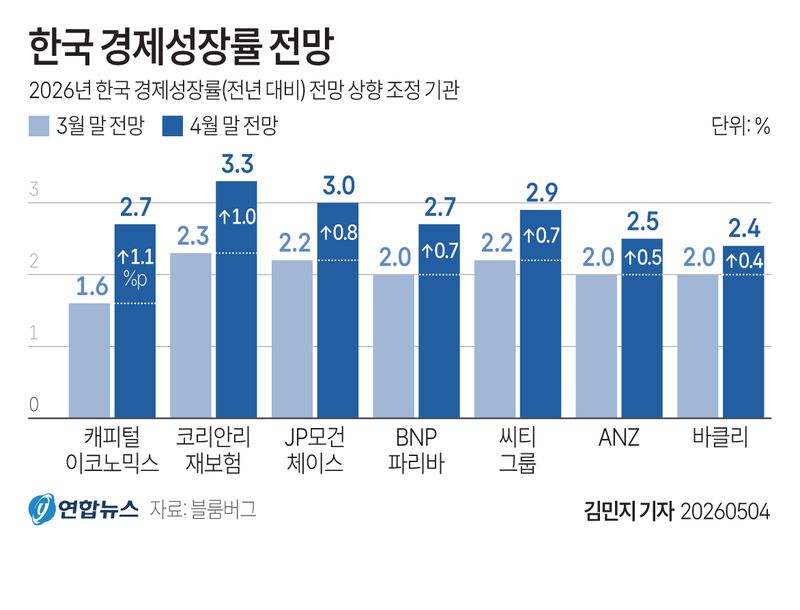
Core inflation, excluding food and energy, is expected to remain high at 2.5% this year. That is well above the 2.0% inflation target. Depending on the situation in the Middle East war, it could rise well beyond the target. Jung said, "Rising core inflation increases upward price pressure in an expansion phase, and that raises the likelihood of a response through interest rate hikes."
Despite the semiconductor boom and economic expansion, the labor market is unlikely to show any notable improvement. Employment is expected to increase only gradually, by about 170,000 jobs in both this year and next.
KDI also called for active structural reform to improve the efficiency of fiscal spending. It said policy should focus on future investment that raises potential growth while providing stronger support for vulnerable income groups.
In particular, KDI singled out the Basic Pension, which is automatically paid to 70% of people aged 65 and older, and the Local Education Subsidy Grants, to which 20.79% of internal taxes and part of the education tax are automatically allocated, and urged structural reform. It said rigid spending patterns must be changed to improve the efficiency of limited government finances.
Senior Research Fellow Jung said, "The Basic Pension should be restructured so that vulnerable older adults who need support receive more help," adding, "The Local Education Subsidy Grants require reform to reduce the share of mandatory spending in light of changes such as the decline in the school-age population."
[email protected] Jung Sang-gyun Reporter