Middle East Conflict and AI Hit Youth and Manufacturing Jobs First... April Employment Falls to Lowest in 16 Months
- Input
- 2026-05-13 09:36:48
- Updated
- 2026-05-13 09:36:48
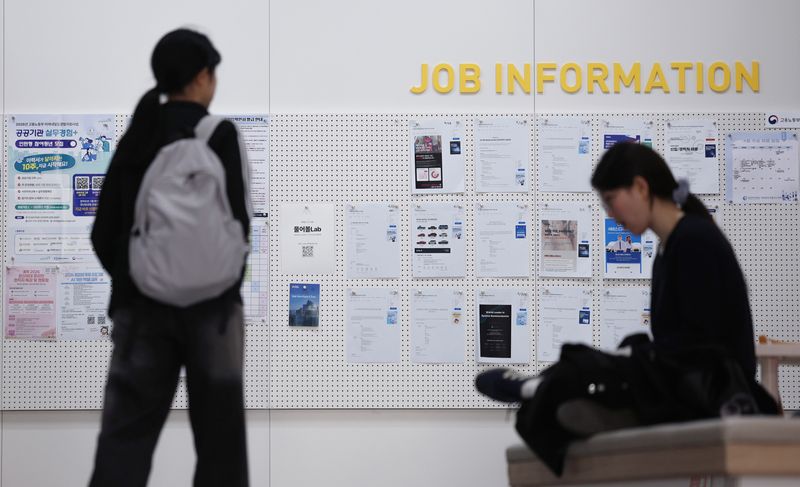
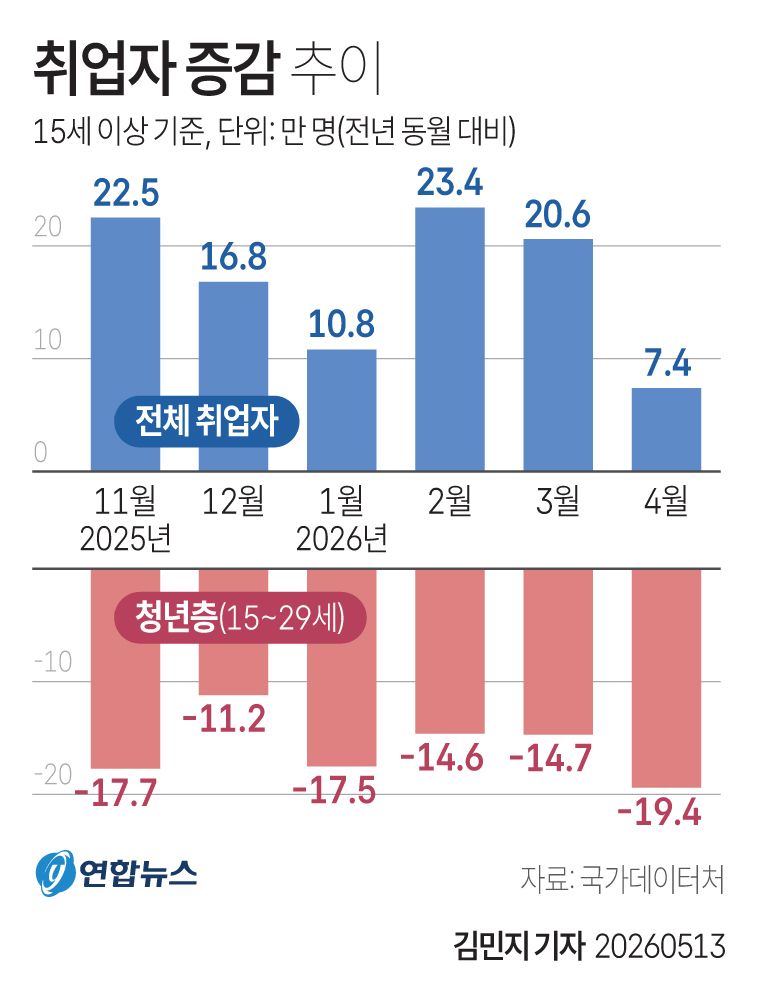
[Financial News] The Middle East conflict and the spread of Artificial Intelligence (AI) have hit the most vulnerable links first: young workers and manufacturing jobs. In April, employment among people aged 15 to 29 fell by more than 190,000 from a year earlier, and the youth employment rate declined for a 24th consecutive month. Manufacturing and construction have continued to post declines for as long as two years. Total employment in April rose by just over 70,000, the smallest increase in 16 months.
According to the April employment report released on the 13th by the Ministry of Data and Statistics, the number of employed people aged 15 and older stood at 28.961 million last month, up 74,000 from a year earlier. The increase was the smallest in 16 months since December 2024, when employment fell by 52,000. Compared with the gains of 100,000 to 300,000 seen from last year through March, the slowdown was sharp.
The employment rate for people aged 15 and older came to 63.0 percent, down 0.2 percentage point from a year earlier. It was the first decline since December 2024, when it fell by 0.3 percentage point.
By age group, the steepest declines were among young people. By industry, the biggest drops were in professional, scientific and technical services, manufacturing, and wholesale and retail.
Employment among people aged 15 to 29 fell by 194,000 from a year earlier. Their employment rate dropped 1.6 percentage points to 43.7 percent, the sharpest decline since August last year, when it also fell by 1.6 percentage points.
Bin Hyun-jun, Director-General of the Social Statistics Bureau at the Ministry of Data and Statistics, said, "This is the longest decline in youth employment since a 51-month streak of decreases from September 2005 to November 2009."
By contrast, employment rose by 189,000 among people in their 60s, by 84,000 among those in their 30s, and by 11,000 among those in their 50s.
By industry, professional, scientific and technical services saw a decline of 115,000, the largest drop since the industrial classification was revised in 2013.
Authorities said the decline reflects a base effect after more than four years of sustained growth. Some observers also see it as a sign that structural changes in the labor market, including the shift toward AI industries, are becoming visible.
Employment weakness in manufacturing and construction, both industries with high job-creation effects, is continuing. Despite export booms in some sectors such as semiconductors, manufacturing employment fell by 55,000 and construction employment by 8,000, marking 22 and 24 straight months of decline, respectively.
Although the farming season has begun, employment in agriculture, forestry and fisheries also fell by 92,000 because of demographic changes such as population aging.
The fallout from the Middle East conflict also affected the labor market. Wholesale and retail, which are closely tied to domestic demand, lost 52,000 jobs, while accommodation and food services lost 29,000. Employment in transportation and warehousing rose by 18,000, but the pace of growth slowed.
Bin said, "We believe the impact of the Middle East conflict partly contributed to the slowdown in total employment growth." He added, "Rising international oil prices and lower cargo volumes have slowed employment in transportation and warehousing, while weaker consumer sentiment has also affected accommodation, wholesale and retail, and other sectors."
On the other hand, health and social welfare services, where older workers are thought to make up a large share of employment, added 261,000 jobs. Arts, sports and leisure services also increased by 54,000, helping support the labor market.
The number of unemployed people stood at 853,000, down 2,000 from a year earlier. The unemployment rate was 2.9 percent, unchanged from last year.
The economically inactive population rose by 174,000. Among them, the number of people who said they were "resting" increased by 63,000.
[email protected] Jung Sang-gyun Reporter