"I Paid 300 Won More for Decaf, So Why Is My Heart Racing?" Will 'Decaf in Name Only' Disappear?
- Input
- 2026-05-13 10:12:02
- Updated
- 2026-05-13 10:12:02
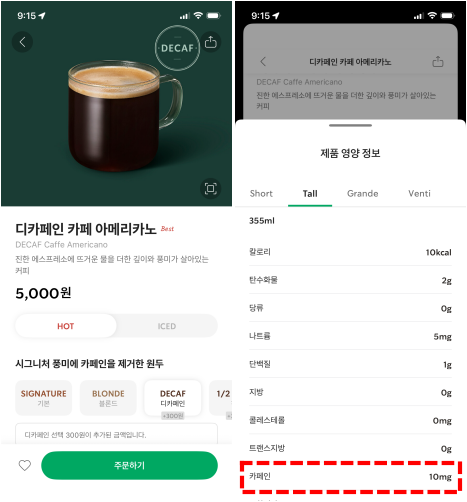
[Financial News] A customer identified as A, who is sensitive to caffeine, used to pay an extra 300 won whenever visiting Starbucks and order a decaffeinated Americano. Even so, A still experienced heart palpitations after drinking it.
After checking the tall-size decaffeinated Americano on the app, A felt strangely betrayed. It turned out the drink still contained 10 mg of caffeine.
As coffee sold as "decaffeinated" continued to contain caffeine and confuse consumers, the government has tightened the product standards. Instead of judging products by whether a certain percentage of caffeine had been removed, the labeling rule will now be based on the actual amount of caffeine remaining.
On the 12th, the Ministry of Food and Drug Safety announced a revision to the Labeling Standards of Foods, Etc. The revision, which mainly improves labeling rules for decaffeinated coffee and alcoholic products in the form of general foods, will take effect on Jan. 1, 2028, although companies may adopt it earlier on a voluntary basis.
Under current rules in South Korea, coffee may be labeled "decaffeinated" if more than 90% of the caffeine has been removed. Critics have pointed out that if the beans themselves contain a high level of caffeine, removing 90% may still leave a meaningful amount behind.
\r\n
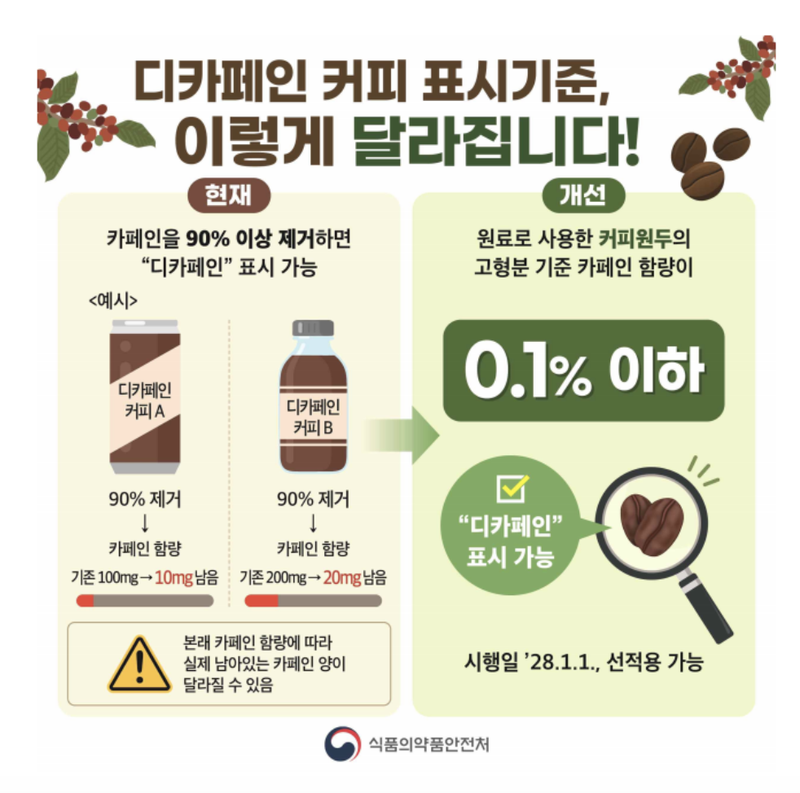
Under the revised labeling standards, coffee products will only be allowed to use the labels "decaffeinated" or "made with decaffeinated beans" when the residual caffeine content in the beans is 0.1% or less. The move aligns with standards used by the United States Department of Agriculture (USDA) and the European Union (EU).
The revision also reflects complaints from Korean consumers who said that even decaffeinated coffee still left them with palpitations or insomnia.
The Ministry of Food and Drug Safety also included stronger labeling rules for alcoholic beverages. As more alcohol products have been developed in collaboration with general food brands, consumers have become more likely to mistake them for non-alcoholic drinks. Going forward, such products must display the words "alcohol" or "alcoholic beverage" prominently on the front in type of at least 20 points.
y27k@fnnews.com Seo Yoon-kyung Reporter