KOSPI Ends Lower After Briefly Hitting 7,999
- Input
- 2026-05-12 18:34:17
- Updated
- 2026-05-12 18:34:17
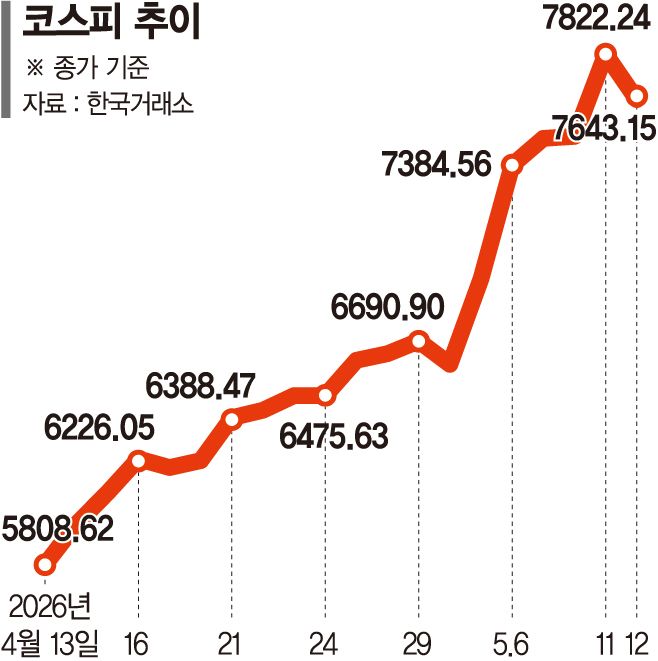
According to the Korea Exchange (KRX) on the 12th, the KOSPI Composite Index closed at 7,643.15, down 179.09 points, or 2.29%, from the previous session. It surged to as high as 7,999.67 shortly after the market opened, coming within striking distance of 8,000, but then reversed course under foreign selling pressure. During the session, it fell as low as 7,421.71, leaving a 577.96-point gap between the day’s high and low. Foreign investors and institutions led the decline with net sales of 513.96 billion won and 141.35 billion won, respectively. Retail investors posted a net buying surplus of 644.16 billion won. Foreign investors, in particular, had been on an aggressive selling streak since the 7th. Their net selling over the past four trading days reached 1.93463 trillion won. The KOSDAQ Index also closed lower, down 28.05 points, or 2.32%, at 1,179.29.
Brokerage analysts viewed the pullback as a short-term cooling-off period after the market became overheated. They said profit-taking intensified after the KOSPI Composite Index’s sharp recent rally, while portfolio rebalancing also triggered heavy selling. Fund managers typically use rebalancing to maintain target allocations, and experts said mechanical selling was likely driven by the rising weight of holdings such as Samsung Electronics and SK hynix amid the market’s steep gains. Lingering geopolitical risks in the Middle East and concerns over higher interest rates also appeared to weigh on investor sentiment. Yang Ji-hwan, head of research at Daishin Securities, said, "As talks between the United States and Iran remain stalled, and long-term bond yields in the United States and Japan have surged, risk appetite has weakened somewhat." He added, "In particular, since the KOSPI Composite Index has risen sharply this month, foreign investors appear to have become more eager to lock in profits."
Some observers argued that remarks by Kim Yong-beom, Chief Presidential Secretary for Policy at Cheong Wa Dae, about a "National Dividend" tied to artificial intelligence may have also weighed on the market. In a Facebook post on the day, Kim said excess profits generated by the AI boom should be redistributed socially. Analysts said the policy uncertainty surrounding those remarks dampened investor sentiment.
[email protected] Seo Min-ji Reporter