Public funds for youth startups are leaking away... illicit loans using foreign nationals [Vanishing Young Founders (Part 1)]
- Input
- 2026-05-12 18:33:59
- Updated
- 2026-05-12 18:33:59
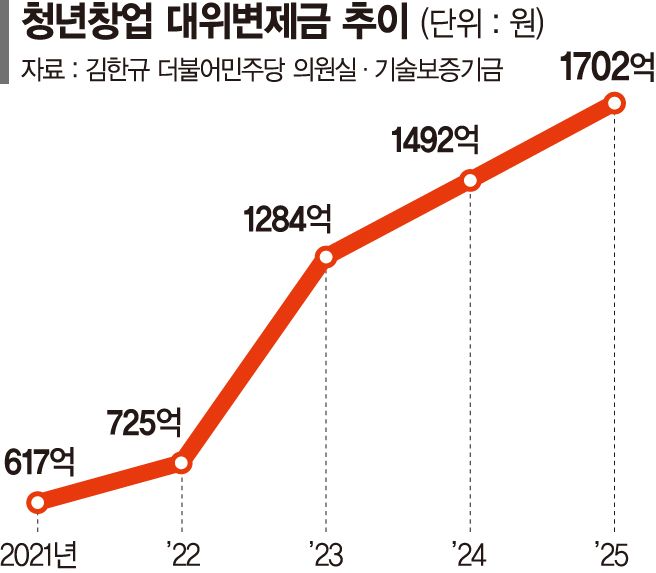
According to data submitted by the Ministry of SMEs and Startups and KIBO, at the request of Democratic Party of Korea lawmaker Kim Han-kyu of the Trade, Industry, Energy, SMEs, and Startups Committee, KIBO's subrogation payments under the Youth Startup Guarantee rose from 61.7 billion won in 2021 to 170.2 billion won last year, an increase of about 176% over four years. Over the same period, the number of guarantee defaults climbed from 680 to 1,224, up 80%, while delinquent amounts jumped more than 120% from 79.6 billion won to 175.8 billion won.
Unlike ordinary business loans, the Youth Startup Guarantee is designed to help young people who struggle to raise seed money by sharply lowering the bar for approval. Rather than focusing on collateral or immediate profitability, it allows applicants to qualify based largely on an idea. The program was formally introduced in 2011 in the form of special guarantees for youth startups, reflecting the view that young people are a future growth engine and a source of innovation.
However, organized fraud schemes are increasingly exploiting the loopholes in this inclusive screening process. A typical case involves registering only a corporate address at a nonresident shared office, then either not operating at all or staging a temporary office only when inspectors are expected, in order to pass the review. There are also cases in which straw owners, such as international students, are used to set up dozens of shell companies, with fake technical documents and financial statements prepared to secure Youth Startup Guarantee loans. Once the money is disbursed, it is quickly wired to overseas accounts, and the companies are shut down or disappear. Brokers are also believed to be involved in the process.
An industry source familiar with the matter said, "In many cases, foreign representatives from China and other countries register dozens of companies at a single shared office address, or companies under Chinese names receive startup support, guarantees and loans, and then disappear."
The authorities, however, are failing to keep up. KIBO does not separately classify suspected intentional fraud cases, such as businesses that do not exist or cannot be contacted. Instead, it simply records them under basic categories first identified on site, such as "delinquency" or "closure," and manages them that way. It also does not tally the scale of fraudulent claims. As a result, there is no structure in place to systematically track where and how much public money is leaking.
The loss of opportunity costs is also seen as serious. Critics say repeated paperwork checks and site inspections for shell companies are creating a vicious cycle in which young founders who genuinely need help are pushed down in the review rankings or denied support altogether.
The Ministry of SMEs and Startups, which oversees startup policy, is also facing criticism for weak post-management. Even when fraud is uncovered, sanctions usually amount to little more than a warning. In one case, government support funds totaling 3.25 billion won were additionally paid to 22 companies that had failed to repay recovered funds.
Professor Lee Jung-hee of the Department of Economics at Chung-Ang University stressed, "We need to strengthen cooperation and oversight between guarantee institutions and tax authorities, and identify the reality of fraudulent claims by foreigners to prevent tax money from leaking away."
The Ministry of SMEs and Startups and KIBO, however, say they are blocking guarantees for shell companies through mandatory on-site inspections and managing multiple company registrations at the same address through pre-screening filters. They also said the large size of subrogation payments reflects the impact of the economic slowdown and high interest rates.
[email protected] Kim Ye-ji Reporter