Kim Yong-beom Calls for Sharing AI Gains Through a Universal Citizen Dividend; Cheong Wa Dae Says It Was a Personal View
- Input
- 2026-05-12 18:30:40
- Updated
- 2026-05-12 18:30:40
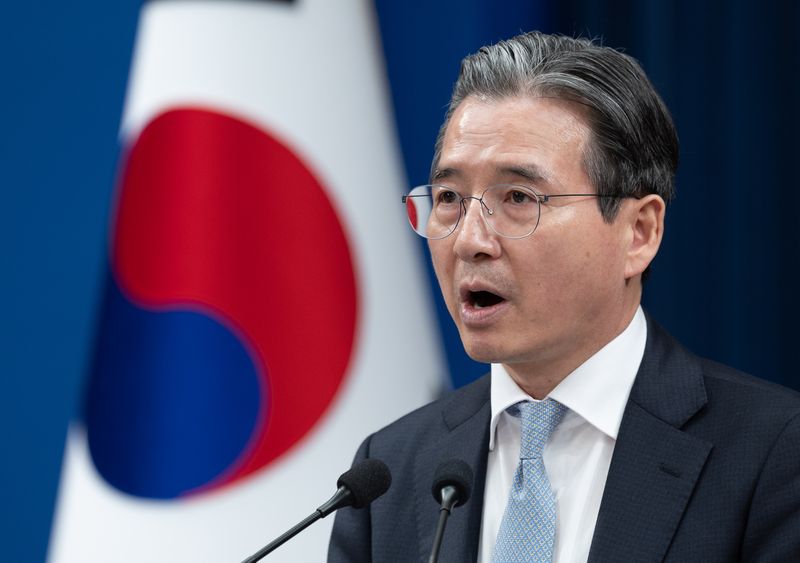
Kim Yong-beom, Cheong Wa Dae policy chief, said on the 12th that "the gains from the era of artificial intelligence (AI) infrastructure are not the result of any single company" and that "part of those gains should be structurally returned to all citizens." He also proposed a so-called "Universal Citizen Dividend" that would return part of the excess profits earned by AI infrastructure companies such as chipmakers to the public. The idea is understood as redistributing to citizens some of the excess tax revenue generated by the extraordinary profits of companies such as Samsung Electronics and SK hynix. As the issue of socially sharing corporate profits emerged, the stock market also reacted.
Foreign media cited the Universal Citizen Dividend as one of the reasons for the sharp drop in the KOSPI Composite Index on the day it approached the 8,000 level. Opinions in the ruling and opposition parties were divided over Kim's proposal. As the controversy spread, however, Cheong Wa Dae drew a line, saying that "the policy chief's social media post was a personal opinion unrelated to any internal discussion or review at Cheong Wa Dae."
Kim posted on Facebook on the 11th, saying, "If a strategic position in the AI infrastructure supply chain creates a structural boom and leads to record excess tax revenue, then how to use that money is not a matter of choice, but a design issue that should naturally be considered." It was a follow-up to a recent Facebook post in which he said, "If the semiconductor boom continues until 2027, tax revenue in 2026 and 2027 is likely to reach historic levels."
In particular, Kim stressed that "the gains of the AI infrastructure era come from an industrial base built together by the entire nation over half a century" and that "part of those gains should therefore be structurally returned to all citizens. That is the legitimacy and principle of the design."
He also cited Norway as an example to argue for introducing a Korean version of the National Dividend. Kim said, "Norway set aside oil revenues in the 1990s in a sovereign wealth fund and designed a structure in which the investment returns are returned to society as a whole in line with fiscal principles. It did not treat a resource boom as a temporary windfall, but transformed it into a long-term social asset." He added, "Korea's situation is different in nature, but the question is the same. How do we institutionalize structural excess profits in a social way? I want to give that principle the name 'Universal Citizen Dividend.'"
The proposal is intended to return part of the tax revenue generated in the AI infrastructure sector to the public. Kim expressed concern, saying that "excess profits in the AI era are, by nature, concentrated." He explained, "Those who already have access to productive assets are likely to benefit greatly through market mechanisms. By contrast, many middle-income households may only enjoy indirect effects such as improved purchasing power from a stronger won, limited fiscal transfers, and some asset gains." He added, "Even if the country becomes richer, the distribution of that wealth does not automatically spread. The key question in the AI era is not simply growth rates, but how to stabilize excess profits socially."
The ruling Democratic Party of Korea said it would review Kim's proposal in the future. Lee Joo-hee, the party's floor spokesperson, said, "We are not in a position to discuss it directly yet," but added, "If a review and a formal position statement are needed, we will speak on it."
Moon Geum-joo, a lawmaker who serves as chair of the Democratic Party National Farmers and Fishermen Committee and as chief of staff to floor leader Han Byung-do, issued a statement on the 28th of last month, saying, "The semiconductor boom is the result of sacrifices and patience accumulated by farmers and fishermen through multiple rounds of free trade agreements (FTA), which opened up markets." He urged the government to "return a certain share of the benefits to rural communities that have borne the damage." The opposition reacted strongly. Park Su-young, the People Power Party's secretary on the Finance, Economy and Planning Committee, wrote on Facebook that "the Cheong Wa Dae policy chief is going one step further from the performance bonus demands and strikes by entrenched unions at major companies such as SK hynix and Samsung Electronics, and is instead calling for a socialist-style distribution of corporate excess profits to the entire public." He also argued, "Semiconductors follow a cycle. Right now it is a super boom, but no one knows when it will end. The whole world is engaged in a race for technological supremacy. Yet if operating profits are given to unions and distributed to the entire public, where will companies get the money to invest in the future?"
Meanwhile, The Straits Times of Singapore reported on the day, citing a wire service article, that amid a labor dispute raising concerns over production disruptions in Samsung Electronics' semiconductor division, a senior South Korean government official's call to share part of AI profits with all citizens led Samsung Electronics and SK hynix to give back their gains, while the KOSPI also tumbled.
[email protected] Choi Jong-geun, Kim Yun-ho, Yoon Jae-jun Reporter