Lee Jae Myung: "Populist austerity is not the answer" ... He aims to boost domestic demand by getting money moving
- Input
- 2026-05-12 18:28:07
- Updated
- 2026-05-12 18:28:07
■ Lee: "Expansionary fiscal policy, economic growth and budget planning"
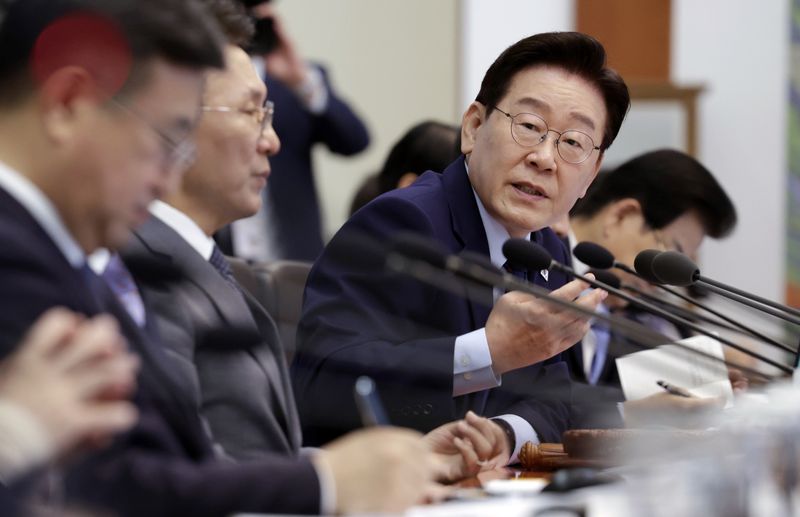
At the State Council meeting and Emergency Economic Review Meeting he chaired at Cheong Wa Dae that day, Lee said, "I am not saying we should spend recklessly at any time. When the economy is normalizing and gaining momentum, there is no reason to keep borrowing and spending. But now is the time to expand investment and build up our potential."
Lee said other analyses have consistently shown that bold, immediate fiscal spending boosts domestic demand and energizes the broader economy. He criticized voices in some parts of society that keep demanding austerity "like a broken record," despite the objective evidence. He said those arguments invoke national debt as a pretext, but are in fact irresponsible calls to stand by while people suffer.
He also said South Korea's debt structure is stronger than that of many other countries. "We are in a crisis," he said. "In times like these, saving money is important, but we also need to invest in strengthening the nation's capabilities. If we stimulate domestic demand through expansionary fiscal policy and raise Gross Domestic Product (GDP) itself, the denominator grows and the national debt ratio actually falls."
He added that if this process raises potential growth and productivity, the tax base will expand as well. That would lower the debt ratio over the long term and create a virtuous cycle that further strengthens the economy's growth engine.
He also called for greater efficiency in drafting next year's government budget.
■ Lee: "Finance is harsh by nature, but there are limits"
Regarding complaints that some private bad banks are not joining the government's debt relief program for ordinary people, leaving debtors to suffer from collection pressure, Lee instructed officials to "find a solution, even through legislation if necessary." At the meeting, he said, "I saw reports that there is a private bad bank called Sangnoksu. It seems there is an institution managing delinquent claims from the card crisis, supposedly to clean up bad debts from that period, but it is still aggressively collecting."
Lee asked, "Didn't card companies and financial institutions get paid with government tax money during the card crisis?" He then said those same claims, which caused the problem in the first place, are still being collected "relentlessly," while the companies reportedly earn tens of trillions of won in operating profit each year and receive dividends worth more than 10 billion won.
Earlier in the morning, Lee shared a media report on X (formerly Twitter) saying that debtors were struggling because private bad banks were not participating in the government's debt relief policy for ordinary people. He wrote that he had not realized "this primitive predatory finance was still openly surviving and tightening its grip on ordinary people."
After Lee raised the issue at the meeting, Lee Eok-won, chairperson of the Financial Services Commission, reported that the government would review ways to seek consent by separately contacting shareholders. Lee then criticized the financial sector, saying, "Finance is harsh by nature. Its essence is money-making, but there are still limits."
He went on to say, "How many years has it been since the card crisis? As I said earlier, didn't card companies and other firms all receive government support? Yet people who fell behind on payments back then are now seeing their interest snowball over more than 20 years, turning tens of millions of won into hundreds of millions." He asked, "How are those people supposed to live? Does that fit the public's moral sense?"
At the meeting, Deputy Prime Minister for Economic Affairs and Minister of Finance and Economy Koo Yun-cheol reported plans to expand the diesel fuel price-linked subsidy cap and offer discounts on processed foods. The government decided to raise the fuel price ceiling for the diesel subsidy from 1,961 won to 2,100 won. As a result, support will be provided for up to 280 won per liter, or 70% of the increase above 1,700 won.
For hoarding and speculative stockpiling, the government plans to use all currently available measures, including seizure or confiscation, to ensure effective penalties. Koo said the government has begun revising the Price Stabilization Act, including the introduction of whistleblower rewards and penalties for unjust enrichment.
For processed foods, discounts will be offered in May on more than 4,300 items from 16 companies. Koo said, "I understand that people are especially worried because chicken and pork prices are high." He added, "To stabilize prices, we will do our best through discount support and tariff-rate quotas."
[email protected] Choi Jong-geun, Seong Seok-woo, Seo Young-joon Reporter