[Editorial] With Q1 Growth Topping the List, South Korea Must Prepare for a Semiconductor Downturn
- Input
- 2026-05-12 18:11:09
- Updated
- 2026-05-12 18:11:09
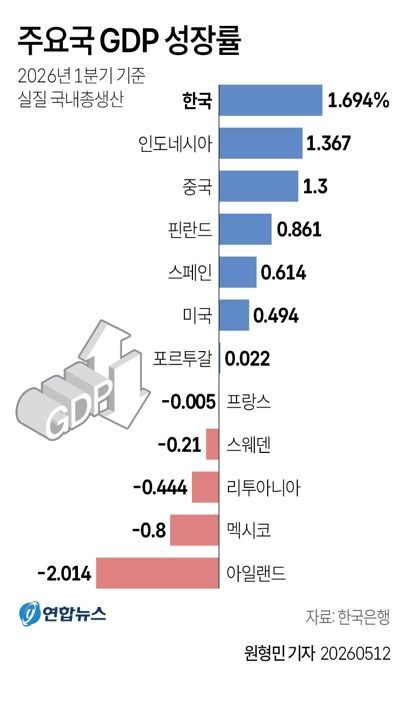
This is a sharp turnaround for South Korea, which ranked 38th among 41 major economies in the fourth quarter of last year with growth of -0.161%. Without semiconductors as a growth engine, the South Korean economy would have struggled amid the turmoil in the Middle East. Higher global oil prices are weighing on economies everywhere. That is evident from the stagnation and negative growth seen in several countries in the United States and Europe.
An economy that relies on a single industry such as semiconductors carries significant risk. It is like putting all your eggs in one basket. Of course, having a growth engine like semiconductors is a tremendous advantage, and related industries should continue to be developed. But like other sectors, semiconductors are highly sensitive to the business cycle and move in cycles. The current supercycle will not last forever.
Particularly noteworthy is the Korea Institute for International Economic Policy (KIEP)'s warning that the GDP contribution of artificial intelligence-related investment is expected to peak in 2025 and then gradually slow from 2026, meaning South Korea must prepare for what comes after AI and semiconductors. In other words, the semiconductor cycle could turn downward at some point, and that downturn could begin now.
The same applies to the stock market rally driven by semiconductors. The fact that the KOSPI briefly approached the 8,000 level before turning lower that day reflects that market outlook. The institute projected global growth this year at 3.0%, down 0.4 percentage points from last year. It said high oil prices and tariff uncertainty stemming from the United States could dampen trade and investment sentiment.
South Korea's economy cannot avoid being affected by the broader global cycle. Several institutions expect inflation to continue rising through next year. Aside from semiconductors, there is little in the domestic or external environment that looks favorable.
Even now, only the semiconductor sector is booming, while ordinary households are feeling a chill. The public does not feel the impact of being No. 1 in growth. Semiconductor-led growth may gradually spread to the wider economy, but no one knows how long that will take, and it is hard to say whether the trickle-down effect will materialize at all.
We should prepare for the possibility that the impressive figures we are hearing about, such as first-place quarterly growth, record quarterly exports, and new highs in the stock index, may turn out to be little more than temporary spikes. This is not the time to be complacent and waste resources. In a downturn, a frugal mindset is needed, one that saves even a drop of oil and turns off even a single light.
Although inflation is still lower than in advanced economies, that is largely due to the government's forced adjustment of fuel prices. Prolonged artificial price controls can distort the market and create even greater side effects. The Middle East crisis does not appear likely to be resolved anytime soon. If so, fuel prices should be brought closer to market levels to normalize pricing.
It is true that semiconductors are driving the economy, but the Samsung Electronics labor union's demand for performance-based bonuses is clearly excessive. Many leading global tech companies have no unions at all, and even where unions exist, demands like those seen here are rare.