K-food Stocks Left Behind in the Bull Market... "Exports Are at Record Highs, and Fundamentals Are Expected to Improve"
- Input
- 2026-05-13 06:00:00
- Updated
- 2026-05-13 06:00:00
[The Financial News] The KOSPI Composite Index has been showing strong momentum, even surpassing the 7,000 level and eyeing 8,000. But food company stocks have been somewhat sluggish. Brokerage analysts say the sector could enter an upward phase, pointing to export results that are posting record-breaking gains.
According to the Korea Exchange (KRX) on the 13th, the KOSPI food and tobacco sector had risen 11.75% this year, far below the KOSPI Composite Index's 81.37% gain over the same period. The KOSDAQ food and tobacco sector fell 1.66% this year, also trailing the KOSDAQ's 27.43% rise.
The HANARO Fn K-Food ETF, which tracks food stocks, has risen only 4.08% this year. Over the past three months, it has fallen 5.03%. The ETF includes Orion Corporation, CJ CheilJedang, Samyang Foods, Nongshim, Ottogi Corporation, Lotte Chilsung, and Daesang Corporation.
The weakness is being attributed to capital flowing mainly into semiconductors and power equipment amid the recent expansion of the artificial intelligence (AI) industry. Shim Eun-joo, a researcher at Hana Securities, said, "Capital is concentrating in large-cap semiconductor stocks, and the share-price performance of other sectors is relatively weak." She added, "Domestic-demand companies are being left out of investment because they are not benefiting from the direct spillover effects of expanded AI investment."
Weaker domestic demand caused by the Middle East situation has also played a role. According to the Bank of Korea (BOK), the Composite Consumer Sentiment Index (CCSI) stood at 99.2 last month, down 7.8 points from the previous month. That marked the sharpest decline since the martial law turmoil in December 2024.
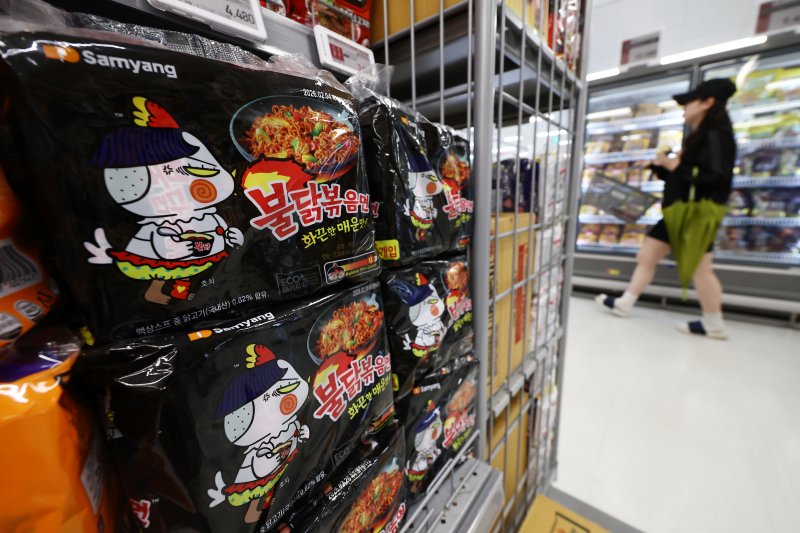
Overseas performance, however, is at a record high. Last month's ramen exports reached $180 million, up 35% from a year earlier and 11% from the previous month, marking the highest monthly figure on record. In the first quarter of this year, agricultural, fishery, and food exports totaled $3.11 billion, up 7.4% from the same period last year.
Brokerage analysts say export-driven stock gains are possible. Kwon Woo-jung, a researcher at Kyobo Securities, said, "Ramen export data has hit an all-time high and continues to show solid growth." She explained, "The industry has moved away from its previous China-centered structure. The United States has emerged as a stable growth engine, and more recently the sector has entered a structural growth phase that is spreading across Europe, led by the United Kingdom."
She added, "The consumer goods sector is currently being overlooked in the market because capital is concentrated in semiconductors, and most stocks remain below last year's highs. However, we believe the underlying fundamentals have improved from a year ago."
Some also say investors should focus on companies expanding shareholder returns, including dividends. Shim said, "Domestic-demand companies have strong operating cash flow, and they are actively using it for shareholder returns, which provides strong downside support for their stock prices." She added, "In the current environment, concentrated investment in companies with strong earnings growth this year and room to expand dividends appears effective. Overall, large-cap stocks with a high export share are likely to post stronger earnings growth and have ample room for dividends."
[email protected] Lim Sang-hyuk Reporter