Kim Yong-beom: "Let’s distribute AI windfall gains to the public... return part of the profits to all citizens"
- Input
- 2026-05-12 15:20:36
- Updated
- 2026-05-12 15:20:36
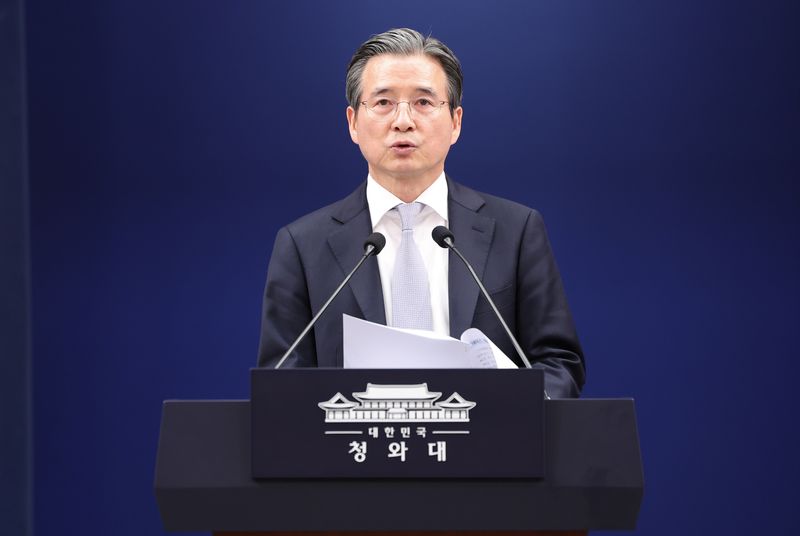
[The Financial News] On the 12th, Kim Yong-beom, Chief Presidential Secretary for Policy at The Blue House, said that "the gains from the era of AI infrastructure are not the result of any one company alone" and added that "part of those gains should be structurally returned to all citizens." He also proposed a tentative 'National Dividend Scheme,' under which some of the excess tax revenue generated by windfall profits at AI infrastructure companies such as semiconductor makers would be returned to the public. The idea can be understood as redistributing excess tax revenue generated by windfall profits at AI infrastructure companies such as Samsung Electronics and SK hynix to the public.
Kim posted on Facebook on the 11th and said, "If a strategic position in the AI infrastructure supply chain creates a structural boom, and that leads to record-high excess tax revenue, then how to use that money is not a matter of choice but a design issue that we should naturally consider."
In particular, Kim stressed that "the gains from the AI infrastructure era come from an industrial base that all citizens have built together over half a century," adding, "If that is the case, part of those gains should be structurally returned to all citizens. That is the legitimacy and principle of the design."
He argued that "Korea has already seen a similar scene. During the semiconductor boom in 2021 and 2022, excess tax revenue was spent on an ad hoc basis without any predesigned principles. This cycle could be far larger than that one," and warned that "letting it flow away in the same way as before could mean wasting a once-in-a-lifetime historical opportunity."
Citing Norway as an example, he argued for the need to introduce a national dividend system in Korea. Kim said, "Norway set aside oil revenues in the 1990s in a sovereign wealth fund (SWF) and designed a structure in which investment returns are returned to society as a whole according to fiscal principles. It did not treat a resource boom as a temporary windfall, but transformed it into a long-term social asset." He added, "Korea's situation is different in nature, but the question is the same. How do we institutionalize structural excess profits for society? I want to give that principle the name of a tentative National Dividend Scheme."
The proposal is aimed at returning part of the tax revenue generated in the AI infrastructure industry to the public. Kim expressed concern, saying that "windfall profits in the AI era are, by nature, concentrated." He explained, "Those who already have access to productive assets are likely to benefit greatly through market mechanisms. By contrast, many in the middle class may only enjoy indirect effects such as improved purchasing power from a stronger won, limited fiscal transfers, and some asset gains. A country may become richer, but the distribution of that wealth does not automatically spread. The key question in the AI era is not simply the growth rate, but how to socially stabilize excess profits."
Kim said, "If there is no excess tax revenue, then a national dividend is a fantasy. But if the argument is valid, then letting the gains from those windfall profits flow away without any principle could be the more irresponsible choice." He continued, "Korea now stands before a rare historical possibility. It could become not just a country that supplies AI infrastructure, but the first nation to return the excess profits of the AI era to human lives." He added, "That possibility will not be realized automatically. The choices made from now on could either send Korea back to an ordinary cyclical export economy or push it into a completely new type of industrial nation."
The ruling Democratic Party of Korea (DPK) said it would review Kim's proposal in the future. Lee Joo-hee, the DPK's floor spokesperson, told reporters after a floor strategy meeting that "we are not in a position to discuss it directly yet," but added, "We will review it, and if a statement is needed, we will make one." In fact, public calls have already emerged within the DPK for semiconductor boom profits to be returned to society.
Moon Geum-joo, a DPK lawmaker who chairs the National Farmers and Fishermen Committee and serves as chief of staff to floor leader Han Byung-do, issued a statement on the 28th of last month, saying that "the semiconductor boom is the result of sacrifices and patience accumulated through multiple free trade agreement (FTA) negotiations, during which farmers and fishermen had to accept market opening." He urged the government to "return a certain share of the benefits to rural communities that have borne the damage."
The opposition pushed back. Park Su-young, the People Power Party's secretary on the National Assembly Planning and Finance Committee, criticized the National Dividend Scheme, saying that "The Blue House is trying to move toward socialism." On Facebook, Park said, "Going one step further from the performance bonus demands and strikes by vested-interest unions at major companies such as SK hynix and Samsung Electronics, the Blue House policy chief is now arguing for a 'corporate profit distribution system' that would simply hand out corporate windfall profits to all citizens in a socialist manner." He also said, "Semiconductors have cycles. Right now it is a super boom, but no one knows when it will end. The world is engaged in a race for overwhelming technological superiority. But if operating profits are given to unions and distributed to all citizens, what money will companies have left to invest in the future?"
[email protected] Choi Jong-geun, Kim Yun-ho Reporter