"Samsung Electronics Drops 5%? Group Chat Goes Wild"... Even as the KOSPI Swings, Where Did These 'Cautious Retail Investors' Go? [World of Retail Investors]
- Input
- 2026-05-13 06:00:00
- Updated
- 2026-05-13 06:00:00
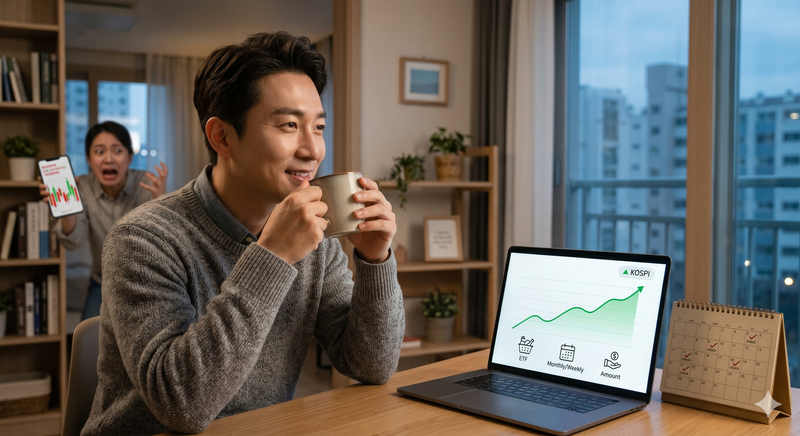
[The Financial News] Ahn Jae-young, 34, was surprised when he checked his group chat during lunch. He had turned off notifications because he felt overwhelmed by friends who had recently become obsessed with stocks and kept talking about them nonstop. Instead, the chat was full of groans. The mood was very different from just the day before, when everyone had been boasting that "it is only a matter of time before the KOSPI reaches 10,000." Ahn scrolled back up to see why everyone was so down.
Just like yesterday's euphoria, today's despair was also about stocks.The KOSPI Composite Index had climbed to an intraday high of 7,999.67 shortly after the market opened, then plunged 5%.As a result, stocks such as "Samsung Electronics and SK hynix," which his friends had bought, fell across the board. Messages flew back and forth in confusion: "Why is it dropping when it's so close to 8,000?" "Foreigners sold again," and "Should we buy more and think of it as a sale?"
"I can't handle individual stocks because I'm too nervous"... The choice of cautious retail investors
Ahn said nothing and closed the chat. The discussion had little to do with him. He calls himself a "cautious retail investor" and has been buying only exchange-traded funds (ETFs) through automatic monthly investments ever since he first started investing a year ago.His Individual Savings Account (ISA) is set to automatically withdraw 500,000 won on the 25th of every month to buy the TIGER US S&P 500 ETFautomatically.
"I started investing because savings account interest rates were so low, but I did not want the stress of watching prices rise and fall. I also felt it was a waste of time to keep staring at the stock screen," Ahn explained.
Whether the KOSPI rises or falls, whether Samsung Electronics hits a record high or foreign investors dump 3 trillion won worth of shares, Ahn simply keeps buying his ETFs, which he started instead of a savings plan. His friends complain that he is letting this bull market pass him by, but Ahn says this is exactly the level of comfort he wants.
The method Ahn chose is the so-calledDollar-Cost Averaging (DCA) strategy,a regular installment approach that automatically buys a fixed amount each month. If prices rise, you buy less; if they fall, you buy more. The advantage is that you can keep investing steadily without worrying about analyzing individual stocks or timing your purchases.
It is only natural that Ahn, who puts "psychological comfort" first, chose the S&P 500. Historically, the S&P 500 has delivered average annual returns of 10% to 11%. Looking at data from 1970 to 2020, there was not a single case of negative returns for investors who held it for more than 15 years.
Even in volatile markets, the mind stays calm... The value of psychological cost
Today's market also revealed a paradox of concentration. According to Han Ji-young, a researcher at KIWOOM Securities Co., Ltd., only two of the KOSPI's 26 sectors had outperformed the index as of the 11th of this month: semiconductors and autos. It was the first time in history that only two sectors had beaten the monthly performance of the KOSPI.That means that even when the index rises, most stocks are left behind. And on days like today, when those two sectors weaken, the entire index shakes.
Of course, Ahn was not completely without regrets. While Samsung Electronics and SK hynix had risen more than 100% from the start of the year, the return on his S&P 500 ETF was lower. There were moments when he thought, "I should have just bought SK hynix." But Ahn knows that if he had done that, he would have been stressed by constantly worrying about the market, just like he was on the morning of the 11th, when the atmosphere was chaotic.
In the world of investing, the concept of"psychological cost"also applies.It refers to the cost paid through uncertainty, stress, time consumption, and regret in addition to financial gains and losses. In other words, the time and emotional energy spent anxiously checking an account every day are also part of the cost of investing, even if they do not appear in returns.Ahn's S&P 500 ETF may lag behind Samsung Electronics and SK hynix in this year's return race. But its psychological cost is far lower. This month, too, Ahn plans to keep investing in the S&P 500 as steadily as if he were making a savings deposit.
I do not want to become one of those people who keep saying, "I should have bought, I should have sold, I should have held..." Stocks, real estate, and money management all seem to be working out for everyone else but me. No matter how much I study, investing is still hard. For readers who want to share in this empathy,[World of Retail Investors]please subscribe to the reporter page.We also welcome tips from retail investors who have investment stories they would like to share.
[email protected] Kim Hee-sun Reporter