Warning Signs of a Sharp Rally... Half of Daily Deposits in 'Short-Term Trading'
- Input
- 2026-05-11 18:33:27
- Updated
- 2026-05-11 18:33:27
According to the Korea Exchange (KRX) on the 11th, the KOSPI Composite Index closed at 7,822.24, up 324.24 points, or 4.32%, from the previous session, setting a new all-time high. It also touched an intraday record of 7,899.32 earlier in the day.
The semiconductor heavyweights, Samsung Electronics and SK hynix, led the index higher. Samsung Electronics rose 6.33% and SK hynix gained 11.51% on the day. As the KOSPI Composite Index surged, the total market capitalization of the domestic stock market topped 7,000 trillion won for the first time. Based on closing prices, the KOSPI Composite Index's market cap stood at 6,410.8802 trillion won, while KOSDAQ's market cap reached 673.6115 trillion won, bringing the combined total to 7,084.4917 trillion won.
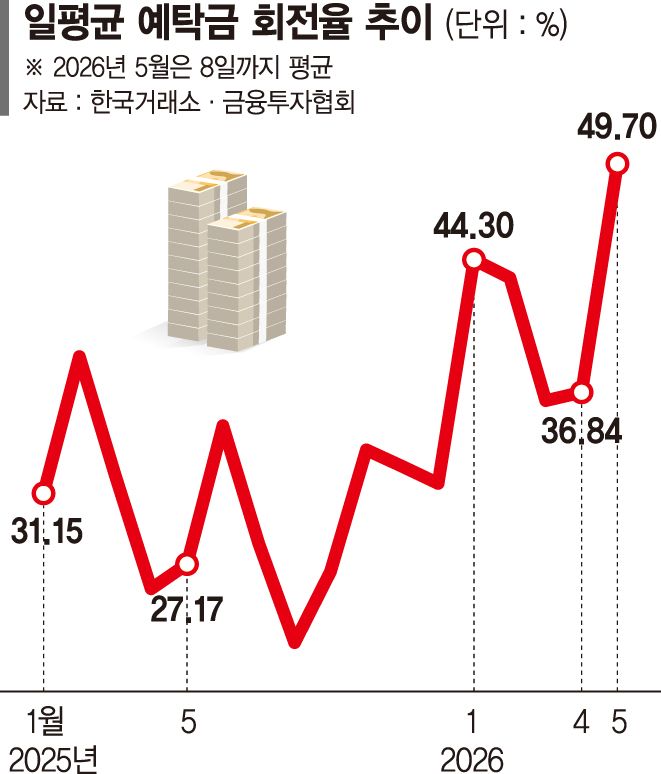
As the KOSPI Composite Index continued its steep climb, concerns about overheating have also emerged. In fact, the customer deposit turnover ratio, a gauge used to assess whether the market is overheating, has been rising rapidly.
So far this month through the 8th, the average daily customer deposit turnover ratio stood at 49.70%, sharply higher than 36.84% in the previous month. On the 6th, it even reached 59.70%, coming close to 60%. The ratio shows the share of customer deposits held in brokerage accounts for stock purchases, or cash left unwithdrawn after selling stocks, that is actually used for trading.
As a rule of thumb, a customer deposit turnover ratio above 40% is seen as entering the overheated zone, while a reading above 50% is considered firmly in overheated territory.
Signs of excessive short-term trading were also pronounced. The average daily market capitalization turnover ratio for the KOSPI Composite Index has jumped to 0.80% this month through today, up from 0.59% in the previous month. That is also well above last year's daily average of 0.48%. The market capitalization turnover ratio is the ratio of trading value to market capitalization, and a higher figure indicates more frequent turnover among investors.
Another burden is the sharp rise in the KOSPI 200 Volatility Index, Korea's fear gauge. The KOSPI 200 Volatility Index closed at 65.60 on the day, the highest level since March, when markets swung sharply amid the Middle East war. The index measures expected market volatility reflected in option prices and usually rises when the KOSPI Composite Index falls sharply. When it rises during a bull market, it is interpreted as a sign that investor anxiety is growing amid short-term overheating.
Brokerage analysts expect the record-setting trend to continue on the back of earnings momentum, but they also warn that the pace of the rally is so steep that concerns about a near-term top are mounting.
Lee Sang-yeon, a researcher at Shinyoung Securities Co., Ltd., said, "We should leave room for the possibility that short-term profit-taking will expand depending on the U.S.-China summit and uncertainties related to the United States–Iran war." He added, "The market's concentration in a small number of artificial intelligence (AI) and semiconductor leaders can be seen as a factor adding to short-term overheating concerns."
Lee Kyung-min, a researcher at Daishin Securities, also advised, "In the short term, investors need to prepare for a rotation-driven market after the repeated early-month semiconductor rallies and concentration seen each month." He added, "Foreign investors sold heavily in both the cash and futures markets earlier this month, so short-term volatility should be watched closely."
[email protected] Seo Min-ji Reporter