Single-income four-person households qualify if monthly health insurance contributions are 320,000 won or less; dual-income households if they are 390,000 won or less
- Input
- 2026-05-11 18:32:24
- Updated
- 2026-05-11 18:32:24
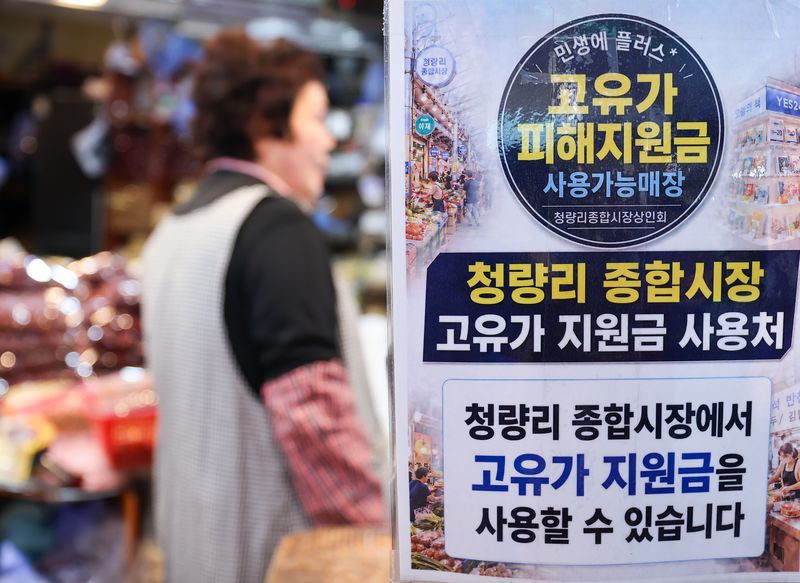
The Ministry of the Interior and Safety (MOIS) held a joint briefing with related ministries at Government Complex Seoul on the 11th and released the detailed criteria for the Financial Assistance for Damages Caused by High Fuel Prices, which will be paid to 70% of the population, or about 36 million people.
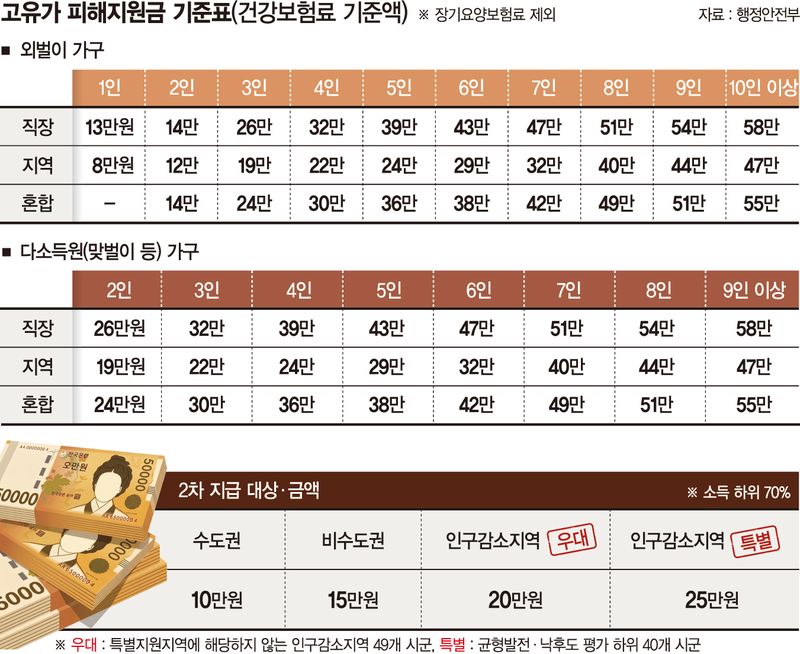
Eligibility will be determined by the total household amount of the health insurance contributions charged in March this year. Long-Term Care Insurance Contribution is excluded. For single-income salaried households, one-person households qualify if monthly health insurance contributions are 130,000 won or less, two-person households if they are 140,000 won or less, three-person households if they are 260,000 won or less, four-person households if they are 320,000 won or less, five-person households if they are 390,000 won or less, and six-person households if they are 430,000 won or less. Converted into annual income, that is about 43.4 million won for a one-person household and 106.82 million won for a four-person household.
Households with multiple income sources, such as dual-income families, will be assessed using the general standard plus one additional household member. For local insured households, one-person households qualify if monthly health insurance contributions are 80,000 won or less, two-person households if they are 120,000 won or less, and four-person households if they are 220,000 won or less. For local insured households with multiple income sources, two-person households qualify if they are 190,000 won or less, three-person households if they are 220,000 won or less, and four-person households if they are 240,000 won or less.
Household composition will be determined based on the Resident Registration Record as of March 30, 2026. Even if they live at different addresses, a spouse and children who are Health insurance dependent are counted as part of the same household. Parents or siblings living at different addresses are counted as separate households. Dual-income couples living at different addresses are, in principle, treated as separate households, but if applying the combined health insurance contributions of the couple is more favorable, they will be recognized as the same household.
High-asset households are excluded. Even if they meet the health insurance contribution standard, an entire household will be ineligible if the combined 2025 property tax base of household members exceeds 1.2 billion won or if 2024 financial income exceeds 20 million won. Song Kyung-joo, Director-General for Local Finance and Economy at MOIS, explained that a property tax base of 1.2 billion won corresponds to an asset level of 2.6 billion won or more for a single-home owner based on the Officially Announced Property Price. The exclusion applies to 937,000 households, or about 2.5 million people.
Applications can be submitted from the 18th to July 3 through credit card company apps and websites, bank branches, Local Love Gift Certificate apps, and Eup, Myeon, Dong Administrative Welfare Centers. The assistance must be used by August 31, and any unused balance after that date will expire.
[email protected] Lee Bo-mi Reporter