The Exit from Oil Price Caps Moves Further Away as International Oil Prices Jump 3.4% on Failed Truce Talks
- Input
- 2026-05-11 18:31:56
- Updated
- 2026-05-11 18:31:56
At 11 a.m. Korea time on the 11th, Brent Crude Oil futures for July delivery on the Intercontinental Exchange (ICE) in London were up 3.38% from the previous session at $104.71 per barrel. West Texas Intermediate crude oil (WTI) futures for June delivery on the New York Mercantile Exchange (NYMEX) also rose 3.86% to $99.10 per barrel. Brent Crude Oil and WTI have remained volatile, after both closed up on the 8th as well, by 1.23% and 0.64%, respectively.
The latest rise is seen as reflecting renewed doubts over expectations for a ceasefire agreement between the U.S. and Iran. On the 10th local time, Trump wrote on Truth Social that "Iran's response is completely unacceptable," effectively rejecting the ceasefire proposal.
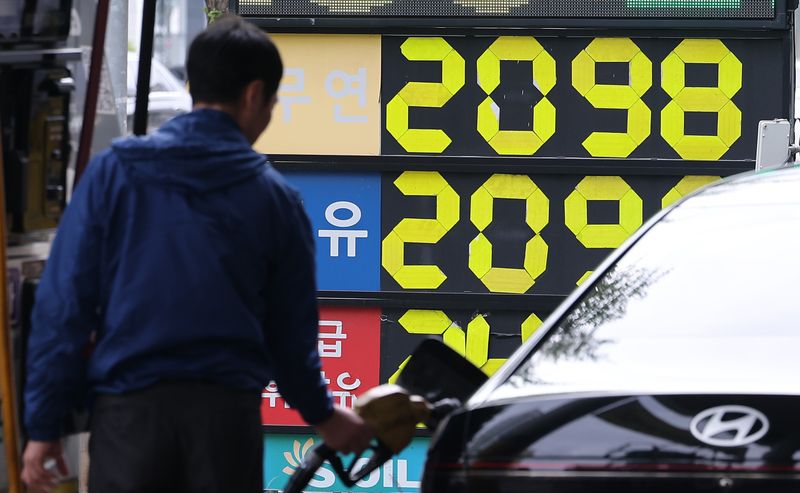
As international oil prices rise again, uncertainty is also growing around the government's exit strategy for the oil price cap. Earlier, Minister of Trade, Industry and Energy Kim Jung-kwan said, "If the war ends or international oil prices stabilize, we will end the price cap as quickly as possible."
However, critics say the government's own benchmark for "price stability" remains vague. In practice, volatility and the persistence of supply disruptions are seen as more important factors than the overall level of international oil prices. According to the Financial Times (FT), global crude inventories fell by about 200 million barrels last month. On a daily basis, that amounts to a drop of 6.6 million barrels, far above the usual fluctuation range of several hundred thousand to 1 million barrels. Goldman Sachs said current global crude inventories are approaching their lowest level in eight years.
This situation is expected to make it difficult to end the price cap easily. If the cap is lifted, the currently suppressed price increases could be reflected all at once, causing a heavier burden on consumers. On the other hand, concerns are also mounting over the side effects of prolonging the policy. The refining industry says losses from the price cap have reached about 3 trillion won, and there are also concerns that the government's fiscal burden could grow.
Experts say the price cap can help stabilize inflation in the short term, but if it lasts too long, it could distort the market. Lee Hong, associate research fellow at the Korea Institute for Industrial Economics & Trade (KIET), said, "If the supply shock continues in the medium to long term, pressure to exit the market could increase for small gas stations and marginal stations outside the capital region," adding, "When the system ends, suppressed price adjustments could resume all at once, potentially leading to a larger rebound."
[email protected] Park Ji-young Reporter