Semiconductor and Stock Markets Enjoy Record Boom... Koo Yun-cheol Says Growth Will Exceed 2% This Year
- Input
- 2026-05-11 16:00:23
- Updated
- 2026-05-11 16:00:23
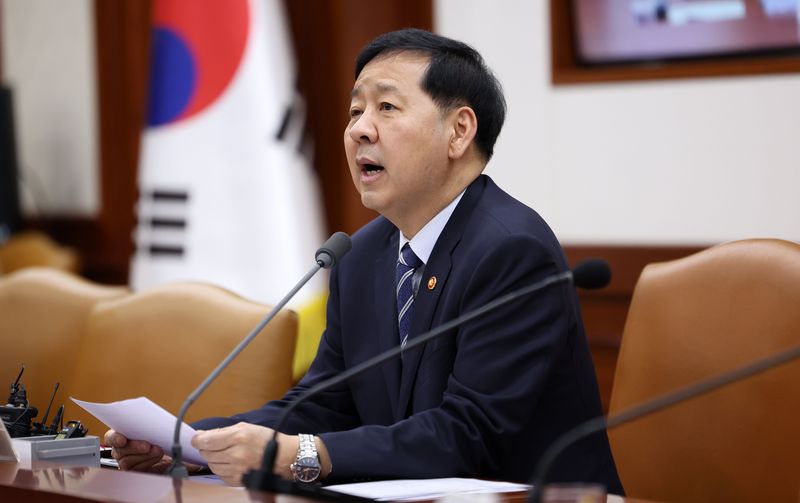
[Financial News] Deputy Prime Minister and Minister of Economy and Finance Koo Yun-cheol said on the 11th that "the country's economic growth rate this year will exceed 2%." The government has set its growth target for this year at 2.0%. With first-quarter Gross Domestic Product (GDP) growth coming in at 1.7%, the annual growth rate is being interpreted as potentially rising into the mid-2% range. Inflation has also held up relatively well in the upper 2% range. Koo reaffirmed that the Petroleum Product Price Ceiling System, which has helped suppress upward pressure on prices, will remain in place until the Arab-Israeli conflict ends.
At the press briefing on the 11th at Government Complex Sejong, Koo said, "We need to look at factors such as the strength of the semiconductor boom and the impact of the Arab-Israeli conflict, but this year's economic growth rate will exceed 2%."
Koo added, "Detailed forecasts, including how much it will exceed that level, will be released in June as part of the second-half economic growth strategy."
He cited record-breaking exports driven by the semiconductor boom and a strong stock market as the main reasons for his upbeat outlook.
Koo said, "Exports have risen from No. 7 to No. 5 in the world, surpassing Japan and Italy," and added, "The current account posted its largest surplus ever during the February-March period."
Pointing to the first-quarter current account surplus of $73.3 billion, which far exceeded the previous record of $39.2 billion, Koo said, "This shows our growth potential."
The KOSPI Composite Index is also setting new records almost daily. On the day, it jumped more than 4% and closed above 7,800 for the first time ever.
Koo said, "In terms of market capitalization, we have overtaken Germany, France and the United Kingdom since the new administration took office," adding, "We have moved up from 13th to 7th in the world, and market cap that was about 2,270 trillion won when we were 13th has now exceeded 6,100 trillion won."
The won–dollar exchange rate has also been relatively stable. It rose to as high as 1,530 won at the end of March, but is now fluctuating around the 1,470 won level.
Inflation is also under control in the mid-2% range.
Koo said, "In a high-price environment where international oil prices were around $100, we responded quickly with measures such as the price ceiling system and fuel tax cuts, and as a result inflation rose 2.6%." He added, "As of March, this is well managed compared with major economies, with the United States at 3.3%, the European Union (EU) at 2.8% and the United Kingdom at 3.4%."
He went on to say, "The Petroleum Product Price Ceiling System had the effect of lowering April inflation by 1.2 percentage points," and emphasized, "Although inflation is rising at a slower pace than in major countries, it is still increasing, so we will not be complacent and will manage it actively."
[email protected] Jung Sang-gyun Reporter