Top-performing Grade 6 civil servants to be fast-tracked to Grade 5; Grade 6 and 7 officials to be trained as specialists
- Input
- 2026-05-11 14:06:28
- Updated
- 2026-05-11 14:06:28
[Financial News] A path will open for outstanding Grade 6 civil servants to be promoted quickly to Grade 5 administrative officer. The government is introducing a fast track to move capable frontline officials into managerial-level Grade 5 posts more quickly.
In fields that require expertise, such as international trade, labor inspection and artificial intelligence (AI), Grade 6 and 7 frontline officials will also be able to enter a specialist track and work in one area for an extended period without rotational assignments. The government aims to shift the civil service personnel system away from one based on seniority and rank toward one centered on performance and expertise.
The Ministry of Personnel Management said on the 11th that it will announce draft revisions to the Enforcement Decree on the Appointment of Civil Servants, the Regulations on the Operation of Open Positions and Competitive Positions, and the Professional Civil Servants Personnel Regulations.
The revisions are a follow-up to the public-sector capability enhancement measures announced by Cheong Wa Dae on April 29. At the time, Kang Hoon-sik, Chief of Staff to the President of the Republic of Korea, explained the results of the Task Force for Enhancing Vitality in the Public Service Sector and outlined plans to introduce a Grade 5 promotion fast track and cultivate specialist civil servants. Senior Secretary for Personnel Affairs Cho Seong-ju said, "The purpose of the system is to have people from three tracks — the existing Grade 5 open recruitment route, fast-track promotees, and Grade 5 hires with private-sector experience — compete within government ministries."
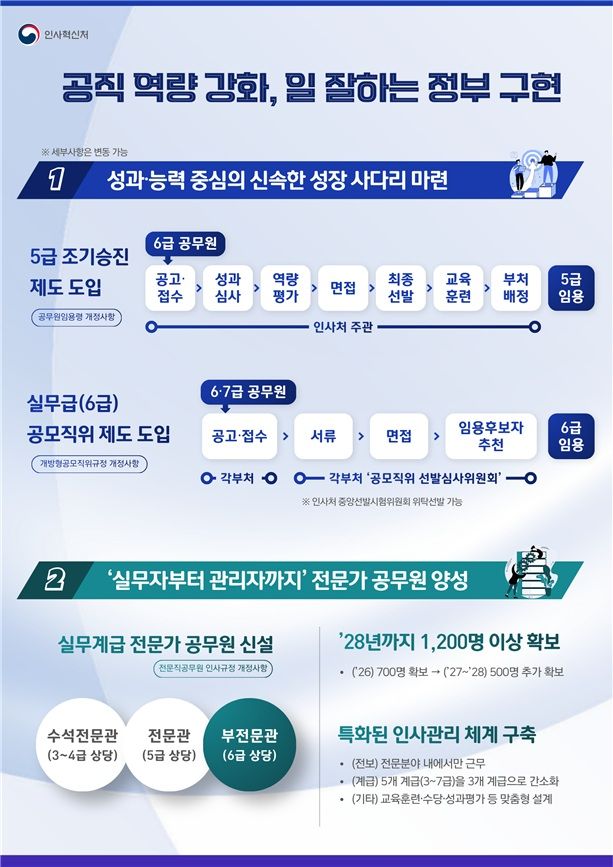
First, the government will introduce an early promotion system for Grade 5 starting this year. Grade 6 civil servants with strong work performance will be able to receive special promotion to Grade 5 after passing performance reviews, competency evaluations and interviews. The Ministry of Personnel Management will oversee the system, while each ministry will recommend outstanding Grade 6 officials for review and selection.
Until now, the usual path for a Grade 6 civil servant was to serve for a set period and then move up to Grade 5 through a promotion review. Going forward, officials with clear performance and competence will be able to enter managerial roles sooner, even if they have fewer years of service.
The Ministry of Personnel Management will oversee the program. Each ministry will recommend outstanding Grade 6 civil servants, and the ministry will select candidates after reviewing their performance and capabilities. The government said this will help reduce morale problems among frontline officials caused by promotion bottlenecks and widen the path for capable civil servants to grow into managerial positions.
The scope of competitive positions, which are filled through internal competition in the civil service, will also be expanded. At present, such positions have mainly been operated for civil servants at Grade 5 and above. Going forward, the government will extend them to Grade 6 frontline officials, and newly designated frontline competitive positions will also be open to Grade 7 civil servants.
The specialist civil servant system will also be expanded. The professional civil servant program allows officials to work for long periods without rotational assignments in fields that require high expertise and field experience, such as international trade, labor inspection, financial supervision and weather forecasting. While ordinary civil service personnel are rotated across departments to build experience, the specialist system is designed to let officials remain in one field and accumulate expertise.
The specialist civil servant system is currently operating across 12 fields in 11 ministries and agencies, including international trade at the Ministry of Trade and Industry, disaster management and legal affairs at the Ministry of the Interior and Safety (MOIS), North Korea information analysis at the Ministry of Unification (MOU), labor dispute prevention and mediation at the Ministry of Employment and Labor (MOEL), financial industry supervision at the Financial Services Commission (FSC), environmental health and air quality at the Ministry of Climate, Energy and Environment, talent recruitment at the Ministry of Personnel Management, food safety at the Ministry of Food and Drug Safety, weather forecasting at the Korea Meteorological Administration (KMA), defense acquisition management at the Defense Acquisition Program Administration (DAPA), and fisheries management at the Ministry of Oceans and Fisheries (MOF). So far, the system has mainly been used for civil servants from Grade 3 to Grade 5. The government has decided to expand it to frontline Grade 6 and 7 officials as well. To that end, it will introduce a new category called "sub-specialist." Grade 6 and 7 civil servants who have at least three years of practical experience in the same field and pass a selection exam will be able to enter the specialist track. Those selected will work long term in the relevant field and deepen their expertise.
The government is introducing the sub-specialist system because demand for specialized administration is rising rapidly. Fields such as AI, international trade, labor inspection and special judicial police work require legal knowledge, field experience and technical understanding. Officials have long pointed out that frequent rotations can weaken policy continuity and reduce the ability to respond on the ground.
The Ministry of Personnel Management plans to secure more than 1,200 specialist civil servants by 2028. It will also establish a separate personnel management system to strengthen professional capabilities. The goal is not simply to keep officials in one field for a long time, but to design training, evaluation and assignment management together.
Inter-ministerial personnel exchanges will also be strengthened. As more policy issues require joint responses from multiple ministries, the government will designate key exchange positions and provide promotion incentives to officials who serve in them. The system will reduce the minimum promotion period by up to one year, based on half of the exchange service period.
The Ministry of Personnel Management also plans to regularly survey the operation of open positions and actively identify fields and posts that require private-sector expertise.
Deputy Director-General Kim Seong-hoon said, "We will strengthen preferential treatment for civil servants with strong performance and ability, which will enhance public-sector capability." He added, "We will continue personnel reforms so that the public service can maintain competitiveness and lead the future."
[email protected] Lee Bo-mi Reporter