Even the 'doves' say rate cuts are difficult... Rate hikes are now just around the corner
- Input
- 2026-05-11 15:00:00
- Updated
- 2026-05-11 15:00:00
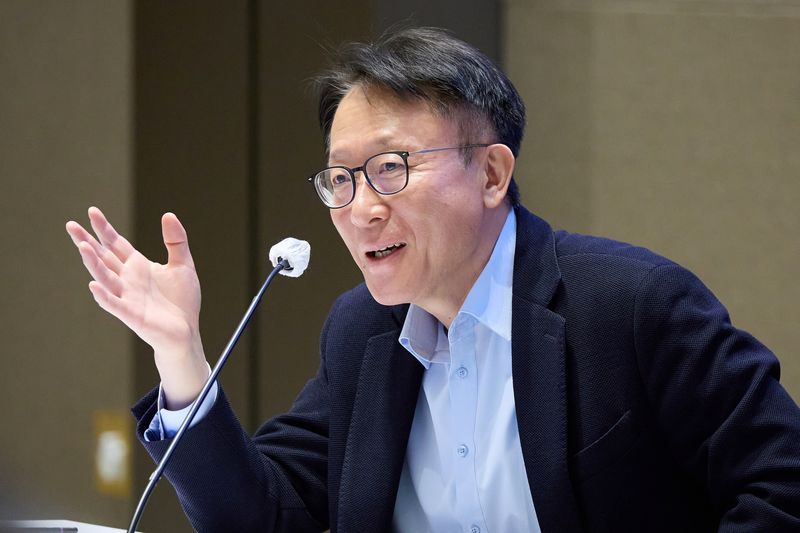
■A rate hike is inevitableAt a press briefing held on the 11th at the BOK Annex in Jung District, Seoul, Shin Sung Hwan said, "It is quite burdensome to even discuss an interest rate cut right now." He added, "There are considerable concerns about inflation, and if we were to plot a dot chart, that view would be reflected."
Shin is widely regarded as one of the most dovish members of the Monetary Policy Board. Since taking office in July 2022 through April this year, he has cast seven dissenting votes in favor of a rate cut out of 30 Monetary Policy Board meetings on monetary policy direction. Even so, he appears to have concluded that the inflationary environment has become more severe since the outbreak of Middle East tensions in late February.
He paid particular attention to oil prices as a key driver of inflation. Earlier, the Asian Development Bank (ADB) said that if average global oil prices this year remain at $96 per barrel, South Korea's economic growth forecast of 1.9% could be lowered by 0.9 percentage points.
Shin explained, "There is also an inflationary impact from semiconductor profits, but the real issue is oil." He added, "If prices surge to around $100 and stay there, then even if the economy suffers, the BOK's task is to minimize second-round effects."
His concerns, however, were directed toward vulnerable sectors. This year's growth forecast stands at 2.0%, but he sees it as a number propped up by the semiconductor boom. In his view, the economy is a so-called 'K-shaped' one, with many other industries still in decline. If rates rise, those sectors would be hit first through higher financing and borrowing costs.
Shin pointed out, "About 10% of our economy, and an even smaller share in terms of employment, is made up of sectors such as semiconductors that determine the overall headline number." He added, "For the remaining 70% to 80%, raising rates will only deepen their difficulties."
Even so, a rate hike appears unavoidable. Ryoo Sangdai, the BOK's deputy governor, had already hinted at a policy shift by saying, "It is time to consider raising interest rates." Although Shin will not have voting rights at this month's Monetary Policy Board meeting, he predicted that the central bank would "focus all its efforts on bringing inflation under control because there is no other option from the perspective of the monetary authorities."
■Excessive bias in the foreign exchange marketOn the won–dollar exchange rate, he did not offer an assessment of the level itself, but said market bias is pushing the rate higher. Shin said, "In the past, when the current account posted a surplus, the exchange rate would fall. Now, however, foreign exchange inflows and outflows in the financial markets are overwhelmingly large." He added, "As the link to international financial markets grows stronger, the degree of bias can become even greater."
In that context, Shin said, "There are times in international financial markets when the wisdom of the crowd turns into the madness of the crowd." He stressed that it is important to prepare contingency plans that can either respond in advance or react immediately when something happens.
The BOK has previously identified overseas investment by domestic residents and foreign investors' withdrawals from the local stock market as factors behind greater exchange-rate volatility. Shin said, "The US-Korea interest rate differential is the fundamental cause, but even taking that into account, the won is undervalued." He added, "Foreign capital is flowing in through channels such as the World Government Bond Index (WGBI), but there is still enough overseas investment to offset it."
Shin also mentioned South Korea's savings rate, saying it has already exceeded an appropriate level. That, in turn, is a factor limiting economic vitality because it ultimately leads to weak private consumption. As of the end of the fourth quarter last year, the household gross savings rate stood at 35.9%, while the net savings rate was 8.8%.
Shin said, "Even when economic growth is strong, private consumption remains sluggish." He added, "We need to make the system more efficient, one in which people live frugally to buy a home and die rich." He did not present any specific policy measures.
Shin's term runs through the 12th of this month. His successor is expected to attend the Monetary Policy Board meeting on the 28th. Since the Korea Federation of Banks is the recommending institution for this board seat, a candidate from academia or the market is likely to be nominated.
[email protected] Kim Tae-il Reporter