Apgujeong Hyundai Apartment owner with three homes to pay 4.8 billion won more in capital gains tax [Capital gains tax surcharge returns]
- Input
- 2026-05-10 18:30:37
- Updated
- 2026-05-10 18:30:37
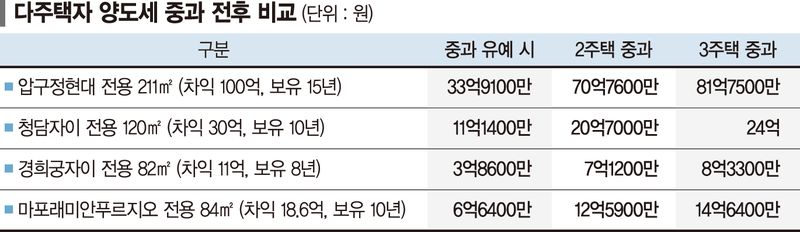
For a 120-square-meter unit at Xi Chungdam in Gangnam District, owned for 10 years, the capital gains tax was 1.114 billion won through the 9th. From the 10th onward, however, it jumps to 2.07 billion won for a two-home owner and 2.4 billion won for an owner of three or more homes.
Even when capital gains are in the 1 billion won range, the tax payable can more than double. Assuming a three-home owner in an adjustment zone sells an 82-square-meter unit at Gyeonghuigung Xi in Jongno District, Seoul, after holding it for eight years, the capital gains tax would rise from 386 million won through the 9th to 833 million won after the 10th, or 2.16 times higher.
If the same three-home owner sells a 84-square-meter unit at Mapo Raemian Prugio in Mapo, Seoul, after holding it for 10 years, the capital gains tax would jump from 664 million won to 1.464 billion won. The current market price of the 84-square-meter unit at Raemian Prugio in Mapo is 2.7 billion won, while the highest price 10 years ago was 835 million won, meaning the capital gain over that period was 1.865 billion won. After taxes, the seller would be left with roughly 400 million won.
As the tax burden more than doubles across most price ranges, the market is increasingly interpreting the move as likely to push multi-homeowners who have not yet sold into a 'hold out' mode. A real estate industry official said, "Multi-homeowners who urgently needed to sell already completed their disposals in February and March," adding, "Some areas are already showing signs of a supply freeze." According to the real estate platform Asil, the number of apartment listings for sale in Seoul stood at 66,914 as of that day, the lowest level since February 24. Even Gangnam District, where listings had surged amid fears of the capital gains tax surcharge, has fallen below 10,000 units.
In contrast, Kim Yun-duk pushed back directly against such forecasts through his Social Network Service (SNS) account that day. Kim said, "There are many concerns about a supply freeze after the capital gains tax surcharge was reinstated, but these forecasts are largely based on experience with previous administrations," adding, "In the long run, the Government of the People will be different, and it has no choice but to be different." He went on to say, "Whether the capital gains tax surcharge is applied is only one factor affecting housing price expectations," and added, "We will completely redesign the structure of economic incentives, including finance, taxes, and supply, to bring about a major shift from an economy reliant on real estate windfalls to a productive economy."
[email protected] Choi A-young, Kwon Jun-ho Reporter