Four Months Into the War on Multi-Homeowners: Gangnam Falls 0.95%, Suji Rises 5% [Reinstating Heavy Capital Gains Taxes]
- Input
- 2026-05-10 18:25:52
- Updated
- 2026-05-10 18:25:52
Experts say key variables after May 9 will include instability in the rental market, the spread of the balloon effect and policy volatility. Their outlook for the sales market is mixed, but they expect jeonse and monthly rents to keep rising.
■ As Gangnam fell 0.9%, Suji rose 5%
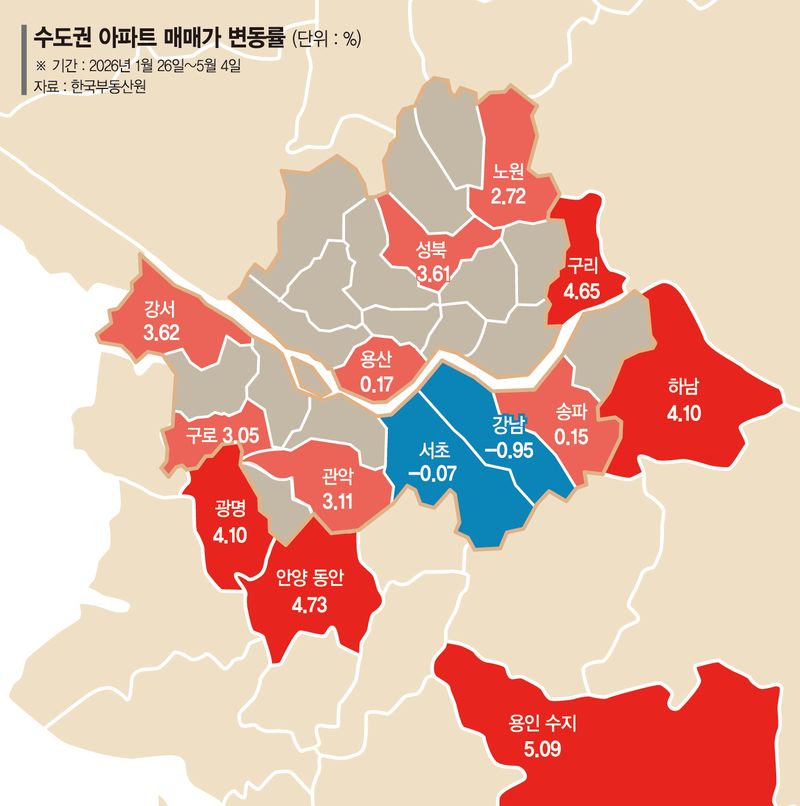
Financial News analyzed price trends from Jan. 26, when pressure on multi-homeowners intensified, through May 4 using weekly data from the Korea Real Estate Board (KREB). It found that apartment prices in the four Gangnam districts fell 0.08%. By contrast, Gangseo District led Seoul with a 3.62% gain, while Suji District in Yongin topped the Seoul metropolitan area with a 5.09% increase.
Seoul apartment prices rose 1.80% over the roughly four-month period. That was a larger increase than the 1.43% recorded in the same period last year. Gangnam District fell 0.95% and Seocho District slipped 0.07%, but outlying areas led the gains, with Gangseo District, Seongbuk District at 3.61%, Gwanak District at 3.11% and Guro District at 3.05% driving the market higher.
In Seongbuk District, a 59-square-meter unit at Raemian Gireum New Town 5 Complex changed hands in April for 1.18 billion won, setting a new record. The previous high was 950 million won in September 2021.
Even though parts of Gyeonggi Province near Seoul were designated as regulated areas, price gains were strong. Apartment prices in Gyeonggi Province rose 1.17% over the four-month period, with Suji District in Yongin up 5.09%, Dongan District in Anyang up 4.73%, Gwangmyeong City up 4.10% and Hanam City up 3.82%, all climbing more than 3%.
Incheon also posted a positive change, with apartment prices rising 0.11% over the four months of the campaign against multi-homeowners. A year earlier, every district in Incheon had recorded negative growth over the same period.
■ Jeonse prices surge... Will they push up sale prices?
Jeonse prices posted sizable gains over the four months. Last year, Seoul apartment jeonse prices rose only 0.46% from late January to early May. Gyeonggi Province gained 0.23%, while Incheon fell 0.16%. This year, however, from Jan. 26 to May 4, Seoul rose 2.05% and Gyeonggi Province 1.71%, while Incheon reversed course and climbed 1.19%. In all three parts of the Seoul metropolitan area, jeonse price growth outpaced sale price growth. Only three places in the region — Yeoju City, Icheon City and Gwacheon City — saw jeonse prices fall.
According to the Ministry of Land, Infrastructure and Transport, 73% of apartment buyers in Seoul in March were owner-occupiers, compared with a 2025 monthly average of 56.1%. That means the share of renters trying to buy homes has surged, while instability in the rental market has become even more pronounced.
What will the market look like going forward? Recently, Gangnam home prices have stopped falling and are showing signs of rebounding, drawing attention.
Kim Inman, head of the Kim Inman Real Estate Economy Research Institute, said, "In Gangnam and the Han River belt, buying sentiment is likely to weaken significantly." By contrast, Professor Seo Jin-hyung of Kwangwoon University said, "In the three Gangnam districts, where capital gains are large, listings are likely to dry up and prices are expected to rise further."
Many analysts say prices in non-Gangnam and near-Seoul areas could keep rising due to the balloon effect. Kim added, "Apartments priced below 1.5 billion won are likely to rise further," and predicted that "the balloon effect will spread across the entire Seoul metropolitan area." Choi Won-cheol, a professor at Yonsei University, also said, "As instability in the jeonse and monthly rental market is likely to continue, there is considerable room for it to push up sale prices."
[email protected] Lee Jong-bae Reporter