Is It Korea’s Battle-Tested Edge or Japan’s Technology? Southeast Asia Becomes a Defense Battleground
- Input
- 2026-05-10 18:14:40
- Updated
- 2026-05-10 18:14:40
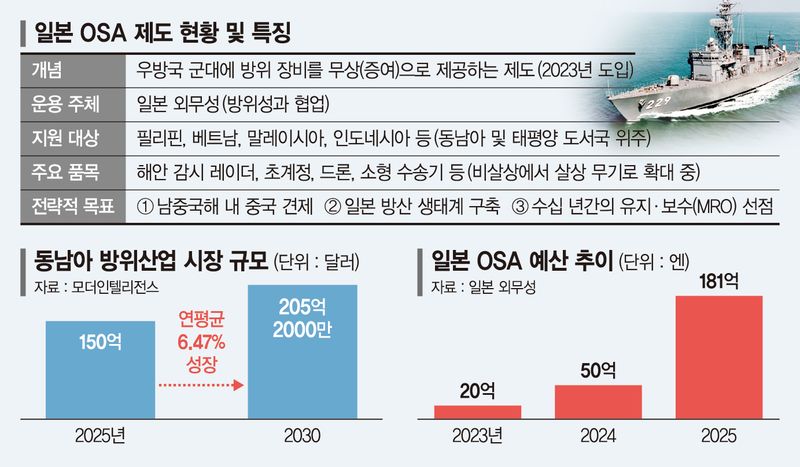
South Korea’s defense industry is on high alert over Japan’s move to lift export restrictions on its defense firms. On the 21st of last month, the Japanese government significantly relaxed the weapons export rules it had maintained under its pacifist constitution. As the door to Japanese defense exports, which had been closed for decades, opens, analysts say the rapidly growing Southeast Asian defense market could also be shaken. In particular, countries in Southeast Asia are accelerating military modernization amid tensions in the South China Sea and strategic competition between the United States and China, so the emergence of Japanese firms is expected to become a major variable in the region’s defense procurement race.
The Japanese government has revised its system to abolish the existing export criteria that limited defense equipment sales to five categories: rescue, transport, surveillance, patrol, and mine countermeasures. In effect, it has opened the way for exports of lethal weapons. By pushing the Official Security Assistance (OSA) program, which links Official Development Assistance (ODA) with military support, Japan is also moving aggressively into Southeast Asia. That is expected to become a new challenge for K-defense exports, which have recently been in the spotlight.
■ Japan rushes into Southeast Asia as soon as defense export restrictions are lifted
According to Japanese media on the 10th, the Japanese government has chosen Southeast Asia as its first export destination after easing defense export rules.
Japanese Minister of Defense Shinjirō Koizumi visited Indonesia and The Philippines from the 3rd to the 7th, signaling the start of Japan’s defense sales push. He signed a defense cooperation agreement with Indonesia and discussed the provision of used submarines. Japan also agreed with The Philippines to set up a working-level consultative body for the transfer of six Abukuma-class destroyer escorts and TC-90 training aircraft.
Nihon Keizai Shimbun said, "With this easing of export restrictions, the technological strength and quality competitiveness of Japanese companies will be put to a full-scale test in the global market."
Japanese media also analyzed that Southeast Asian countries are stepping up military modernization and maritime security capabilities as security concerns in the South China Sea deepen. Japan, they said, is seeking to expand its influence by taking advantage of this opening and offering support for maritime surveillance and patrol capabilities.
■ K-defense firms grow wary as Japan leans on free aid
The OSA program, introduced by the Japanese government in 2023, allows defense equipment to be provided free of charge to the armed forces of friendly countries. More recently, Japan has also been pushing to expand the scope of support from surveillance equipment such as radar to multipurpose vessels and some lethal systems.
The Japanese government has increased the OSA budget to 18.1 billion yen, up 125% from the previous year, and provided coastal surveillance radar to The Philippines free of charge. It is also broadening its influence by supplying rescue boats and patrol drones to Malaysia and Vietnam.
The defense industry is paying close attention to the possibility that Japan’s free-aid strategy could translate into long-term market dominance. Once defense equipment is introduced, maintenance, repair and overhaul (MRO) and follow-on logistics support continue for decades, so early assistance could also affect long-term contract competition, analysts say.
An industry source said, "For Southeast Asian countries, Japan’s OSA is highly attractive because they can acquire equipment without an initial financial burden." The source added, "Once they adopt a Japanese system, there is a strong chance that future maintenance, parts supply, and additional equipment purchases will also follow."
■ 'Technology-driven Japan' vs. 'battle-tested Korea'
Japan’s strength in defense lies in its advanced core technologies. In particular, companies such as Mitsubishi Heavy Industries, Ltd. and Kawasaki Heavy Industries have strong capabilities in aircraft, naval vessels, and sensors. However, high production costs and limited mass-production experience are seen as weaknesses.
By contrast, K-defense firms are highlighting price competitiveness, fast delivery, and real-world operational experience. In ground weapons in particular, such as the K9 Thunder and the K2 Black Panther main battle tank, South Korea is widely seen as having an edge over Japan.
The defense industry expects competition between K-defense and Japan to intensify, especially in naval systems such as surface ships and submarines, as well as in fighter jets and missile sectors, following Japan’s easing of export restrictions.
■ A whole-of-government response needed to counter Japan’s G2G push
An industry source said, "Because references matter so much in the defense industry, Japan’s approval of lethal weapons exports will not immediately pose a direct threat to K-defense. But in Southeast Asia, if Japan launches an offensive using OSA and Government-to-Government agreement (G2G) deals, it could soon emerge as K-defense’s biggest rival."
There are also calls for a whole-of-government, "one-team" response to Japan’s challenge in defense exports. Another industry source said, "Japan has more than twice as many defense attachés stationed at diplomatic missions in Southeast Asia as South Korea does, and it also has a strong network built through ODA over many years." The source added, "If competition through government-to-government deals becomes serious, Japan could end up in a more favorable position than South Korea. Meanwhile, our country is providing support through KOTRA and the Defense Materials Trade Support Center, but companies are still competing largely on their own, so a stronger whole-of-government support system is needed."
[email protected] Reporter