The Shadow of a Semiconductor-Driven Bull Market: Small Caps and KOSDAQ Face a Chill
- Input
- 2026-05-10 18:10:59
- Updated
- 2026-05-10 18:10:59
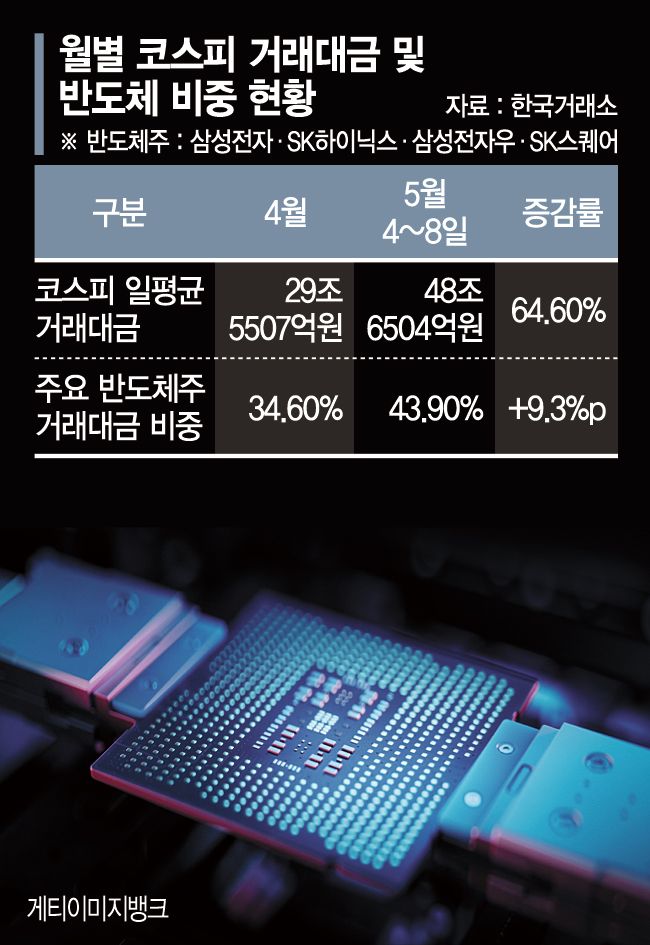
According to the Korea Exchange (KRX) on the 10th, average daily KOSPI trading value from the 4th to the 8th came to 4.86504 trillion won, up 64.6% from 2.95507 trillion won in the previous month. By contrast, average daily trading volume fell 16.6% from 94.7183 million shares to 78.9813 million shares. In other words, fewer shares changed hands, but trading value rose sharply.
By stock, the share of trading value accounted for by leading semiconductor names stood out. Over the four trading days this month, Samsung Electronics recorded 39.367 trillion won in trading value, while SK hynix posted 35.1683 trillion won. Combined, the two stocks accounted for 74.5353 trillion won, or 38.3% of total KOSPI trading value of 194.6015 trillion won during the same period. Including Samsung Electronics preferred shares and SK Square, trading value for the four stocks rose to 85.3552 trillion won, lifting their share to 43.9%. Concentration also increased from the previous month. Last month, Samsung Electronics, SK hynix, Samsung Electronics preferred shares, and SK Square accounted for 34.6% of KOSPI trading value. This month, that figure rose by 9.3 percentage points to 43.9%. The increase in KOSPI trading value was therefore driven less by broad-based buying and more by large semiconductor names and related large-cap stocks.
Brokerage analysts are also voicing concerns that the recent index rally is becoming increasingly one-sided. While the market appears strong overall, they note that only a small number of tech stocks and artificial intelligence (AI)-related names are driving the index higher, while most other stocks continue to lag. There are also worries that volatility could rise if investor sentiment toward semiconductors and AI-related stocks weakens.
The number of advancing stocks shows that the rally has spread only narrowly. From the 4th to the 8th, KOSPI advancing issues totaled just 282, while declining issues reached 608. That compares with 805 gainers and 119 losers in the previous month. In other words, although the index and trading value jumped sharply, the rally has not clearly broadened across the market.
Heo Jae-hwan, a researcher at Eugene Investment & Securities, said, "If semiconductors are excluded, the KOSPI is estimated to be around 4,100." He added, "Most non-semiconductor sectors have failed to keep up with the KOSPI's rise, and sectors that are hitting new highs this year account for only one-third of the overall market."
Over the same period, average daily KOSDAQ trading value rose only 19.9%, from 1.40794 trillion won last month to 1.68851 trillion won this month. That is a relatively modest increase compared with the KOSPI's 64.6% jump in trading value. As funds continue to flow into the KOSPI, where large semiconductor stocks are included, the spillover into small- and mid-cap stocks and the KOSDAQ remains limited for now.
Still, some say the concentration in a few names should not be viewed as overheating on its own, since it is being supported by improving semiconductor conditions and upward revisions to earnings estimates. Jongmin Kim, senior research fellow at Samsung Securities, said, "This concentration is backed by a clear megatrend and overwhelming earnings, so it cannot simply be seen as overheating." He added, "But because index concentration is approaching a critical threshold, the market could move in three directions from here: continued dominance by semiconductors, a broader spillover into adjacent sectors, or a short-term pause for breath."
[email protected] Bae Hangeul Reporter