Stock market waiting funds hit 136 trillion won, setting a new record
- Input
- 2026-05-10 18:10:52
- Updated
- 2026-05-10 18:10:52
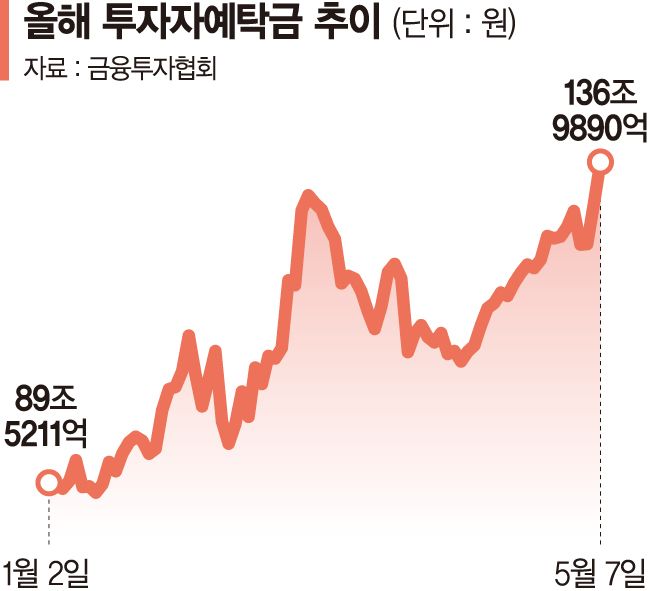
According to the Korea Financial Investment Association (KOFIA) on the 10th, investor deposits stood at 136.989 trillion won as of the 7th, setting a new record. The figure jumped by more than 28 trillion won in just one month.
Investor deposits refer to money that investors leave in securities accounts to buy stocks, or funds left unclaimed after selling shares. Because the money can flow into the market at any time, it is classified as stock market waiting funds. In general, when expectations for stock price gains rise, waiting funds for market entry also increase. On March 4, investor deposits first topped 130 trillion won, reaching 132.0682 trillion won. But as the market wobbled on the impact of the war between the United States (US) and Iran, deposits steadily declined and fell to 107.4674 trillion won on the 6th of last month.
As the market quickly recovered, investor deposits also rose sharply. On the 6th, they climbed back above 130 trillion won for the first time in two months, and a day later they surged by more than 6 trillion won to set another record.
The average daily amount of investor deposits so far this year through the 7th has reached 110.4737 trillion won. That is up 68% from last year's daily average of 65.7374 trillion won.
As stock market participation has accelerated, the scale of leveraged investing has also remained high. As of the 7th, the balance of margin loans stood at 35.5072 trillion won, up about 2.8 trillion won from a month earlier. It is also close to the all-time high of 36.0682 trillion won set on the 29th of last month. Margin loan balances measure the amount investors have borrowed from securities firms to buy stocks and have not yet repaid, making them a key gauge of retail leveraged investing. In general, a rising balance is interpreted as a sign of stronger expectations for index gains.
The active return of investors to the stock market is also reflected in account numbers. As of the 7th, the number of active stock trading accounts reached 105.45 million, up 7.16 million this year alone. That is well above half of last year's full-year increase of 11.72 million. Active stock trading accounts refer to brokerage and securities savings accounts with assets of at least 100,000 won and at least one transaction in the past six months. They include regular stock accounts as well as ISA, RIA, and IMA accounts.
Brokerages expect the rally to continue on the back of earnings momentum. Lee Kyung-min, a researcher at Daishin Securities, said, "Even as the KOSPI Composite Index tries to break through the 7,500 level, the forward price-earnings ratio (PER) is only 7.66 times. If a PER of 9 times is applied, it would reach 8,800. We should factor in short-term overheating and a period of supply absorption, but the KOSPI Composite Index's march to record highs will repeat as valuation normalizes based on earnings."
[email protected] Seo Min-ji Reporter