Samsung Electronics retail investors consider damages claim over strike; legal experts say it may be possible if proven, but obstacles remain [Seocho Intersection]
- Input
- 2026-05-10 13:24:29
- Updated
- 2026-05-10 13:24:29
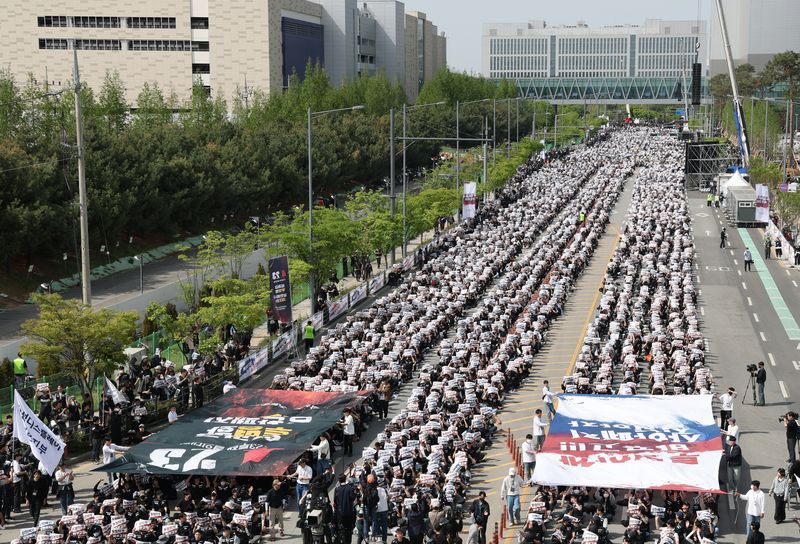
[Financial News] As Samsung Electronics minority shareholders raise the possibility of filing damages claims against the labor union, attention is focusing on whether such liability would be recognized in court if a lawsuit is actually filed. Legal experts say it may be possible if the minority shareholders can prove a causal link between the strike and the stock price decline, though doing so would be difficult. However, the so-called Yellow Envelope Act, which narrows the scope of unlawful labor disputes, and the difficulty of calculating individual liability are seen as major obstacles.
According to legal and industry sources on the 10th, Samsung Electronics' labor union will enter a post-facto mediation process on the 11th and 12th at the recommendation of the Ministry of Employment and Labor (MOEL). If the talks break down, the union is likely to launch a general strike as scheduled on the 21st.
Meanwhile, some Samsung Electronics shareholder groups are opposing the union's planned general strike and have even mentioned possible legal action. At a press conference on the 7th, the Korea Shareholder Action Headquarters said it would seek damages from union members under the legal theory of third-party interference if company assets are damaged by the strike.
The third-party interference theory cited by shareholders is the idea that liability can be imposed when a third party intervenes in a contractual relationship and obstructs performance. The argument is that Samsung Electronics and its shareholders have a legal relationship premised on the company’s normal business performance. If an illegal strike by the union causes production disruptions and a drop in the stock price, shareholders would have suffered damages.
Legal experts say a damages claim could be recognized if a causal link between the strike and the stock price decline is proven. They also note, however, that presenting such evidence to the court would be highly challenging.
A lawyer in Seocho-dong said, "If evidence is presented that the union's strike distorted the market price of the stock, the claim is not entirely impossible." He added, "In principle, shareholder losses are indirect losses, so they should be compensated through the company."
Some also say the move may be intended to pressure the union, given how difficult it is to prove a causal link between the strike and the stock price decline before the strike is formally ruled illegal.
A lawyer on the labor team at a major law firm assessed that "this move by shareholders appears to be less about actually winning a case and more about warning the union and drawing public support."
The Yellow Envelope Act, which took effect this year, is seen as a factor that lowers the chances of shareholders successfully seeking damages. The revised law expands the scope of lawful labor disputes and limits damages liability by requiring individual assessment even when unlawful conduct is recognized.
Seo Jun-beom, managing attorney at Byeonhwa Law Office, explained, "For a union's labor dispute to constitute an unlawful act, it must intentionally or negligently cause harm to another person, and the act itself must be illegal." He added, "With the Yellow Envelope Act in force, the scope for determining illegality has become far too narrow."
Experts therefore say the structure in which shareholders are effectively excluded from labor-management conflicts at large companies needs to be reconsidered.
Attorney Seo said, "From shareholders' perspective, there is no way to respond even if they suffer damage from excessive labor action, so a basis for expressing their views is needed." Ahn Duk-geun also said, "A legal mechanism that allows shareholders' opinions to be heard is necessary," but added that, since the Yellow Envelope Act is still in its early stages, it would be better to wait and see what side effects emerge in practice before pursuing follow-up legislation.
[email protected] Choi Eun-sol Reporter