Japan Pushes EPA Talks With Five South American Countries, Targeting a Market of 300 Million People
- Input
- 2026-05-10 10:36:26
- Updated
- 2026-05-10 10:36:26
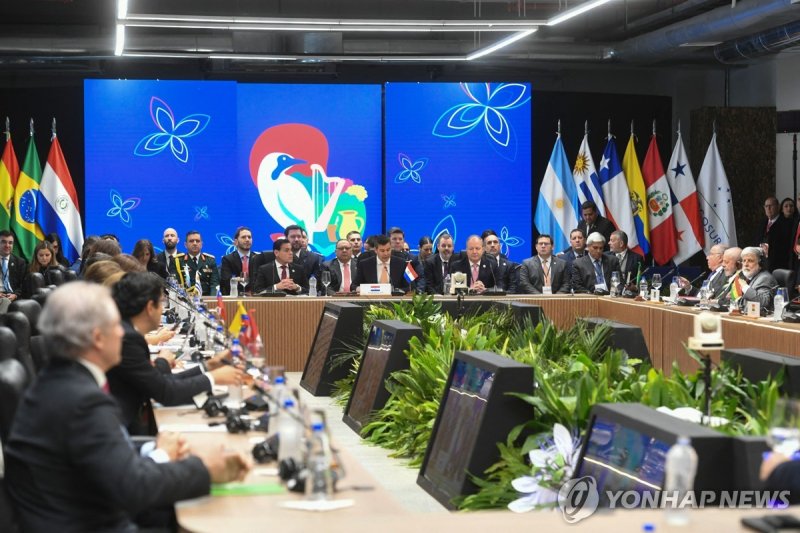
[Financial News, Tokyo = Correspondent Seo Hye-jin] The Japanese government is seeking to begin negotiations on an Economic Partnership Agreement (EPA) with five South American countries by this summer, Nihon Keizai Shimbun, or The Nikkei, reported on the 10th. The plan is to expand free trade into a region with a population of about 300 million, strengthen the foundation for Japan's economic growth, and increase sources of crude oil and critical minerals to reduce dependence on the Middle East and China.
■ Japan and Mercosur to hold talks later this month, laying the groundwork for EPA negotiations According to The Nikkei, the Japanese government plans to hold the Strategic Partnership Framework, a consultative body with Southern Common Market (MERCOSUR), later this month. It is also coordinating a visit to Japan by Brazilian Foreign Minister Mauro Vieira, the top diplomat of Mercosur's largest economy, in mid-month.
The Japanese government hopes the two rounds of talks will lay the groundwork for launching EPA negotiations.
Prime Minister Sanae Takaichi received a report on Mercosur from senior officials at the Ministry of Foreign Affairs of Japan at the Prime Minister's Office of Japan on the 28th of last month. If EPA negotiations begin, they will be the first major free trade talks under the Takaichi Cabinet.
Mercosur is made up of five countries: Brazil, Argentina, Uruguay, Paraguay and Bolivia. Venezuela has been suspended from membership since 2016 over human rights violations.
The combined Gross Domestic Product (GDP) of the five countries amounts to $3.16 trillion, or about 4,631 trillion won. That is roughly three-quarters of the size of the Association of Southeast Asian Nations (ASEAN). Trade with Japan totaled about 2.4 trillion yen last year, less than one-tenth of Japan's trade with the United States or ASEAN, suggesting significant room for growth.
Japan is especially interested in expanding energy procurement from South America. The recent attacks by the United States and Israel on Islamic Republic of Iran have highlighted the risks of relying on the Middle East. Until tensions in the region rose, Japan imported more than 90% of its crude oil from the Middle East.
Brazil is the world's ninth-largest oil producer and is seeking to increase output through offshore field development. In March, its crude oil production hit a record 4.3 million barrels per day.
Venezuela, whose membership has been suspended, holds the world's largest proven crude oil reserves. Since President Maduro was detained in the United States in January, momentum for Venezuela's return to Mercosur has also been growing.■ Expectations rise for securing critical minerals such as lithium and rare-earth elementsThere are also major advantages in securing critical minerals. Argentina is a producer of Lithium, which is essential for electric vehicle (EV) batteries. Brazil has the world's second-largest reserves of rare-earth elements.
Until now, Japan's business community has called for an early EPA with Mercosur, hoping for lower tariffs on industrial goods such as automobiles and machinery.
The Nikkei noted that this is driven by a sense of urgency that Japanese companies could become less competitive against foreign rivals.
The Free Trade Agreement (FTA) between the European Union (EU) and Mercosur took effect provisionally on the 1st. If Japan exports internal combustion engine vehicles to Mercosur countries, Japanese companies could face a disadvantage on tariffs.■ The biggest issue is imports of Brazilian beefThe biggest obstacle to EPA negotiations is the issue of importing Brazilian beef, The Nikkei said. At the end of last year, LDP lawmakers in charge of agriculture raised the view in talks with senior officials from relevant ministries that "beef imports must definitely be restricted."
According to USDA statistics, Brazil's beef production reached 12.61 million tons last year, overtaking the United States to rank first in the world. By contrast, Japan's production stood at just 350,000 tons in 2024. There are concerns that a large influx of Brazilian beef could push down prices and hurt Japanese livestock farmers.
Still, even among LDP lawmakers in charge of agriculture, there is a growing sense that negotiations are necessary. One lawmaker said, "Given the need to secure energy and critical minerals, it is hard to oppose this outright." A senior official close to the administration also expressed support for pushing ahead, saying, "We will respect the party's position, but in the end we will make the decision from a national diplomacy perspective."
Japan has effectively restricted imports of Brazilian beef so far, citing concerns over livestock diseases such as foot-and-mouth disease. Some also argue that South American beef, which is mainly lean red meat, does not directly compete with Japanese Wagyu, which is known for its marbling.
An EPA with Mercosur has been discussed for a long time, but it has not materialized because of opposition from the agricultural sector. South American countries also stand to benefit by securing new export markets for crude oil and farm products, which would help reduce the risk of dependence on China, a key trading partner.
[email protected] Seo Hye-jin Reporter