The tech boom is also creating a K-shaped divide: stock prices are surging, while jobs are shrinking
- Input
- 2026-05-09 03:40:34
- Updated
- 2026-05-09 03:40:34
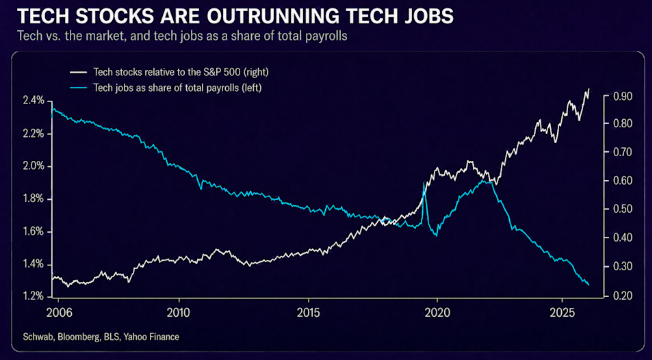
As the tech sector dominates Wall Street, the stock market and the labor market are moving in opposite directions.
Yahoo Finance reported on the 8th local time that, amid the artificial intelligence (AI) boom, stock prices for tech shares including semiconductors are hitting record highs day after day, while jobs at tech companies are steadily declining.
K-shaped divide
In the tech sector, this K-shaped divide has become a defining feature: stock prices are rising, while jobs are falling.
The term has usually been used to describe diverging consumption trends between the wealthy and low-income groups.
It has now become the best way to describe the decline in tech-sector jobs and the surge in tech stock prices reflected in the Labor Department's April employment report released that day.
Tech stock valuations are now carrying their highest premium in at least 20 years. By contrast, jobs within the sector continue to decline.
Kevin Gordon, head of macro research at the Schwab Center for Financial Research, illustrated this K-shaped split clearly in his chart.
Compared with the S&P 500 Index, a benchmark for market returns, tech stock prices are at record highs. Meanwhile, the share of tech workers shown in the Labor Department's employment report has fallen to a record low.
According to the April employment report, the U.S. added 115,000 jobs last month, while the unemployment rate held steady at 4.3%, unchanged from March.
New jobs came from the health care, transportation, warehousing and retail sectors.
By contrast, employment in information, which represents the tech sector, fell by 13,000. According to the Bureau of Labor Statistics (BLS), the number of workers in the information sector has dropped by 342,000, or 11%, from its peak in November 2022.
Capital and labor diverge
The K-shaped divide in the tech sector is a split between capital and labor.
The capital side is thriving, including stock prices, market capitalization, AI infrastructure and the revenue per worker that these investments promise.
Labor, on the other hand, is on the decline.
Jobs in software, internet, telecommunications, media and other tech-related fields are no longer growing. Expectations that stronger performance in the information sector would lead to more related jobs have been completely upended.
Cloudflare, a network infrastructure company specializing in internet security, announced on the 8th that it will cut 1,100 jobs, or 20% of its workforce, because of AI. Coinbase, the cryptocurrency exchange, also recently said it plans to lay off about 7,000 employees, or 14% of its staff, and other layoff announcements have followed.
Meta Platforms Inc. and Microsoft had previously unveiled large-scale layoff plans as well.
Different from the dot-com bubble burst
However, these layoffs are unfolding differently from the dot-com bubble burst of the early 2000s.
When the bubble burst, demand slowed, stock prices plunged and layoffs followed.
This time, AI is driving automation and reducing the number of workers companies need. At the same time, huge sums of money are being poured into expanding AI infrastructure such as semiconductors, data centers, networking and power, adding pressure to cut fixed labor costs.
Investors are reinforcing this trend by buying shares of companies that adopt AI and reduce headcount.
[email protected] Song Kyung-jae Reporter