Foreign Investors Ramp Up Profit-Taking as Warning Bells Sound Over a Semiconductor-Driven Market
- Input
- 2026-05-08 10:19:30
- Updated
- 2026-05-08 10:19:30
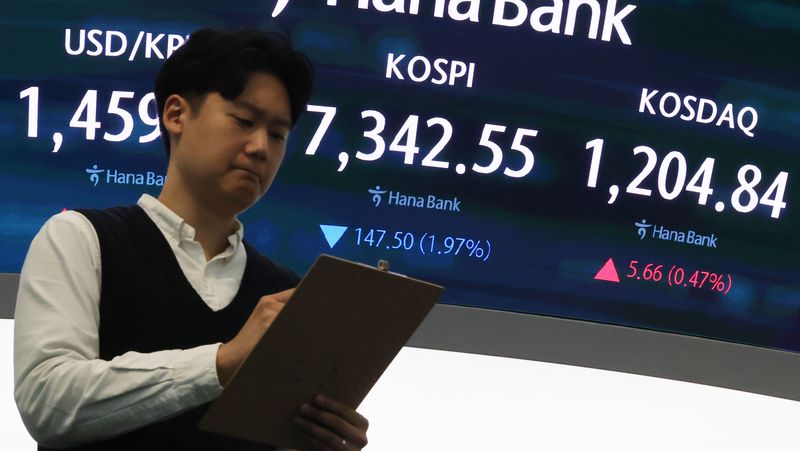
[Financial News] As the KOSPI Composite Index has surpassed the 7,000 mark for the first time, foreign investors are beginning to step up profit-taking. Analysts also say the gap between market sentiment and the actual index is widening, as gains have been concentrated in semiconductor heavyweights such as Samsung Electronics Co., Ltd. and SK hynix.
According to the Korea Exchange (KRX) on the 8th, foreign investors sold a net 671.72 billion won worth of shares on the Korea Exchange Main Board the previous day. As of 10 a.m. that day, they had also sold an additional net 210 billion won or more.
Foreign selling has been concentrated in Samsung Electronics Co., Ltd. and SK hynix, which had driven the index higher. The previous day, foreign investors sold a net 279.54 billion won of Samsung Electronics shares, while SK hynix also saw net foreign selling of 243.6 billion won.
According to Daishin Securities, 356 stocks rose on the previous day, while 503 declined, meaning losers outnumbered gainers. This suggests that the index has continued to be lifted mainly by large semiconductor stocks.
In fact, the combined market capitalization share of Samsung Electronics and SK hynix in the KOSPI Composite Index expanded from 40% at the end of March to 47% as of the 7th of this month.
Lee Kyung-min, a researcher at Daishin Securities, analyzed that "the rally is continuing amid persistent concentration in large semiconductor stocks" and that "foreign investors have started to sell for profit-taking after the recent sharp gains."
In the securities industry, the prevailing view is that it is too early to interpret foreign selling as a trend reversal. Analysts say the KOSPI Composite Index has surged sharply in a short period, increasing the urge to lock in profits, while foreign funds are also slowing their pace somewhat. Still, the narrow leadership of the market is seen as a burden.
Looking at sector returns so far this year, the semiconductor sector has surged 131.7% from the start of the year, followed by IT hardware at 156.7%, machinery at 103.0%, and construction and building at 100.5%. By contrast, media and education fell 20.2%, hotels and leisure dropped 10.1%, and healthcare declined 6.2%.
The market believes that strength in U.S. tech stocks and expanding investment in AI are supporting expectations for further gains in semiconductor heavyweights. As hopes for easing tensions between the United States and Iran stabilize oil prices, risk appetite is also broadening.
Lee Kyung-min explained that "market participants are reacting more sensitively to expectations of easing tensions between the United States and Iran than to employment data" and that "the Fear and Greed Index has once again moved close to the extreme greed zone."
[email protected] Choi Du-seon Reporter