"Semiconductors Could Not Be Stopped Even by War"... Current Account Surplus Hits Record High [Full Report]
- Input
- 2026-05-08 10:19:35
- Updated
- 2026-05-08 10:19:35

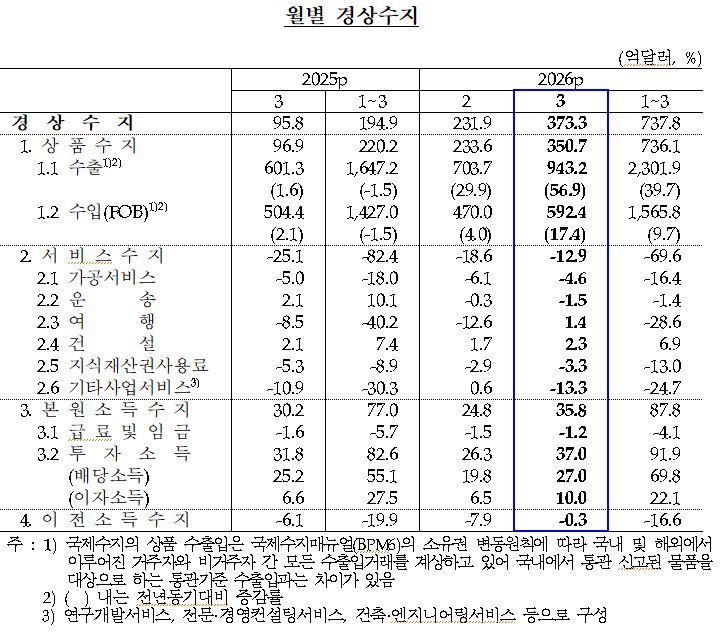
According to the Bank of Korea (BOK) on the 8th, the preliminary current account balance for March 2026 came to $37.33 billion. That was 61.0%, or $14.14 billion, higher than February's previous record of $23.19 billion. As a result, the current account surplus for the first quarter reached $73.78 billion, setting a record for the third straight quarter.
The surplus has now continued for 35 months in a row. It is the second-longest surplus streak since the 2000s began. The longest run was the 83-month surplus that lasted through March 2019.
The goods account, the largest component of the current account, stood at $35.07 billion in March. That was also the highest figure on record. It exceeded the previous peak of $23.36 billion set in February by 50.1%.
Exports totaled $94.32 billion, up 34.0% from the previous month and 56.9% from a year earlier. The increase was driven by strong performance in information technology products, especially semiconductors and computer peripherals, while non-IT items also posted solid gains thanks to more working days and higher petroleum product prices.
By item, customs-cleared exports of semiconductors reached $32.97 billion, up 149.8% from a year earlier. Information and communications equipment rose 78.1% to $6.15 billion, and petroleum products climbed 69.2% to $5.63 billion. Auto parts, at $6.08 billion, fell 5.3%.
Kim Young-hwan, Director of Economic Statistics Division 1 at the BOK, said, "The impact of the Middle East crisis and a possible closure of the Strait of Hormuz was not significant in March, but it did show up in April on both the import and export sides of goods." He added, "However, it was not enough to shake semiconductor exports overall."
Kim also said, "Due to shortages in semiconductor supply, facility investment is increasing and imports of raw materials have also turned upward." He added, "There is no sign that the trend will be disrupted, even as semiconductor export prices rise."
Imports came to $59.24 billion, down 26.0% from the previous month but up 17.4% from a year earlier. Kim explained, "Despite the Middle East conflict, energy import prices continued to fall because of the time lag in shipments, but imports of chemical products increased, led by pharmaceuticals, semiconductors and raw materials for secondary batteries."
The services account posted a deficit of $1.29 billion, led by other business services and processing services. Other business services recorded a $1.33 billion deficit, processing services a $460 million deficit, and transportation a $150 million deficit. Construction, at $230 million, and travel, at $140 million, remained in surplus.
In particular, the travel account moved into surplus for the first time in 136 months, since November 2014, as inbound arrivals topped 2 million in a single month for the first time, helped by the spring domestic travel season and the popularity of K-pop.
The primary income account posted a surplus of $3.58 billion, driven by investment income of $3.7 billion, including $2.7 billion in dividend income and $1 billion in interest income. That was about 53.2% higher than the previous month's $2.48 billion.
The secondary income account recorded a deficit of $30 million.
Direct investment totaled $5.12 billion, up 78.3% from $2.87 billion in the previous month. Domestic residents' overseas investment increased by $8.89 billion, while foreign investment in South Korea also rose by $3.77 billion.
Portfolio investment posted a net asset increase of $38.05 billion, up 84.9% from $20.58 billion in the previous month. Domestic residents' overseas investment rose by $4 billion, mainly in stocks, while foreign investors' investment in South Korea fell by $34.04 billion, also led by stocks.
Financial derivatives increased by $5.6 billion, more than 11 times the previous month's $490 million.
Other investment widened its decline sharply, from a $2.5 billion decrease in the previous month to a $9.93 billion decrease in March. Assets rose by $1.56 billion, mainly in cash and deposits, while liabilities increased by $8.36 billion, led by borrowing.
Reserve assets turned to a $1.85 billion decrease, after rising by $1.36 billion in the previous month.
[email protected] Kim Tae-il Reporter