Stock Market Rally Triggers a 'Money Move' as Deposits Shrink by 12 Trillion Won in Two Months [The Paradox of KOSPI's Rise]
- Input
- 2026-05-07 18:25:49
- Updated
- 2026-05-07 18:25:49
■The 'money move' strengthens, from banks to stocks
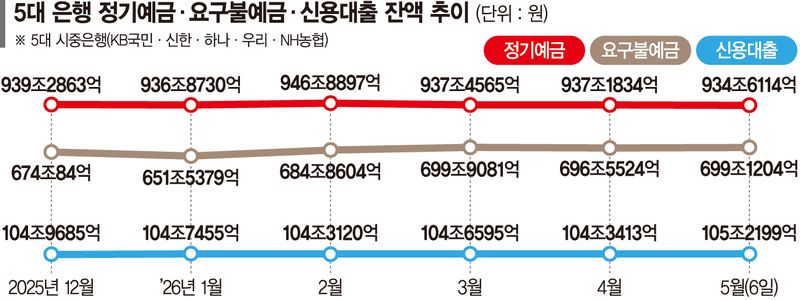
According to the financial sector on the 7th, time deposit balances at the Five Major Commercial Banks — KB Kookmin Bank, Shinhan Financial Group, Hana Bank, Woori Bank and NH NongHyup — stood at 934.6114 trillion won as of the 6th. That was down 2.572 trillion won from the end of last month, when the figure was 937.1834 trillion won. Compared with the end of February, when balances peaked at 946.8897 trillion won this year, the total has fallen by 12.2783 trillion won. Time deposits had risen through February after reaching 939.2863 trillion won at the end of last year, but the trend has now reversed.
Demand deposits, which serve as standby funds, are also showing greater volatility. Balances at the Five Major Commercial Banks rose to 699.9081 trillion won at the end of March, then fell to 696.5524 trillion won at the end of last month. As of the 6th, they stood at 699.1204 trillion won.
Analysts say the trend is tied to the recent mood in the domestic stock market. With the KOSPI Composite Index surging past 7,500 and the market booming, retail money is moving into equities. The Korea Composite Stock Price Index (KOSPI) climbed from 4,214.17 at the end of last year to an intraday high of 7,531.88 on the day, jumping 78.73% in less than five months. By contrast, flagship time deposit products at major commercial banks are still offering interest rates in the upper 2% range.
Some signs of debt-fueled investing are also emerging. Credit loans have fluctuated since the end of last year, but they have started rising again in May as the stock rally has accelerated.
Credit loan balances at the Five Major Commercial Banks rose by 87.86 billion won, from 104.3413 trillion won at the end of last month to 105.2199 trillion won as of the 6th. In effect, that means they increased by nearly 900 billion won in just two trading days after the holiday period. The figure is also up 251.4 billion won from the end of last year, when balances stood at 104.9685 trillion won.
■Commercial banks take a wait-and-see approach, while second-tier lenders defend deposits
Although the 'money move' is strengthening, commercial banks appear to believe the outflow has not yet reached a threatening level. They say retail funds are moving into stocks, but some corporate and institutional money is flowing back in, leaving the overall deposit base more resilient than expected. Inside the banking sector, there is also growing attention on falling loan-to-deposit ratios caused by slower loan growth, rather than on deposit declines alone.
A financial industry official said, "Retail money is clearly moving into the stock market, but some of that is being offset by inflows from corporate and institutional investors, so overall bank deposits are holding up better than expected." The official added, "We have raised rates slightly, but it is not easy to raise them further, and the actual effect on deposit defense will likely be limited."
"With the stock market rising so quickly, it is hard to stop the flow of funds with simple rate competition alone," the official added.
Savings banks and mutual finance institutions, by contrast, are feeling more pressure and are moving to defend their deposits. As the money-move phenomenon spreads amid the stock market boom, they are turning to rate hikes. According to the Korea Federation of Savings Banks, the average one-year time deposit rate at 79 savings banks nationwide stood at 3.24% on the day. That is the highest level in about 1 year and 4 months, since January last year. Of the 310 savings bank time deposit products, 52 offered rates of 3.5% or higher. Another 270 products were offering more than 3%.
A savings bank official said, "Keeping rates high overall means money is flowing out into the investment market." The official added, "Loan capacity has shrunk, but securing funds for securities investments can serve as an incentive to raise deposit rates."
It remains unclear, however, whether higher rates will be enough to reverse the money flow. A mutual finance sector official said, "Most customers used to roll over their deposits when they matured, but now the money is flowing into the stock market." The official added, "Even if we guarantee interest in the upper 3% range for a year, it is hard to say whether funds that have moved into stocks will come back when some shares are rising 10% a day."
[email protected] Reporter Ye Byung-jeong Seo Ji-yoon Reporter