Academia says the logic for abolishing the Financial Investment Income Tax also applies to virtual assets, calling a tax push a legislative contradiction
- Input
- 2026-05-07 16:13:38
- Updated
- 2026-05-07 16:13:38
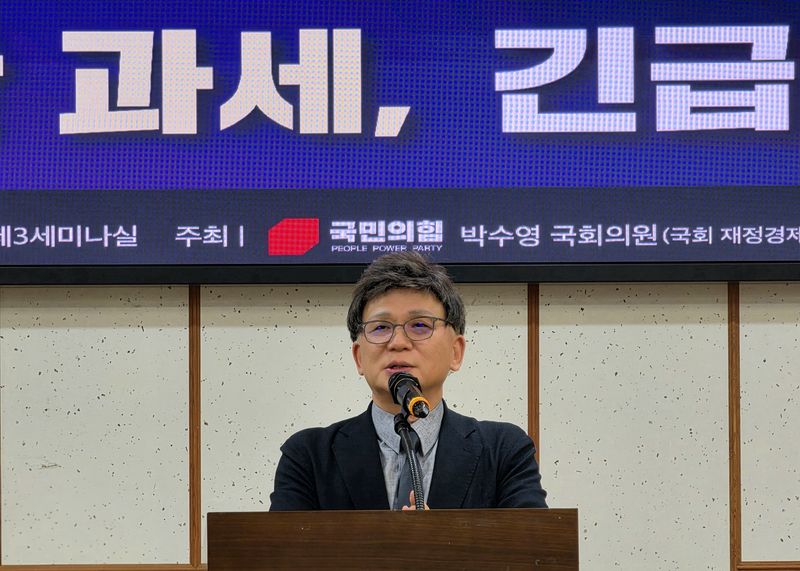
[The Financial News] "The logic behind abolishing the Financial Investment Income Tax (FII Tax) also applies to virtual assets, so pushing ahead with taxation only on virtual assets is a logical contradiction."
Moon-Sung Oh, professor at Kyung Hee University Graduate School of Business Administration and chairman of the Korean Association of Tax Policy, said this at the "Virtual Asset Taxation: Emergency Review Forum" held at the National Assembly area in Yeouido, Seoul, on the 7th.
The forum was hosted by People Power Party lawmaker Park Su-young, who serves as the opposition secretary on the National Assembly Planning and Finance Committee, and was sponsored by the Digital Asset eXchange Alliance (DAXA).
Oh gave a presentation on the theme of "A Review of the Appropriateness of Virtual Asset Income Taxation and Policy Effectiveness." He said taxation on virtual assets had been postponed three times since legislation was passed in 2020, with each delay citing a lack of infrastructure. However, he added that no meaningful progress had been made in resolving the issue over the past five years.
He then pointed out that the core issue is that the arguments used to justify abolishing the FII Tax — such as market contraction, inadequate infrastructure and double taxation — also apply to virtual assets. He argued that imposing taxes on virtual assets while abolishing the FII Tax is inconsistent with tax fairness.
He also said there is a risk of unconstitutionality. According to Constitutional Court of Korea precedents, the principle of equality also applies to tax law, he noted. He emphasized that the court has held that treating specific taxpayers differently without a reasonable basis is not allowed, and that rather than forcing taxation, preemptive institutional reforms are needed to ensure tax fairness.
He added that taxation cannot gain practical legitimacy if the tax authority does not know the standards, taxpayers do not know how to file, and the tax requirements are not clearly specified in the law. He stressed that securing market understanding is a prerequisite for implementing taxation.
He also argued that improvement is only possible if four basic principles are observed: consistency with the capital gains tax framework, implementation of the net income taxation principle, alignment with global standards, and a phased approach.
He further proposed five preconditions: completion of legislation to convert other income into capital gains income, explicit legal standards for taxing new types of transactions, legalization of the Crypto-Asset Reporting Framework (CARF), a full reporting obligation system for exchanges, and a taxpayer guidance system.
Oh said, "I do not deny the need to tax virtual assets, but the priority should be the consistency of taxation rather than taxation itself." He added that taxing under the current approach poses serious problems in theoretical, constitutional and enforcement terms.
In the subsequent discussion, Professor Emeritus Choi Yong-seon of the University of Seoul served as moderator. Panelists included Professor Emeritus Hong Ki-yong of Incheon National University, Professor Shim Tae-seop of UOS, Professor Kim Hyun-dong of Pai Chai University, accountant Jeong Seong-cheol, and Moon Kyung-ho, head of the income tax division at MOEF.
[email protected] Lim Sang-hyeok Reporter