"If They Made Money in Stocks, They Bought a House"... 70% of Capital Gains for Home-Less Households Went to Real Estate
- Input
- 2026-05-07 12:00:00
- Updated
- 2026-05-07 12:00:00

[The Financial News] It has become clear that money earned in the domestic stock market tends to flow into real estate investment before it goes into consumption. Even when stock prices rise and household wealth increases, the share that actually translates into spending is far lower than in major advanced economies. On the other hand, there are also concerns that if stock prices fall, consumption could contract more sharply amid the recent expansion of leveraged investing, including margin loans.
"They made money in stocks and bought a house instead of spending it"
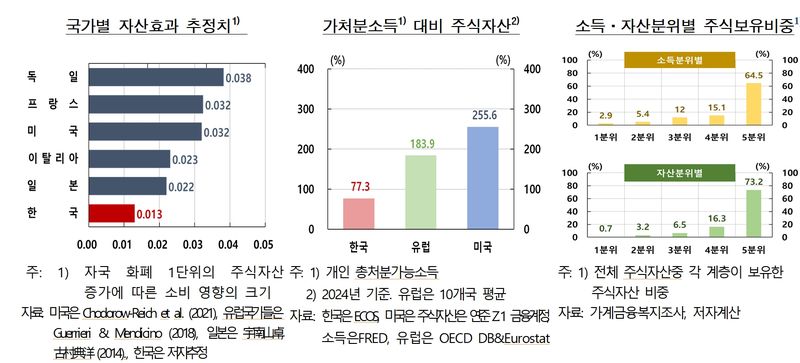
According to the Bank of Korea (BOK)'s report released on the 7th, titled 'An Assessment of the Wealth Effect of Stock Assets in Korea,' households use only about 1.3% of the gains from stock investments for consumption. In other words, if stocks generate 10,000 won in capital gains, the amount that actually leads to spending averages only about 130 won.This is far below the wealth effect seen in major economies in the United States and Europe, where the figure stands at 3% to 4%. It suggests that the link between a stock market boom and higher consumption is relatively weak.
The BOK pointed to the limited structure of stock investment among Korean households as a key reason. As of last year, household stock assets in Korea were equivalent to 77% of disposable income, well below 256% in the United States and the 184% average in major European countries. Stock ownership is also concentrated among high-income and high-asset households, meaning the gains from rising stock prices do not spread broadly across consumption.
What stood out in particular was that a large portion of stock investment gains moved into real estate. The BOK estimated that households without homes shifted about 70% of their stock capital gains into real estate assets. In fact, recent home sales in Seoul also showed a larger share of proceeds from stock and bond sales.
A BOK official explained, "Korean households tend to view stock investment gains as temporary profits rather than as a sustained increase in income," adding, "Instead of boosting consumption, they have tended to reinvest in other assets such as real estate."
Analysts say the structure of Korea's asset market lies behind the tendency for stock gains to flow into real estate rather than consumption. According to the BOK, from 2011 to 2024, the domestic real estate market was less volatile than the stock market and delivered relatively higher returns. For households, reinvesting in real estate was seen as a more attractive choice than spending.
Low trust in the domestic stock market was also cited as a factor limiting the wealth effect. Compared with the United States, Korea's stock market has lower expected returns, higher volatility, and shorter periods of upward momentum, leading households to view gains from rising stock prices as temporary.
"There are concerns about a reverse wealth effect when stock prices fall"
There are, however, signs of change. As global investment in Artificial Intelligence (AI) has driven a sharp rally in the stock market, the size of household stock holdings and the range of participating investors have expanded rapidly. Last year, household stock capital gains reached 429 trillion won, about 22 times the average for 2011 to 2024.The BOK paid particular attention to the rising participation of younger people and middle- to low-income households in the stock market. Compared with 2019, the share of total stock assets held by younger investors rose by 5.5 percentage points, while the share held by middle- to low-income households increased by 2.2 percentage points. Because these groups tend to have a higher propensity to consume, the BOK said Korea's wealth effect could grow further in the future.
The BOK also warned about the possibility of greater stock market volatility. With leveraged investing expanding as margin lending balances rise, a drop in stock prices could lead to a sharper pullback in consumption. The concern is that falling asset prices and rising debt burdens at the same time could weigh on spending and slow the recovery.
A BOK official said, "Recently, the wealth effect may become larger than before as the range of stock market participants has diversified and expected returns have increased," but added, "If stock prices correct, the reverse wealth effect could be even stronger, so we need to pay attention to the possibility of accumulating financial imbalances."
[email protected] Hong Ye-ji Reporter